What Are IoT Devices? Types, Examples & How They Work
Published: 25 Jul 2026
IoT devices are becoming a fundamental part of modern life, powering everything from smart homes and wearable fitness trackers to connected factories, hospitals, farms, and cities. As organizations continue their digital transformation, these intelligent devices collect and exchange real-time data, enabling faster decisions, greater automation, and improved operational efficiency. According to industry estimates, the number of connected IoT devices worldwide is expected to exceed 40 billion by the early 2030s, highlighting the rapid adoption of connected technologies across nearly every industry.
Unlike traditional electronic devices, IoT devices perform more than one function. They continuously sense their environment, communicate with other systems, and share data through secure networks to support real-time monitoring and intelligent automation. Whether a logistics company is tracking shipments, a hospital is monitoring patient health, or a farmer is measuring soil moisture, IoT devices provide the data needed to improve efficiency, reduce costs, and respond more quickly to changing conditions.
This guide explains what IoT devices are, how they work, their key components, common types, real-world examples, industry applications, benefits, security considerations, and future trends. You’ll also learn how IoT devices communicate, what data they collect, and why they have become the foundation of modern IoT systems. Before exploring specific devices, it’s helpful to understand the Internet of Things (IoT) and how an IoT system works, since every connected device is part of a broader ecosystem that enables data exchange and intelligent decision-making.
An IoT device is a physical object equipped with sensors, software, processing capability, and internet connectivity that collects, exchanges, and sometimes analyzes data to automate tasks, enable remote monitoring, and support real-time decision-making.
Table of Contents
What Are IoT Devices?
IoT devices are physical objects embedded with sensors, processors, software, and communication technologies that enable them to collect, process, and exchange data over a network. Unlike traditional electronic devices that operate independently, IoT devices communicate with other connected devices, cloud platforms, or edge computing systems to automate tasks, monitor conditions, and support data-driven decision-making.
The term Internet of Things (IoT) refers to the network of these connected devices working together to create intelligent systems. Each IoT device performs a specific function, such as measuring temperature, tracking location, detecting motion, monitoring equipment health, or controlling appliances. The collected data is transmitted through communication protocols such as MQTT, LoRaWAN, Wi-Fi, Bluetooth, or cellular networks, allowing users and organizations to monitor and manage devices remotely.
A modern IoT device typically performs four essential functions:
- Sense – Collects data using sensors, such as temperature, humidity, motion, pressure, or GPS location.
- Connect – Sends and receives data through wired or wireless communication networks.
- Process – Uses onboard processors, edge devices, or cloud platforms to analyze information.
- Act – Automatically performs an action or alerts users based on predefined conditions or real-time data.
For example, a smart thermostat continuously measures room temperature, sends the data to a connected platform, compares it with user preferences, and automatically adjusts the heating or cooling system to maintain the desired environment. Similarly, an industrial vibration sensor can detect abnormal machine behavior and trigger maintenance alerts before equipment failure occurs.
Today, IoT devices are used across homes, healthcare, agriculture, manufacturing, logistics, transportation, and smart cities. Their ability to generate real-time operational data makes them the foundation of intelligent automation, predictive maintenance, remote monitoring, and digital transformation across industries.
What Makes a Device an IoT Device?
A device is considered an IoT device when it can collect data, communicate with other systems, process information, and support automated or remote actions. Unlike traditional electronic devices that perform a fixed task in isolation, IoT devices are designed to exchange real-time data with users, applications, or other connected devices through the Internet or private networks.
Four core capabilities distinguish an IoT device from a conventional device:
1. Data Collection
Every IoT device gathers information from its environment using embedded sensors or input components. Depending on its purpose, it may measure temperature, humidity, motion, vibration, pressure, light, air quality, location, or energy consumption. Continuous data collection enables organizations to monitor assets and respond to changing conditions in real-time.
2. Network Connectivity
An IoT device must be able to communicate with other devices or cloud platforms. It can connect through technologies such as Wi-Fi, Bluetooth, Zigbee, cellular networks, LPWAN, LoRaWAN, or Ethernet. Lightweight messaging protocols like MQTT are widely used to transfer data efficiently between devices and applications.
3. Data Processing
Once data is collected, it is processed either on the device itself, at an edge computing node, or in the cloud. Processing transforms raw sensor readings into meaningful information, such as detecting equipment failures, identifying abnormal temperatures, or predicting maintenance needs.
4. Intelligent Action
The final characteristic is the ability to trigger an action based on collected data. An IoT device may send an alert, activate another connected device, update a dashboard, or automatically perform a predefined task without requiring manual intervention. This ability to sense, communicate, analyze, and act is what makes IoT systems intelligent.
For example, a conventional security camera simply records video footage. An IoT security camera can detect motion, send instant notifications to a smartphone, store recordings in the cloud, and integrate with smart lighting or alarm systems. Likewise, a traditional electricity meter only measures power usage, while a smart meter continuously transmits consumption data to utility providers for real-time monitoring and demand forecasting.
Traditional Device vs. IoT Device
| Feature | Traditional Device | IoT Device |
| Connectivity | Operates independently | Connects to networks and other devices |
| Data Collection | Limited or manual | Collects real-time sensor data |
| Communication | No automatic communication | Continuously exchanges data |
| Monitoring | Requires manual inspection | Supports remote monitoring |
| Automation | User-controlled | Can automate actions based on data |
| Software Updates | Usually manual | Supports remote firmware updates |
| Decision Support | Minimal | Enables analytics and AI-driven insights |
Main Components of an IoT Device
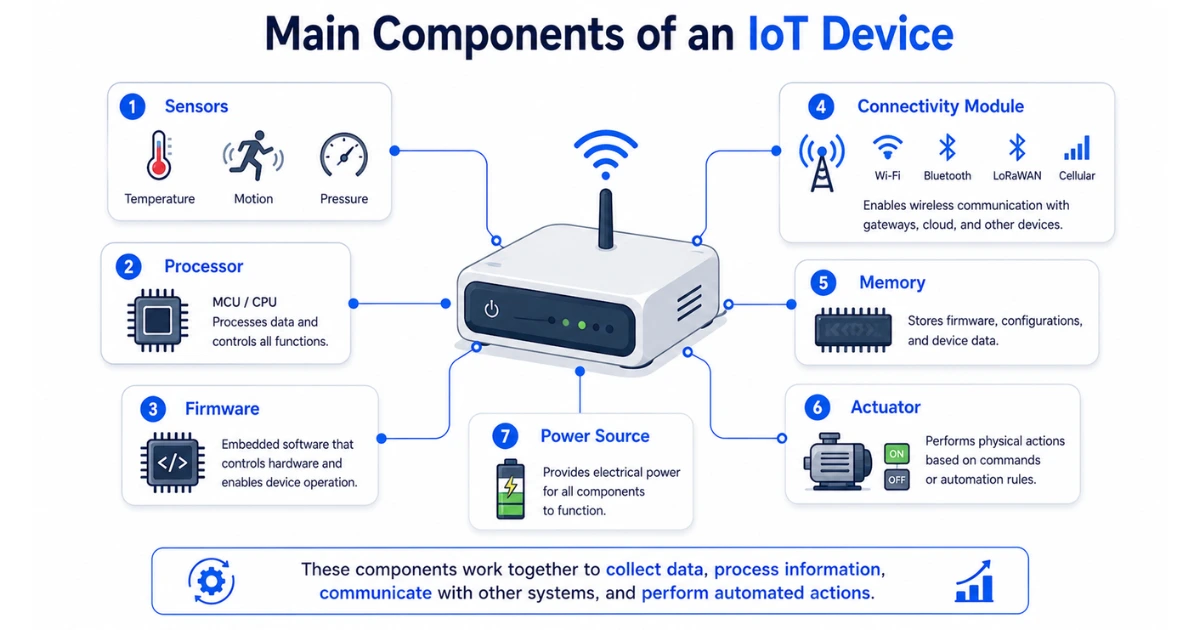
Every IoT device combines hardware and software components that enable it to sense its surroundings, process information, communicate with other systems, and perform intelligent actions. Although IoT devices vary in size and purpose, from wearable fitness trackers to industrial machines, they all rely on the same core building blocks.
Sensors
Sensors are the primary input components of an IoT device. They detect physical or environmental conditions such as temperature, humidity, motion, pressure, vibration, light, air quality, or GPS location. The type of sensor depends on the device’s purpose. For example, a smart thermostat measures temperature, while a logistics tracker uses GPS and motion sensors to monitor cargo during transportation.
Processor (Microcontroller or Microprocessor)
The processor acts as the control center of an IoT device. It receives data from sensors, executes firmware instructions, performs local processing, and determines whether information should be transmitted to an edge device or cloud platform. Modern IoT devices often use energy-efficient microcontrollers to balance performance with low power consumption.
Connectivity Module
After processing data, the device must communicate with other systems. The connectivity module enables this communication through technologies such as Wi-Fi, Bluetooth, Zigbee, Ethernet, cellular networks, LPWAN, or LoRaWAN. Many IoT applications also use lightweight messaging protocols like MQTT to exchange data quickly and efficiently, especially in environments with limited bandwidth.
Firmware
Firmware is the embedded software that controls the device’s hardware and core functions. It manages sensor readings, communication, security features, and automated operations. Regular firmware updates improve device performance, introduce new capabilities, and patch security vulnerabilities throughout the device’s lifecycle.
Power Supply
Every IoT device requires a reliable source of power. Depending on the application, devices may use rechargeable batteries, replaceable batteries, mains electricity, solar panels, or energy-harvesting technologies. Low-power design is particularly important for remote sensors that must operate for months or even years without battery replacement.
Actuators
While sensors collect information, actuators perform physical actions based on processed data or remote commands. They can switch electrical circuits, open or close valves, adjust motors, lock doors, or control lighting systems. In smart factories, for example, an actuator can automatically stop a production line when sensors detect abnormal machine vibrations.
Together, these components enable IoT devices to sense, process, connect, and act. This integrated architecture allows organizations to automate operations, monitor assets in real time, and make faster, data-driven decisions across industries.
How Do IoT Devices Work?
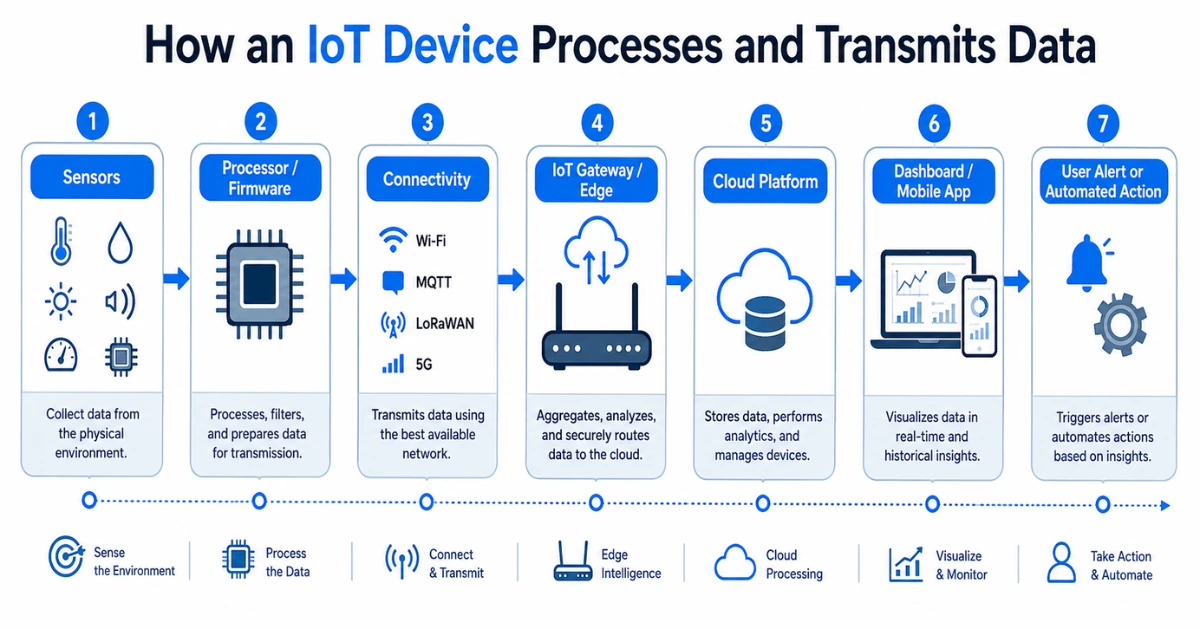
After understanding the components of an IoT device, the next step is to see how they work together to collect, transmit, and use data. Although IoT devices serve different purposes, they generally follow the same workflow—from sensing information to triggering an action.
Figure 1 illustrates the typical data flow of an IoT device. Data collected by sensors is processed by the device, transmitted through a communication network, optionally routed through an IoT gateway or edge computing platform, analyzed in the cloud, and finally displayed to users or used to trigger automated actions.
Step 1: Collect Data Through Sensors
The process begins when sensors measure physical or environmental conditions. Depending on the application, an IoT device may collect temperature, humidity, vibration, air quality, location, motion, pressure, or energy consumption data. These sensor readings represent the real-time status of the surrounding environment.
Step 2: Process the Data
The collected data is sent to the device’s processor or microcontroller, where firmware filters, validates, or performs basic calculations. Some IoT devices analyze data locally, while others forward it to an edge computing platform or cloud service for more advanced processing.
Step 3: Transmit Data Over a Network
After processing, the device sends data through a communication network. The choice of technology depends on range, power consumption, bandwidth, and deployment environment. Common connectivity options include Wi-Fi, Bluetooth, Ethernet, Zigbee, cellular networks, LoRaWAN, and LPWAN. Many IoT applications also rely on the lightweight MQTT protocol for efficient device-to-device and device-to-cloud communication.
Step 4: Analyze Data in the Cloud or at the Edge
The transmitted data is processed using cloud platforms or edge computing systems. Analytics software converts raw sensor readings into meaningful insights, identifies patterns, detects anomalies, and supports predictive maintenance or operational optimization. Processing data at the edge reduces latency, while cloud platforms provide centralized storage, scalability, and long-term analytics.
Step 5: Display Information or Trigger an Action
The final step is to transform the analyzed data into action. Information may appear on a dashboard, mobile application, or monitoring system, allowing users to make informed decisions. In many cases, IoT devices automatically respond without human intervention. For example, a smart irrigation system activates watering when soil moisture falls below a predefined threshold, while an industrial sensor can generate a maintenance alert when abnormal machine vibration is detected.
This continuous cycle of collecting, processing, transmitting, analyzing, and acting on data enables IoT devices to deliver real-time monitoring, intelligent automation, and data-driven decision-making across homes, healthcare, manufacturing, agriculture, logistics, and smart cities.
Types of IoT Devices
Although all IoT devices collect, process, and exchange data, they are designed for different environments and business objectives. Some focus on improving everyday convenience in homes, while others monitor industrial equipment, support healthcare services, or track assets across global supply chains. Understanding these categories makes it easier to identify the right IoT device for a specific application.
| IoT Device Type | Common Devices | Primary Applications |
| Consumer IoT | Smart thermostats, smart speakers, smart locks | Smart homes and personal use |
| Industrial IoT (IIoT) | Vibration sensors, PLCs, machine monitors | Manufacturing and industrial automation |
| Commercial IoT | Smart lighting, occupancy sensors, energy meters | Offices, retail stores, commercial buildings |
| Healthcare IoT | ECG monitors, insulin pumps, wearable health trackers | Patient monitoring and telemedicine |
| Transportation & Logistics IoT | GPS trackers, RFID tags, fleet telematics | Fleet management and supply chain visibility |
| Environmental IoT | Air quality sensors, flood sensors, and weather stations | Environmental monitoring and public safety |
Consumer IoT Devices
Consumer IoT devices are built for homes and personal use. They improve convenience, security, and energy efficiency by allowing users to monitor and control connected devices through smartphones or voice assistants. Popular examples include smart thermostats, video doorbells, connected lighting systems, smart speakers, and wearable fitness trackers.
Industrial IoT (IIoT) Devices
Industrial IoT devices operate in factories, warehouses, power plants, and production facilities where reliability and continuous monitoring are essential. These devices monitor machine performance, detect equipment failures, collect operational data, and support predictive maintenance. Industrial sensors, programmable logic controllers (PLCs), vibration monitors, and machine condition monitoring systems are among the most widely deployed IIoT devices.
Commercial IoT Devices
Commercial IoT devices help organizations improve building management, workplace efficiency, and energy consumption. Smart lighting systems, occupancy sensors, connected HVAC controls, and intelligent energy meters enable businesses to automate daily operations while reducing operating costs.
Healthcare, Transportation, and Environmental IoT Devices
IoT technology is also transforming specialized industries. Healthcare IoT devices support remote patient monitoring and connected medical equipment. Transportation and logistics devices improve fleet management, shipment tracking, and asset visibility using GPS trackers, RFID tags, and telematics systems. Environmental IoT devices continuously monitor air quality, weather conditions, water levels, and other environmental factors to support sustainability initiatives and disaster preparedness.
Rather than existing as isolated technologies, these device categories often work together within larger IoT ecosystems. For example, a smart city may combine environmental sensors, connected traffic systems, surveillance cameras, and logistics tracking devices to improve urban infrastructure and public services.
20 Common IoT Device Examples
One of the easiest ways to understand IoT technology is to look at real devices that people and businesses use every day. The examples below show how IoT devices collect data, communicate with other systems, and automate actions across homes, healthcare, industry, transportation, and environmental monitoring.
| IoT Device | What It Does | Common Use |
| Smart Thermostat | Adjusts heating and cooling automatically | Smart homes |
| Smart Speaker | Responds to voice commands | Home automation |
| Smart Security Camera | Detects motion and streams video | Home security |
| Smart Lock | Enables remote door access | Smart homes |
| Video Doorbell | Sends visitor alerts to smartphones | Home security |
| Fitness Tracker | Monitors activity, heart rate, and sleep | Personal health |
| Smartwatch | Tracks health metrics and notifications | Wearable technology |
| Smart Insulin Pump | Delivers insulin based on glucose readings | Healthcare |
| Connected ECG Monitor | Records and transmits heart data | Remote patient monitoring |
| Smart Blood Pressure Monitor | Sends readings to mobile apps | Healthcare |
| Soil Moisture Sensor | Measures soil water content | Agriculture |
| Smart Irrigation Controller | Automates watering schedules | Agriculture |
| Livestock Tracker | Monitors animal location and health | Agriculture |
| Industrial Vibration Sensor | Detects machine abnormalities | Manufacturing |
| Smart Energy Meter | Tracks electricity consumption in real time | Utilities |
| RFID Tag | Identifies and tracks assets | Logistics |
| GPS Asset Tracker | Monitors vehicle or cargo location | Transportation |
| Fleet Telematics Device | Collects vehicle performance data | Logistics |
| Air Quality Sensor | Measures pollution and particulate levels | Smart cities |
| Smart Parking Sensor | Detects parking space availability | Smart cities |
The Five Most Common IoT Devices
If someone asks, “What are five examples of IoT devices?”, these are the devices most people encounter regularly:
- Smart thermostat
- Smart speaker
- Smart security camera
- Fitness tracker
- Smartwatch
These devices are widely adopted because they combine sensors, internet connectivity, mobile applications, and automation in a way that provides immediate value to users. For example, a smart thermostat can reduce energy consumption by learning household patterns, while a smartwatch continuously monitors health metrics such as heart rate, activity levels, and sleep quality.
Examples of IoT Devices at Home
Home automation is one of the fastest-growing IoT categories. Common household IoT devices include smart lights, smart plugs, robot vacuum cleaners, connected appliances, video doorbells, and smart thermostats. These devices can be controlled remotely through mobile apps or voice assistants, allowing users to automate routines such as lighting, temperature control, security monitoring, and energy management.
Industrial and Business IoT Examples
In business environments, IoT devices focus on efficiency, reliability, and data-driven operations. Manufacturers use vibration and temperature sensors to predict equipment failures, logistics companies use GPS trackers and RFID tags to improve shipment visibility, and utilities deploy smart meters to monitor energy consumption in real time. These applications demonstrate how IoT extends far beyond consumer gadgets and plays a central role in modern digital transformation initiatives.
IoT Devices Across Different Industries
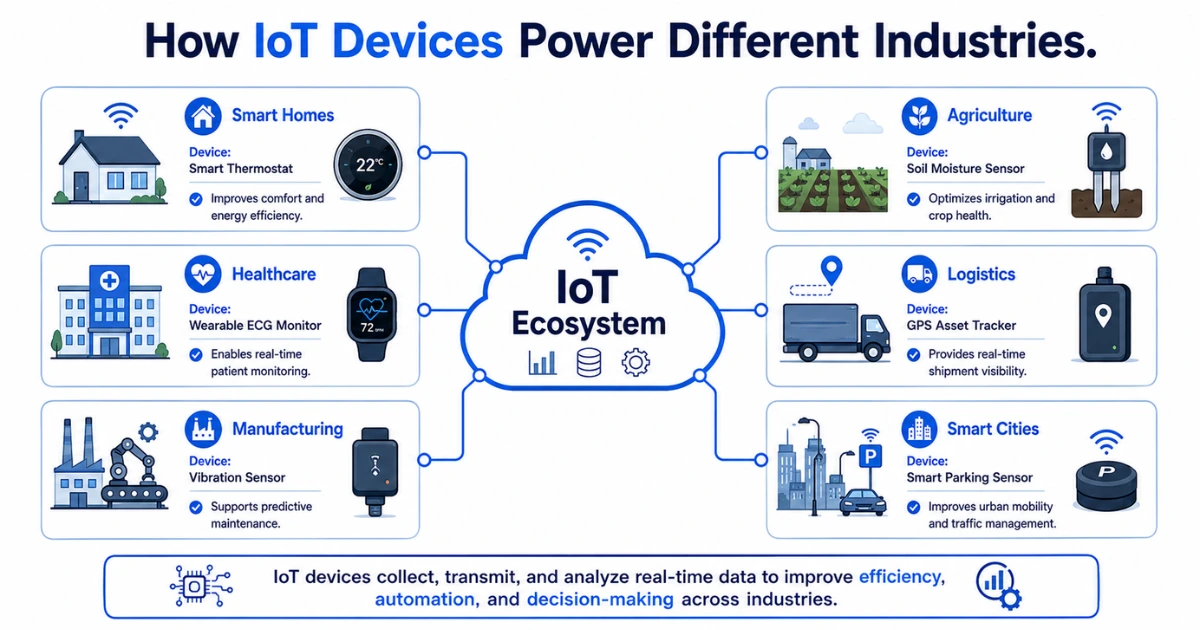
The same IoT technologies can solve very different problems depending on the industry. While a smart thermostat improves energy efficiency in a home, an industrial vibration sensor helps prevent equipment failure in a factory. Likewise, wearable medical devices support patient care, while GPS trackers improve fleet visibility across global supply chains.
Smart Homes
Smart homes use connected devices to automate lighting, climate control, security, and household appliances. Devices such as smart thermostats, smart locks, video doorbells, and voice assistants improve convenience, energy efficiency, and home security by allowing users to monitor and control their homes remotely.
Healthcare
Healthcare organizations use IoT devices for remote patient monitoring, wearable health tracking, connected medical equipment, and hospital asset management. These devices provide real-time patient data, support telemedicine, and enable healthcare providers to detect potential health issues earlier while improving the quality of care.
Manufacturing
Manufacturers deploy Industrial IoT (IIoT) devices to monitor machinery, optimize production lines, and reduce unexpected equipment failures. Sensors continuously collect operational data that supports predictive maintenance, quality control, and production efficiency.
Agriculture
Modern agriculture relies on IoT devices to monitor soil moisture, weather conditions, irrigation systems, livestock, and crop health. By collecting real-time field data, farmers can optimize water usage, improve crop yields, and reduce operating costs through precision agriculture.
Logistics and Transportation
Logistics companies use IoT devices such as GPS trackers, RFID tags, telematics systems, and temperature sensors to improve shipment visibility, fleet management, warehouse operations, and cold chain monitoring. These technologies enable faster deliveries and better supply chain decision-making.
Smart Cities
Cities deploy IoT devices to improve transportation, environmental monitoring, energy management, public safety, and municipal services. Smart parking sensors, adaptive traffic signals, connected streetlights, and air quality monitoring systems help create safer, more sustainable urban environments.
Although the devices used in these industries differ, they all share the same objective: collecting accurate data, communicating in real time, and enabling intelligent decisions through connected systems. As IoT adoption continues to expand, organizations increasingly combine multiple device types to build integrated ecosystems that improve efficiency, sustainability, and operational resilience.
What Data Do IoT Devices Collect?
The value of an IoT device lies in the data it collects. Using embedded sensors and communication technologies, IoT devices continuously capture information about their environment, equipment, or users. This real-time data enables organizations to monitor operations, automate processes, detect anomalies, and make faster, evidence-based decisions.
The type of data collected depends on the device and its intended application. For example, a wearable fitness tracker records heart rate and physical activity, while an industrial vibration sensor monitors machine health to detect early signs of equipment failure.
Common Types of Data Collected by IoT Devices
| Data Type | Collected By | Typical Applications |
| Temperature | Temperature sensors | Cold chain, smart homes, manufacturing |
| Humidity | Humidity sensors | Agriculture, warehouses, HVAC |
| Location | GPS trackers | Fleet management, logistics, asset tracking |
| Motion | PIR and motion sensors | Smart security, lighting automation |
| Vibration | Vibration sensors | Predictive maintenance, manufacturing |
| Pressure | Pressure sensors | Industrial systems, healthcare, pipelines |
| Air Quality | Environmental sensors | Smart cities, environmental monitoring |
| Energy Consumption | Smart meters | Utilities, smart buildings |
| Heart Rate & Health Metrics | Wearable medical devices | Healthcare and fitness |
| Soil Moisture | Soil sensors | Precision agriculture |
After collection, this data is transmitted through communication technologies such as Wi-Fi, Bluetooth, cellular networks, or LoRaWAN, often using lightweight protocols like MQTT. Depending on the deployment, the information is processed by an edge computing platform or a cloud service, where analytics software transforms raw data into meaningful insights.
For example, a connected refrigeration unit can continuously monitor temperature and automatically notify operators if readings exceed safe limits. Likewise, a smart irrigation system analyzes soil moisture levels and activates watering only when necessary, reducing water consumption while maintaining crop health.
The ability to collect accurate, real-time data is what enables IoT devices to support predictive maintenance, remote monitoring, intelligent automation, energy optimization, and data-driven decision-making across industries.
Benefits of IoT Devices
IoT devices do more than connect physical objects to the internet—they transform raw data into actionable insights that improve operational efficiency, reduce costs, and support better decision-making. By continuously collecting and sharing real-time information, connected devices enable organizations to automate processes, monitor assets remotely, and respond quickly to changing conditions across homes, businesses, healthcare, manufacturing, agriculture, logistics, and smart cities.
Real-Time Monitoring
One of the greatest benefits of IoT devices is their ability to provide continuous, real-time visibility into equipment, assets, and environments. Sensors collect live data and transmit it instantly, allowing organizations to monitor operations without being physically present. For example, manufacturers can monitor machine performance, logistics companies can track shipments, and healthcare providers can observe patient health remotely.
Increased Automation
IoT devices automate repetitive tasks based on predefined rules or real-time conditions. Instead of relying on manual intervention, connected devices can automatically adjust settings, trigger alerts, or activate equipment. A smart irrigation system can water crops when soil moisture drops below a set level, while a smart thermostat adjusts indoor temperatures based on occupancy and user preferences.
Predictive Maintenance
Industrial IoT devices continuously monitor equipment conditions such as vibration, pressure, and temperature. By analyzing this data, organizations can identify early signs of wear or failure before unexpected breakdowns occur. Predictive maintenance reduces downtime, extends equipment lifespan, lowers maintenance costs, and improves operational reliability.
Improved Operational Efficiency
By collecting and processing real-time data, IoT devices eliminate many manual processes and reduce human error. Businesses can optimize production schedules, improve inventory accuracy, streamline warehouse operations, and manage fleets more efficiently. Access to real-time insights enables faster decisions and better resource utilization.
Cost Savings
IoT devices help organizations reduce operating costs by improving energy efficiency, minimizing equipment failures, reducing waste, and optimizing resource consumption. Smart energy meters, connected HVAC systems, and predictive maintenance solutions all contribute to lower operational expenses while increasing long-term productivity.
Better Customer Experience
Connected devices improve customer satisfaction by delivering greater transparency, reliability, and personalized services. For example, logistics companies provide customers with live shipment tracking, while healthcare providers use wearable medical devices to monitor patients remotely and respond more quickly to changing health conditions.
Benefits of IoT Devices at a Glance
| Benefit | Business Value |
| Real-time monitoring | Enables faster, data-driven decision-making |
| Automation | Reduces manual work and human error |
| Predictive maintenance | Minimizes downtime and repair costs |
| Improved operational efficiency | Optimizes workflows and resource utilization |
| Cost savings | Reduces energy, maintenance, and operating expenses |
| Better customer experience | Increases transparency, reliability, and service quality |
As IoT adoption continues to accelerate, connected devices are becoming essential tools for improving productivity, sustainability, and innovation across industries. Their ability to transform real-time data into meaningful actions enables organizations to operate more efficiently, make smarter decisions, and remain competitive in an increasingly connected world.
Challenges and Security Risks of IoT Devices
While IoT devices offer significant benefits, they also introduce security and operational challenges. Because these devices continuously collect, transmit, and process data over networks, they can become targets for cyberattacks if not properly secured. Organizations must address these risks through secure device design, regular maintenance, and effective security policies.
Weak Authentication
Many IoT devices are deployed with default usernames and passwords or weak authentication mechanisms. If these credentials are not changed, attackers can gain unauthorized access to devices and connected networks. Using strong passwords, multi-factor authentication (MFA), and device identity management significantly reduces this risk.
Unpatched Firmware
IoT devices often operate for years in the field, but not all receive regular firmware updates. Outdated firmware may contain known vulnerabilities that attackers can exploit. Keeping firmware up to date is essential for fixing security flaws, improving performance, and maintaining device reliability.
Data Privacy Risks
IoT devices frequently collect sensitive information, including location data, health records, environmental conditions, and operational metrics. Without proper encryption and access controls, this information may be intercepted or exposed, creating privacy and regulatory concerns.
Network Vulnerabilities
A compromised IoT device can become an entry point into an organization’s network. Cybercriminals may use vulnerable devices to launch malware attacks, create botnets, or move laterally across connected systems. Network segmentation and continuous monitoring help reduce the impact of compromised devices.
Device Management Challenges
As organizations deploy hundreds or even thousands of connected devices, managing them becomes increasingly complex. Administrators must monitor device health, apply software updates, manage identities, and retire outdated devices throughout their lifecycle.
Although these risks are real, they can be significantly reduced by following cybersecurity best practices such as secure authentication, encrypted communication, regular firmware updates, network segmentation, and continuous device monitoring. A well-designed IoT security strategy protects both connected devices and the data they generate.
How to Choose the Right IoT Device
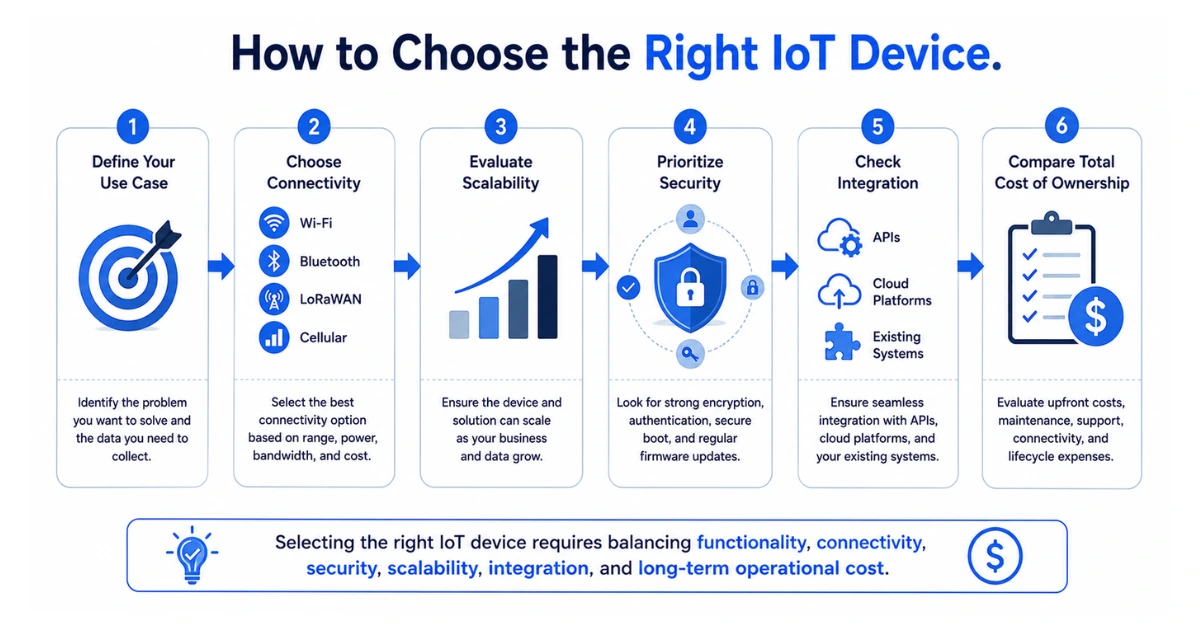
Selecting the right IoT device depends on your business objectives, operating environment, connectivity requirements, and security needs. While thousands of connected devices are available, the most effective solution is one that aligns with your use case and integrates seamlessly with your existing systems.
Define Your Use Case
Start by identifying the problem you want to solve. For example, manufacturers may need vibration sensors for predictive maintenance, while logistics companies require GPS trackers to monitor fleet movements. Choosing a device based on a clear objective ensures better performance and return on investment.
Evaluate Connectivity Options
Different IoT deployments require different communication technologies. Wi-Fi is suitable for indoor environments with reliable internet access, while LoRaWAN and other LPWAN technologies are ideal for long-range, low-power applications. Bluetooth works well for short-range communication, whereas cellular networks support mobile assets that operate over wide geographic areas.
Consider Scalability
An IoT solution should support future growth. Organizations planning to deploy hundreds or thousands of connected devices should choose platforms that simplify device management, firmware updates, and cloud integration without requiring major infrastructure changes.
Prioritize Security
Security should be considered before deployment rather than after installation. Look for devices that support encrypted communication, secure authentication, regular firmware updates, and compliance with recognized cybersecurity standards. Strong security practices help protect sensitive data and reduce the risk of unauthorized access.
Check Integration Capabilities
IoT devices rarely operate in isolation. Ensure the device can integrate with existing software, cloud platforms, analytics tools, and enterprise systems through standard protocols such as MQTT, HTTP, or REST APIs. Seamless integration reduces deployment complexity and improves data accessibility.
Compare Total Cost of Ownership
The purchase price is only one part of the investment. Organizations should also evaluate installation costs, subscription fees, maintenance, connectivity expenses, firmware support, and long-term operational costs. A slightly more expensive device may provide better reliability and lower lifetime costs.
By carefully evaluating these factors, businesses can select IoT devices that deliver reliable performance, strong security, and long-term value while supporting future digital transformation initiatives.
The Future of IoT Devices
The capabilities of IoT devices continue to evolve as technologies such as artificial intelligence (AI), edge computing, 5G, and digital twins become more widely adopted. Future IoT devices will not only collect data but also analyze information locally, make intelligent decisions, and communicate with other connected systems with minimal human intervention.
AI-Powered IoT Devices
Artificial intelligence is making IoT devices smarter by enabling them to recognize patterns, predict outcomes, and automate complex tasks. Instead of simply reporting sensor readings, AI-powered devices can detect equipment anomalies, forecast maintenance needs, optimize energy consumption, and support real-time decision-making.
Edge Computing for Faster Processing
Traditionally, IoT data was sent to cloud platforms for analysis. Today, many devices process data closer to where it is generated through edge computing. This reduces latency, lowers bandwidth usage, and enables faster responses in applications such as autonomous vehicles, industrial automation, and healthcare monitoring.
5G Connectivity
The global expansion of 5G networks is improving the performance of IoT devices by providing higher bandwidth, lower latency, and support for millions of connected devices within a single area. These capabilities enable more reliable communication for smart factories, connected vehicles, and large-scale smart city deployments.
Digital Twins
A digital twin is a virtual representation of a physical asset, machine, or system that continuously receives data from IoT devices. Organizations use digital twins to simulate performance, monitor equipment health, predict failures, and optimize operations before implementing changes in the real world.
Sustainable and Energy-Efficient IoT
Future IoT devices are also being designed with sustainability in mind. Manufacturers are developing low-power sensors, energy-harvesting technologies, and more efficient communication protocols to reduce battery consumption and minimize environmental impact. These advancements are particularly valuable for remote monitoring applications where devices must operate for years with minimal maintenance.
As these technologies continue to mature, IoT devices will become more intelligent, autonomous, and interconnected. Organizations that adopt secure, scalable, and standards-based IoT solutions will be better positioned to improve operational efficiency, support innovation, and adapt to an increasingly connected digital economy.
Key Takeaways
- IoT devices are physical objects equipped with sensors, processors, software, and network connectivity that collect, exchange, and analyze data in real time.
- Common components of an IoT device include sensors, processors, connectivity modules, firmware, actuators, and power sources.
- IoT devices follow a simple workflow: collect data → process it → transmit it → analyze it → trigger actions or provide insights.
- IoT devices can be grouped into several categories, including consumer, industrial, commercial, healthcare, transportation, and environmental devices.
- Popular examples include smart thermostats, wearable fitness trackers, RFID tags, GPS trackers, smart meters, industrial sensors, and connected medical devices.
- Organizations use IoT devices across industries such as manufacturing, healthcare, agriculture, logistics, and smart cities to improve automation, efficiency, and decision-making.
- The primary benefits of IoT devices include real-time monitoring, predictive maintenance, automation, cost savings, and improved operational efficiency.
- Security remains a critical consideration. Organizations should protect IoT deployments through strong authentication, encrypted communication, regular firmware updates, and continuous device management.
- Emerging technologies such as AI, edge computing, 5G, and digital twins are making IoT devices more intelligent, responsive, and scalable.
- Selecting the right IoT device requires evaluating the use case, connectivity options, security features, scalability, integration capabilities, and total cost of ownership.
Conclusion
IoT devices have become the foundation of today’s connected world, enabling organizations and individuals to collect real-time data, automate processes, and make smarter decisions. From smart homes and wearable health monitors to industrial sensors and connected transportation systems, these devices improve efficiency, enhance visibility, and create new opportunities for innovation across nearly every industry.
As IoT adoption continues to grow, understanding what IoT devices are, how they work, and where they are used is becoming increasingly important for businesses, technology professionals, and consumers alike. Choosing the right device requires more than comparing features—it involves evaluating connectivity, scalability, security, integration capabilities, and long-term operational value.
However, the true value of IoT devices is not the hardware itself but the insights they generate. When combined with technologies such as artificial intelligence, edge computing, cloud platforms, and 5G connectivity, IoT devices can transform raw data into intelligent actions that improve productivity, reduce costs, and support better decision-making.
Whether you’re building a smart home, deploying Industrial IoT solutions, or exploring connected technologies for your organization, understanding IoT devices is the first step toward creating secure, scalable, and future-ready IoT systems.



- Be Respectful
- Stay Relevant
- Stay Positive
- True Feedback
- Encourage Discussion
- Avoid Spamming
- No Fake News
- Don't Copy-Paste
- No Personal Attacks
- Be Respectful
- Stay Relevant
- Stay Positive
- True Feedback
- Encourage Discussion
- Avoid Spamming
- No Fake News
- Don't Copy-Paste
- No Personal Attacks
