IoT Applications in Manufacturing: Benefits, Use Cases & Future Trends
Published: 30 Jun 2026
Manufacturing is under constant pressure to produce more with fewer resources while maintaining quality and minimizing downtime. Traditional production methods often struggle to provide the real-time visibility needed to identify equipment issues, optimize workflows, and respond quickly to changing demands. This is where IoT in Manufacturing is reshaping modern factories by connecting machines, sensors, and production systems to create smarter and more efficient operations.
Today, manufacturers across various industries are utilizing connected technologies to monitor equipment performance, enhance quality control, minimize maintenance costs, and make data-driven decisions. As Industry 4.0 continues to evolve, understanding the latest IoT Applications in Manufacturing has become essential for businesses looking to improve productivity and remain competitive.
This guide explores the key benefits, practical use cases, real-world examples, implementation challenges, and emerging trends that are driving the future of connected manufacturing. Whether you are a factory owner, production manager, manufacturing engineer, or simply interested in smart manufacturing technologies, you will gain a clear understanding of how IoT is transforming the manufacturing industry.
IoT in Manufacturing is the use of connected devices, sensors, and software to collect and analyze real time production data. These IoT applications in Manufacturing help businesses monitor equipment, improve product quality, reduce downtime, optimize inventory, and automate manufacturing processes. As a result, manufacturers can increase efficiency, lower operating costs, and make better decisions based on accurate data.
Table of Contents
What Is IoT in Manufacturing?
IoT in Manufacturing refers to the integration of internet-connected devices, sensors, machines, and software into manufacturing processes to collect, exchange, and analyze real-time data. These connected systems help manufacturers monitor production, automate routine tasks, identify equipment issues before they cause failures, and improve operational efficiency.
Unlike traditional manufacturing systems that rely on manual inspections and isolated equipment, IoT creates a connected ecosystem where machines communicate with each other and with centralized platforms. This continuous flow of data gives manufacturers greater visibility into production performance, enabling faster and more informed decision-making.
A typical IoT ecosystem in manufacturing consists of several key components:
- Smart sensors that collect data such as temperature, pressure, vibration, and humidity.
- Connected machines that transmit operational data in real time.
- Communication networks that securely transfer information between devices.
- Cloud or edge computing platforms that process and store production data.
- Analytics and dashboard software that converts raw data into actionable insights.
For example, a manufacturing plant can install vibration sensors on critical machinery to detect unusual operating patterns. Instead of waiting for a machine to fail unexpectedly, maintenance teams receive early alerts, allowing repairs to be scheduled before production is interrupted. This approach minimizes downtime, extends equipment lifespan, and reduces maintenance costs.
As manufacturers continue adopting Industry 4.0 technologies, IoT Applications in Manufacturing are expanding beyond equipment monitoring to include predictive maintenance, quality assurance, inventory management, supply chain visibility, worker safety, and energy optimization.
Benefits of IoT in Manufacturing
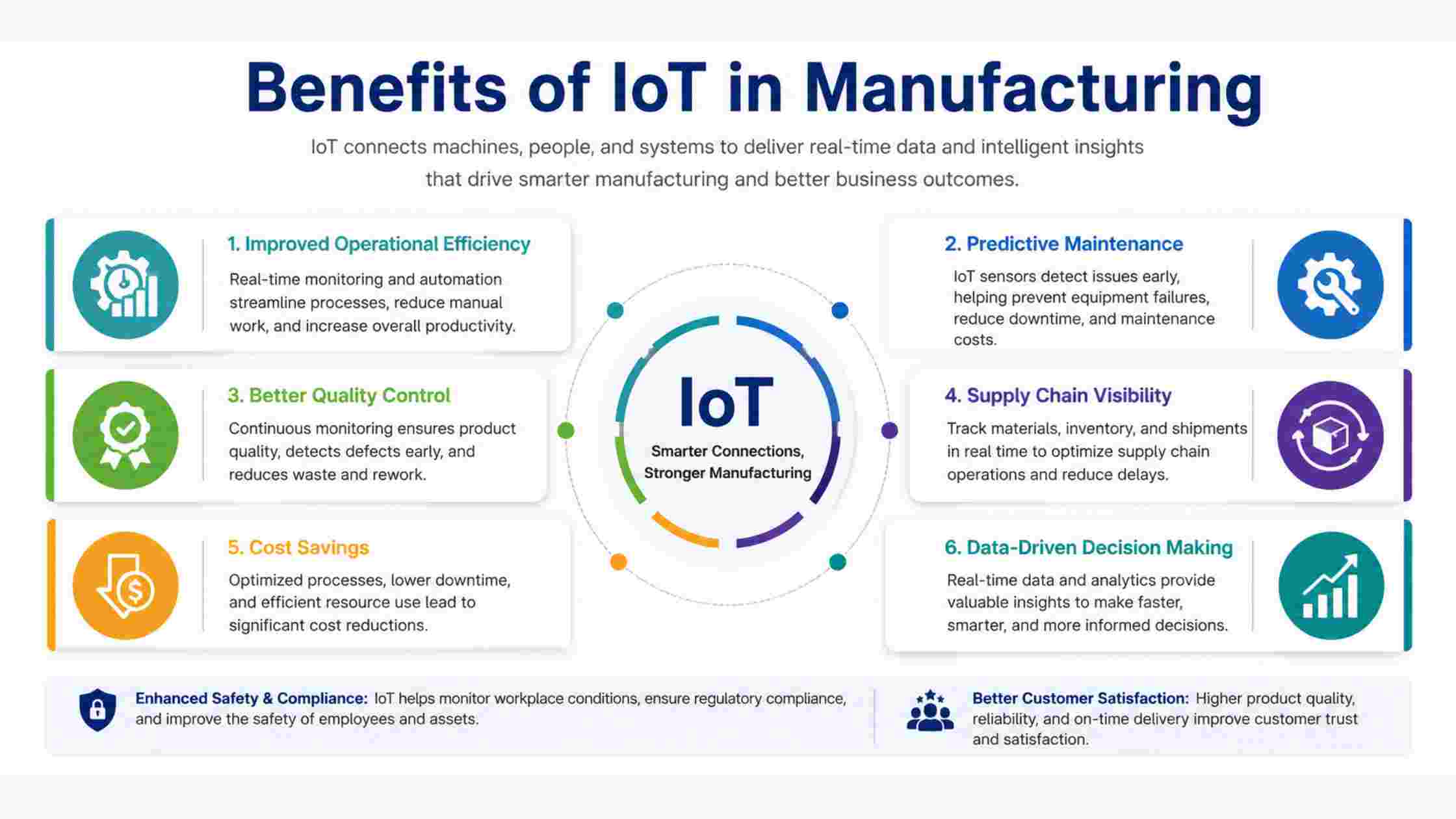
The adoption of IoT in Manufacturing offers far more than automated data collection. Connected devices provide manufacturers with real-time insights that improve operational efficiency, reduce costs, and support better decision making. Whether operating a small production facility or a large industrial plant, businesses can use IoT to streamline processes while maintaining consistent product quality.
Improved Operational Efficiency
Connected sensors continuously monitor production equipment and workflows, allowing managers to identify bottlenecks as they occur. Instead of relying on manual inspections, manufacturers can optimize production schedules using accurate, real time information. This leads to faster operations and better resource utilization.
Reduced Equipment Downtime
Unexpected machine failures can disrupt production and increase operating costs. IoT sensors detect changes in temperature, vibration, pressure, and other performance indicators that often signal developing issues. Maintenance teams can address these problems before they result in costly breakdowns, reducing unplanned downtime.
Better Product Quality
Maintaining consistent quality is essential in manufacturing. IoT devices monitor production conditions throughout the manufacturing process, ensuring products meet predefined quality standards. Real time alerts allow operators to correct deviations immediately, reducing defects and minimizing waste.
Lower Maintenance Costs
Traditional maintenance schedules often result in unnecessary servicing or delayed repairs. IoT enables predictive maintenance by analyzing equipment performance data and identifying when maintenance is actually required. This approach extends machine life while reducing repair expenses.
Enhanced Inventory and Supply Chain Management
IoT systems track raw materials, finished goods, and equipment throughout the supply chain. Manufacturers gain better visibility into inventory levels, reducing stock shortages, preventing overstocking, and improving production planning.
Improved Workplace Safety
Connected sensors help create safer working environments by monitoring hazardous conditions such as excessive heat, gas leaks, or equipment malfunctions. Automated alerts enable faster responses, reducing risks for employees and minimizing workplace accidents.
Greater Energy Efficiency
Energy consumption is a significant operating expense for many manufacturers. IoT solutions monitor electricity, water, and fuel usage in real time, helping businesses identify inefficiencies and reduce unnecessary energy consumption. Lower energy usage not only cuts costs but also supports sustainability initiatives.
These advantages demonstrate how How IoT Helps in Manufacturing extends beyond automation. By combining connected devices with real time analytics, manufacturers can improve productivity, reduce operational risks, and build more resilient production systems.
IoT Applications in Manufacturing
The growing adoption of IoT Applications in Manufacturing is changing how factories operate by connecting machines, production lines, and management systems into a unified network. These connected solutions provide real time visibility into manufacturing processes, enabling businesses to improve efficiency, reduce waste, and make informed operational decisions.
Below are some of the most important Application of IoT in Manufacturing that are driving smart factory transformation.
Predictive Maintenance
Predictive maintenance is one of the most widely adopted IoT Use Cases in Manufacturing. Sensors continuously monitor equipment conditions such as vibration, temperature, pressure, and operating hours. When abnormal patterns are detected, maintenance teams receive early alerts, allowing repairs to be scheduled before equipment fails.
This approach helps manufacturers:
- Reduce unexpected downtime.
- Extend equipment lifespan.
- Lower maintenance and repair costs.
- Improve production reliability.
Smart Quality Control
Maintaining consistent product quality is critical in every manufacturing environment. IoT devices collect production data throughout the manufacturing process, allowing manufacturers to identify quality issues as they occur rather than after products have been completed.
By continuously monitoring production parameters, businesses can:
- Detect defects earlier.
- Reduce material waste.
- Maintain consistent quality standards.
- Improve customer satisfaction.
Real Time Asset Tracking
Manufacturers often manage thousands of tools, machines, raw materials, and finished products. IoT enabled tracking systems provide real-time visibility into the location and status of these assets throughout the facility.
Real-time tracking helps organizations:
- Locate equipment quickly.
- Reduce asset loss.
- Improve warehouse efficiency.
- Optimize production planning.
Inventory Management
Effective inventory management ensures production continues without unnecessary delays or excess stock. IoT sensors automatically monitor inventory levels and update management systems whenever materials are received, consumed, or moved.
This enables manufacturers to:
- Prevent stock shortages.
- Avoid overstocking.
- Improve demand forecasting.
- Streamline purchasing decisions.
Energy Management
Energy costs account for a significant portion of manufacturing expenses. IoT sensors monitor electricity, water, compressed air, and fuel consumption across production facilities, helping businesses identify areas where resources are being wasted.
Manufacturers can use these insights to:
- Reduce operating costs.
- Improve equipment efficiency.
- Support sustainability goals.
- Lower carbon emissions.
Worker Safety Monitoring
Employee safety remains a top priority in manufacturing facilities. IoT enabled wearable devices and environmental sensors monitor workplace conditions and alert workers or supervisors when potential hazards are detected.
Common safety applications include:
- Monitoring air quality.
- Detecting gas leaks.
- Tracking worker locations in hazardous areas.
- Sending emergency alerts during unsafe conditions.
Supply Chain Visibility
Modern manufacturing depends on efficient supply chain management. IoT connects suppliers, warehouses, transportation systems, and production facilities to provide real time updates throughout the supply chain.
This allows manufacturers to:
- Track shipments in real time.
- Identify delivery delays early.
- Improve production scheduling.
- Increase supply chain transparency.
These IoT Applications in the manufacturing industry demonstrate how connected technologies improve every stage of the manufacturing process, from equipment maintenance and production quality to inventory control, workplace safety, and supply chain management.
IoT Use Cases in Manufacturing
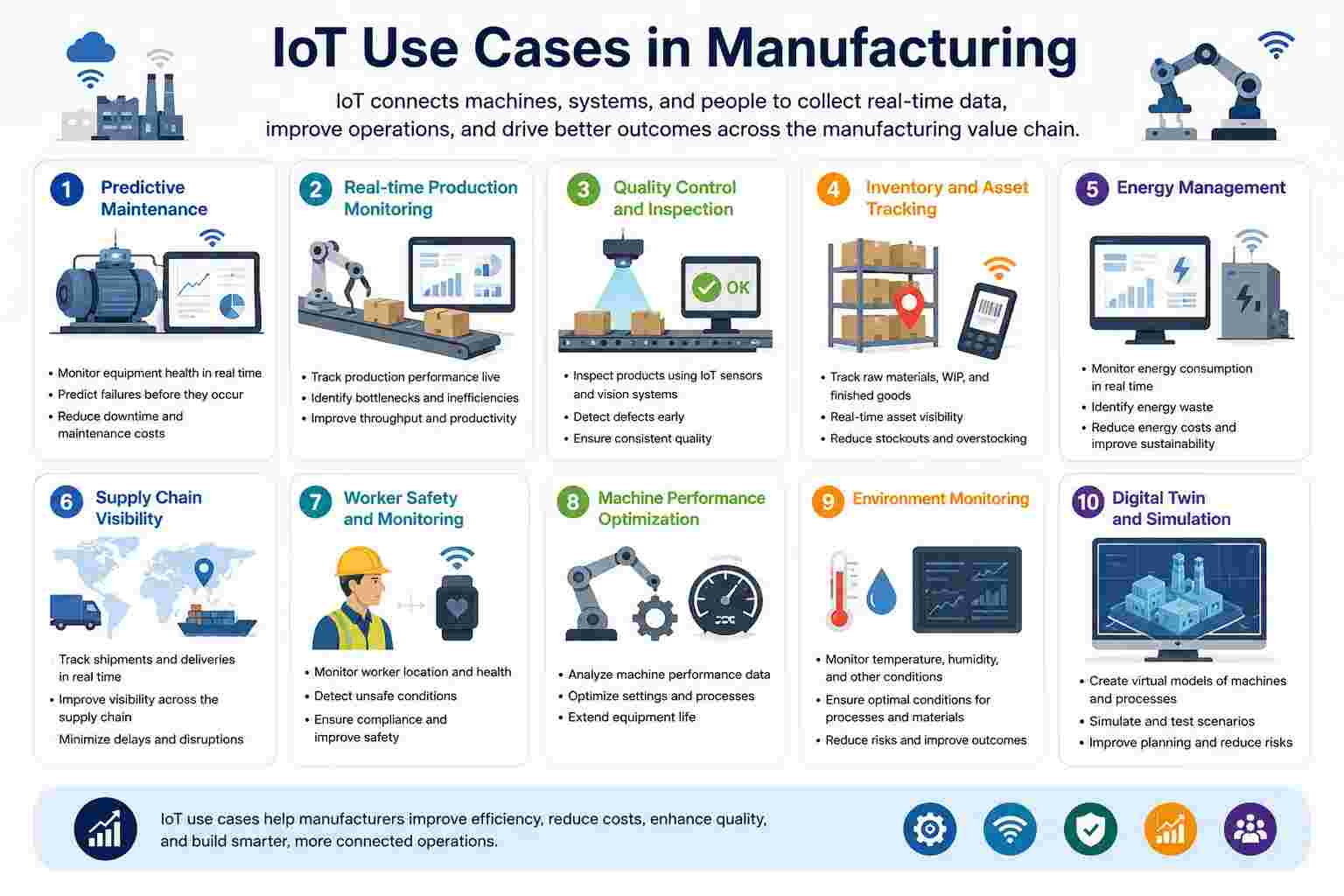
While IoT Applications in Manufacturing explain where connected technologies are implemented, real world use cases demonstrate how manufacturers use these solutions to solve operational challenges. Across industries, IoT is helping businesses increase productivity, improve quality, and reduce operating costs through data-driven decision-making.
Automotive Manufacturing
Automotive manufacturers rely on highly automated production lines where even a brief equipment failure can interrupt assembly. IoT sensors continuously monitor robotic arms, conveyor systems, and welding equipment to detect performance issues before they cause production delays.
For example, vibration and temperature sensors can identify early signs of motor wear, allowing maintenance teams to replace components during scheduled downtime instead of stopping the entire production line unexpectedly.
Food and Beverage Manufacturing
Food manufacturers must maintain strict environmental conditions to ensure product quality and regulatory compliance. IoT sensors monitor temperature, humidity, and storage conditions throughout production and distribution.
If refrigeration equipment exceeds safe temperature limits, the system immediately alerts operators, helping prevent product spoilage and reducing financial losses.
Pharmaceutical Manufacturing
Pharmaceutical production requires precise control over manufacturing environments and complete traceability. IoT devices continuously monitor clean rooms, production equipment, and storage facilities to ensure products are manufactured under controlled conditions.
Real time monitoring also simplifies compliance reporting by automatically recording environmental and production data.
Electronics Manufacturing
Electronics manufacturers produce high value components where even minor defects can result in significant losses. IoT powered inspection systems monitor production equipment and identify variations that may affect product quality.
This allows manufacturers to detect problems early, reduce defective products, and improve overall production consistency.
Heavy Equipment Manufacturing
Factories producing industrial machinery often operate large, complex equipment that requires regular maintenance. IoT sensors collect operational data from motors, hydraulic systems, and rotating components, enabling predictive maintenance programs that reduce unexpected equipment failures.
As a result, manufacturers improve equipment reliability while lowering maintenance expenses.
Smart Factory Operations
One of the most advanced IoT Use Cases in Manufacturing is the smart factory. In a smart factory, machines, production lines, inventory systems, and enterprise software communicate through connected IoT networks.
Production managers gain real time visibility into factory operations through centralized dashboards, allowing them to monitor equipment performance, track production targets, optimize resource allocation, and respond quickly to changing production demands.
These IoT in Manufacturing Examples show that connected technologies deliver measurable value across different industries. Although each sector has unique operational requirements, the common goal remains the same: improving efficiency, reducing downtime, enhancing product quality, and enabling smarter manufacturing decisions.
Comparison of Common IoT Applications in Manufacturing
The table below compares the most widely adopted IoT Solutions in Manufacturing, highlighting their primary objectives and the value they deliver to manufacturers.
| IoT Application | Primary Purpose | Key Benefits | Common Industries |
| Predictive Maintenance | Monitor equipment health and predict failures | Reduced downtime, lower maintenance costs, longer equipment life | Automotive, Heavy Equipment, Aerospace |
| Smart Quality Control | Monitor production quality in real time | Fewer defects, less waste, improved consistency | Electronics, Pharmaceuticals, Food Processing |
| Inventory Management | Track raw materials and finished goods | Better inventory accuracy, reduced shortages, optimized stock levels | Manufacturing, Warehousing, Retail |
| Asset Tracking | Monitor the location and condition of equipment and tools | Improved asset utilization, reduced losses, faster retrieval | Construction, Manufacturing, Logistics |
| Energy Management | Monitor and optimize energy consumption | Lower operating costs, improved sustainability, reduced energy waste | Industrial Manufacturing, Chemical Plants |
| Worker Safety Monitoring | Detect workplace hazards and monitor employee safety | Safer work environments, faster emergency response, improved compliance | Mining, Oil and Gas, Manufacturing |
| Supply Chain Monitoring | Track materials and shipments throughout the supply chain | Greater visibility, better planning, fewer delivery disruptions | Manufacturing, Logistics, Distribution |
Selecting the right IoT Applications in Manufacturing depends on an organization’s operational priorities. Manufacturers focused on reducing equipment failures often begin with predictive maintenance, while those seeking better product consistency may prioritize smart quality control. As IoT adoption grows, many businesses combine multiple solutions to build a connected manufacturing environment that supports efficiency, quality, and long term operational resilience.
Common Mistakes When Implementing IoT in Manufacturing
Adopting IoT in Manufacturing can significantly improve operational efficiency, but success depends on proper planning and execution. Many manufacturers encounter challenges because they focus on technology without addressing the underlying business processes. Avoiding the following mistakes can help maximize the value of IoT investments.
1. Implementing IoT Without Clear Business Objectives
Many manufacturers deploy IoT technologies simply because they are part of Industry 4.0 initiatives. Without defined objectives, it becomes difficult to measure success or justify the investment.
The consequence: Organizations collect large amounts of data but struggle to generate meaningful business outcomes.
The correct approach: Identify specific goals, such as reducing equipment downtime, improving product quality, or lowering energy consumption, before implementing IoT solutions.
2. Ignoring Cybersecurity Risks
Connected devices increase the number of access points within a manufacturing network. Failing to secure these devices can expose production systems to cyber threats and unauthorized access.
The consequence: Security breaches may disrupt production, compromise sensitive operational data, and lead to costly downtime.
The correct approach: Protect IoT devices with strong authentication, encrypted communications, regular software updates, and continuous network monitoring.
3. Underestimating Data Management
IoT devices generate vast amounts of operational data every day. Without an effective strategy for storing, processing, and analyzing this information, valuable insights may never be used.
The consequence: Decision makers become overwhelmed with data while critical performance indicators remain hidden.
The correct approach: Focus on collecting relevant data, establish clear performance metrics, and use analytics platforms that convert raw information into actionable insights.
4. Neglecting Employee Training
Even the most advanced IoT systems require employees who understand how to interpret data and use connected technologies effectively.
The consequence: Low adoption rates, operational errors, and reduced return on investment.
The correct approach: Provide ongoing training so operators, maintenance teams, and managers can confidently use IoT systems in their daily workflows.
5. Attempting Large Scale Deployment Too Early
Some organizations try to connect every machine and production process at once, creating unnecessary complexity and increasing implementation risks.
The consequence: Higher project costs, longer deployment times, and greater disruption to normal operations.
The correct approach: Start with a pilot project targeting a high value area, evaluate the results, and gradually expand IoT deployment across the facility based on proven success.
Expert Tips for Successful IoT Implementation in Manufacturing
Implementing IoT Solutions in Manufacturing requires more than installing connected devices. A well planned strategy helps manufacturers achieve measurable improvements while avoiding unnecessary costs and operational disruptions. The following recommendations can help organizations maximize the value of their IoT initiatives.
Start with High Impact Processes
Begin by implementing IoT in areas where it can deliver immediate business value, such as predictive maintenance, energy monitoring, or quality control. Early successes demonstrate the return on investment and make it easier to expand IoT across other production processes.
Define Performance Metrics Before Deployment
Establish measurable goals before installing IoT systems. Track key performance indicators such as equipment downtime, production efficiency, maintenance costs, defect rates, and energy consumption to evaluate the effectiveness of your implementation.
Prioritize Data Quality Over Data Quantity
Collecting more data does not always produce better insights. Focus on gathering accurate, relevant information that supports operational decisions rather than storing unnecessary data that adds complexity and increases storage costs.
Design for Scalability
Choose IoT platforms and communication infrastructure that can support future expansion. As production requirements grow, scalable systems make it easier to connect additional machines, production lines, and manufacturing facilities without major upgrades.
Integrate IoT with Existing Business Systems
The greatest value comes from combining IoT data with enterprise systems such as ERP, MES, and inventory management software. Integration provides a unified view of manufacturing operations and supports faster, more informed decision making.
Key Takeaways
- IoT in Manufacturing connects machines, sensors, and software to collect and analyze real time production data, enabling smarter and more efficient manufacturing operations.
- Modern IoT Applications in Manufacturing include predictive maintenance, quality control, inventory management, asset tracking, energy monitoring, worker safety, and supply chain visibility.
- Manufacturers that implement IoT effectively can reduce equipment downtime, improve product quality, optimize resource utilization, lower operational costs, and increase overall productivity.
- Successful IoT implementation requires clear business objectives, strong cybersecurity practices, effective data management, employee training, and a phased deployment strategy.
- As Industry 4.0 continues to evolve, emerging technologies such as artificial intelligence, edge computing, and digital twins will further expand the capabilities and value of IoT in modern manufacturing.
Conclusion
The growing adoption of IoT Applications in Manufacturing is transforming production environments by enabling real-time monitoring, predictive maintenance, smarter resource management, and data-driven decision-making. As manufacturers continue embracing Industry 4.0, connected technologies will play an increasingly important role in improving efficiency, product quality, and operational resilience.
Organizations planning to implement IoT in Manufacturing should begin by identifying their operational goals, selecting high-impact use cases, and adopting a phased implementation strategy. With the right approach, IoT can deliver measurable improvements that support long-term growth and competitiveness.
Frequently Asked Questions
1. What is IoT in Manufacturing?
IoT in Manufacturing is the use of internet-connected devices, sensors, machines, and software to collect and exchange real-time production data. It helps manufacturers monitor equipment, automate processes, improve product quality, reduce downtime, and make informed decisions based on accurate operational insights.
2. How is IoT used in Manufacturing?
IoT is used in Manufacturing to monitor machine performance, enable predictive maintenance, track inventory, improve quality control, manage energy consumption, and enhance workplace safety. Connected devices continuously collect operational data, allowing manufacturers to optimize production and respond quickly to potential issues.
3. What are the main benefits of IoT in Manufacturing?
The primary Benefits of IoT in Manufacturing include improved operational efficiency, reduced equipment downtime, lower maintenance costs, better product quality, enhanced inventory management, increased worker safety, and improved energy efficiency. These advantages help manufacturers reduce costs while increasing productivity and competitiveness.
4. Which industries benefit the most from IoT in Manufacturing?
Many industries benefit from IoT, including automotive, food and beverage, pharmaceuticals, electronics, aerospace, chemicals, and heavy equipment manufacturing. Any industry that depends on production efficiency, equipment reliability, and quality control can gain significant value from connected manufacturing technologies.
5. What technologies are required for IoT in Manufacturing?
A typical IoT system includes smart sensors, connected machines, communication networks, cloud or edge computing platforms, data analytics software, and cybersecurity solutions. Together, these technologies collect, process, and analyze manufacturing data to support better operational decisions.
6. What challenges do manufacturers face when implementing IoT?
Common challenges include high initial investment, cybersecurity risks, integration with legacy equipment, managing large volumes of data, and training employees to use new technologies effectively. Careful planning and phased implementation can help organizations overcome these obstacles.
7. Can small and medium-sized manufacturers adopt IoT?
Yes. Small and medium-sized manufacturers can begin with focused IoT projects such as equipment monitoring or energy management before expanding to larger implementations. Starting with a pilot project helps control costs while demonstrating measurable business value.
8. What is the future of IoT in Manufacturing?
The Future of IoT in Manufacturing will involve greater integration with artificial intelligence, machine learning, digital twins, edge computing, and autonomous production systems. These technologies will enable smarter factories that improve efficiency, reduce waste, and make faster, data-driven decisions with minimal human intervention.
Sources
National Institute of Standards and Technology (NIST) – Smart Manufacturing
International Organization for Standardization (ISO) – Smart Manufacturing
World Economic Forum – Advanced Manufacturing and Supply Chains





- Be Respectful
- Stay Relevant
- Stay Positive
- True Feedback
- Encourage Discussion
- Avoid Spamming
- No Fake News
- Don't Copy-Paste
- No Personal Attacks
- Be Respectful
- Stay Relevant
- Stay Positive
- True Feedback
- Encourage Discussion
- Avoid Spamming
- No Fake News
- Don't Copy-Paste
- No Personal Attacks
