Will AI Replace Accountants? How AI Will Change Accounting Jobs
Published: 22 Aug 2026
Artificial intelligence is changing how accounting work is performed. AI-powered tools can already automate tasks such as data entry, transaction categorization, invoice processing, bookkeeping, financial analysis, and parts of financial reporting. As these capabilities continue to improve, many people are asking: Will AI replace accountants?
The short answer is AI is unlikely to completely replace accountants, but it will automate many accounting tasks and change how accounting jobs are performed. The impact will depend on the type of work involved. Repetitive, rule-based, and data-heavy tasks are easier to automate, while professional judgment, complex decision-making, ethical responsibility, regulatory accountability, and client advisory work still depend heavily on human expertise.
This means the future of accounting is less about AI replacing an entire profession and more about AI changing the responsibilities within that profession. Some traditional tasks may require fewer human hours, while accountants may spend more time analyzing financial information, advising clients, solving complex problems, and reviewing AI-generated work.
In this guide, you will learn how AI is changing accounting, which tasks and accounting jobs face the highest automation risk, whether AI could replace CPAs, auditors, and tax accountants, and what accountants can do to stay relevant in an AI-driven workplace.
Quick Answer
AI is more likely to replace specific accounting tasks than accountants themselves. Routine work involving data processing, categorization, reconciliation, and basic reporting has a higher automation potential. In contrast, accountants remain responsible for interpreting financial information, handling complex exceptions, applying professional judgment, advising clients, and taking accountability for financial decisions.
Table of Contents
Will AI Replace Accountants Completely?
AI is unlikely to completely replace accountants. Instead, it will automate specific accounting tasks, especially those that are repetitive, rule-based, and involve processing large amounts of financial data.
This distinction is important: automating tasks is not the same as replacing an entire job. An accountant’s work can include bookkeeping and data processing, but it may also involve interpreting financial information, applying professional judgment, advising clients, ensuring compliance, and taking responsibility for important decisions.
As AI takes over more routine work, the role of accountants is likely to change. Some tasks may require fewer human hours, while skills such as financial analysis, strategic thinking, communication, and professional judgment may become more important.
How AI Is Already Changing Accounting
AI is already changing accounting by automating routine work and helping professionals process financial information faster. Modern AI-powered tools can categorize transactions, extract data from invoices, reconcile accounts, detect unusual patterns, and support financial reporting and forecasting.
Generative AI can also help accountants summarize information, draft reports, and answer questions based on financial data. Meanwhile, AI agents may increasingly handle multi-step workflows by completing tasks across different systems with human oversight.
The main change is not that AI performs every accounting responsibility. Instead, it reduces the time spent on repetitive work, allowing accountants to focus more on reviewing results, analyzing financial information, solving complex problems, and advising clients.
Which Accounting Tasks Can AI Automate?
AI can automate many accounting tasks, especially those that follow clear rules and involve large amounts of structured financial data. Automation can reduce manual work, improve processing speed, and help accountants identify patterns or errors.
Some of the accounting tasks AI can help automate include:
- Data entry: Extracting and recording information from invoices, receipts, and other financial documents.
- Transaction categorization: Classifying income and expenses into the correct accounts.
- Bookkeeping and reconciliation: Matching transactions and identifying discrepancies between financial records.
- Invoice and expense processing: Processing invoices, tracking expenses, and managing routine payment workflows.
- Accounts payable and receivable: Supporting invoice tracking, payment processing, and follow-ups.
- Financial reporting and forecasting: Processing financial data to generate reports and identify trends.
- Fraud and anomaly detection: Identifying unusual transactions or patterns that may require human review.
- Tax preparation support: Organizing financial information and assisting with routine tax-related processes.
However, automation does not mean these processes can operate without oversight. Accountants may still need to review results, investigate unusual situations, verify accuracy, and take responsibility for financial decisions.
Which Accounting Tasks Are Harder for AI to Replace?
AI can process large amounts of financial data, but some parts of accounting require capabilities that are difficult to automate fully.
- Professional judgment: Accountants must interpret complex financial situations and apply accounting standards appropriately.
- Complex decision-making: Unusual transactions and business problems may require context that automated systems cannot reliably evaluate on their own.
- Client relationships and communication: Accountants explain financial information, understand client needs, and provide personalized advice.
- Ethical responsibility: Professionals must make ethical decisions and remain accountable for their work.
- Regulatory accountability: Financial and tax decisions can have legal consequences, creating a need for qualified human oversight.
- Strategic financial advice: Businesses rely on accountants to interpret financial information and support planning and decision-making.
AI can assist with these responsibilities, but assistance is different from replacement. The more a task depends on judgment, context, accountability, and human interaction, the harder it is for AI to fully replace the accountant performing it.
Which Accounting Jobs Are Most at Risk From AI?
| Accounting Role | AI Automation Impact | Why |
|---|---|---|
| Accounting Clerks | High | Many tasks involve repetitive data processing |
| Entry-Level Accountants | High to Moderate | Routine tasks can be automated, but review work remains |
| Bookkeepers | Moderate to High | AI can categorize transactions and automate reconciliation |
| Junior Accountants | Moderate | AI can handle routine work while humans review and analyze |
| Tax Accountants | Moderate | AI can assist with preparation, but complex cases require expertise |
| Auditors | Moderate | AI can analyze data, but professional judgment is still required |
| Chartered Accountants | Lower | Advisory work, judgment, and accountability are harder to automate |
Accounting jobs are not equally exposed to AI. Roles that involve repetitive, standardized, and rule-based tasks face a higher risk of automation than roles centered on judgment, strategy, and client advisory.
Entry-Level Accountants and Accounting Clerks
Entry-level roles often involve data entry, transaction processing, reconciliations, and routine reporting. Because many of these tasks can be automated, AI may reduce the amount of manual work required.
Bookkeepers and Accounting Technicians
Bookkeeping and accounting technician roles can also be affected because AI-powered software can categorize transactions, process invoices, and help reconcile accounts. However, human review may still be needed to handle errors, exceptions, and unusual transactions.
Junior Accountants
Junior accountants may see their responsibilities change as AI handles more routine work. Instead of spending most of their time on manual processing, they may increasingly focus on reviewing AI-generated results, analyzing financial data, and developing higher-level skills. Understanding how AI models work can also help accounting professionals better understand the systems they use.
The key risk is therefore not that every accounting job will disappear, but that the most repetitive tasks within those jobs are more likely to be automated.
Will AI Replace Specialized Accountants?
AI will affect specialized accounting roles differently. While it can automate parts of tax preparation, auditing, financial reporting, and data analysis, specialized accountants perform work that often requires professional judgment, regulatory knowledge, and accountability.
Will AI Replace CPAs and Chartered Accountants?
AI can assist CPAs and chartered accountants with data analysis, document processing, and routine reporting. However, complex financial decisions, professional judgment, client advisory, and legal or regulatory responsibility are harder to automate completely.
Will AI Replace Tax Accountants?
AI can help organize financial information, identify relevant data, and support parts of tax preparation. However, complex tax situations, changing regulations, interpretation, and professional advice still require human expertise.
Will AI Replace Auditors?
AI can analyze large datasets and identify unusual transactions or potential risks. However, auditors must evaluate evidence, apply professional skepticism, exercise judgment, and remain accountable for their conclusions.
Will AI Replace Financial Accountants?
AI can automate parts of financial reporting, reconciliation, forecasting, and data processing. Financial accountants, however, still play an important role in interpreting results, ensuring accuracy, and helping organizations make informed financial decisions.
Overall, AI is more likely to automate parts of specialized accounting work than completely replace specialized accountants.
How Will AI Change the Role of Accountants?
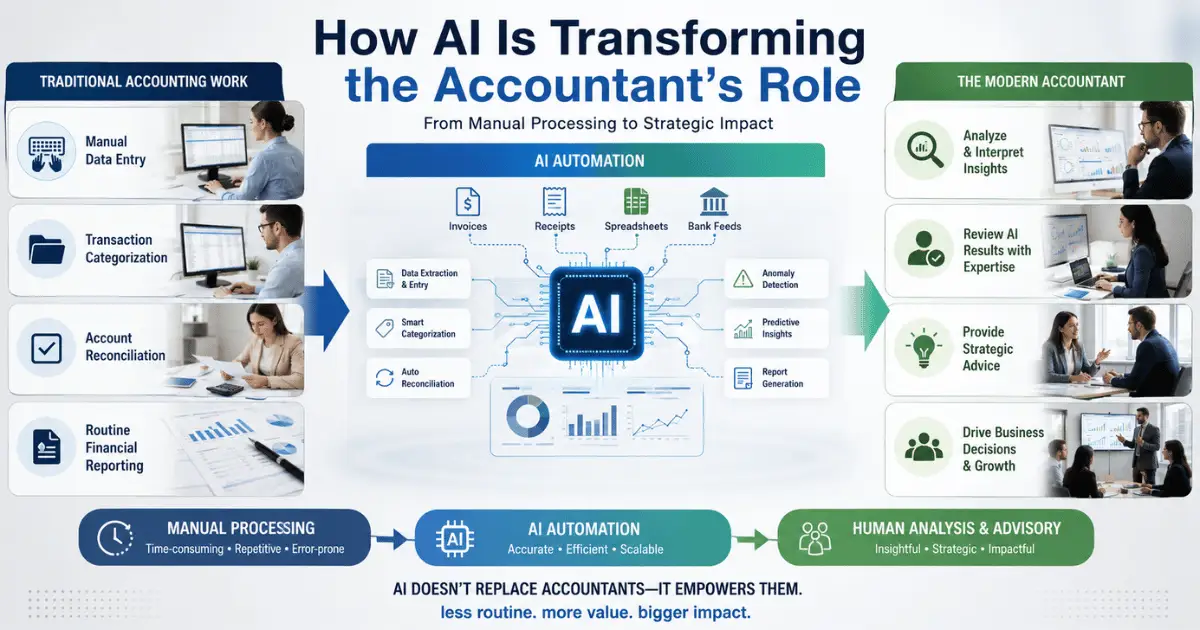
AI is likely to change the role of accountants more than eliminate it. As AI automates repetitive tasks, accountants can spend less time on manual data processing and more time interpreting financial information and supporting business decisions.
This shift may move the profession toward more analytical and advisory work. Accountants may increasingly review AI-generated results, identify errors or unusual patterns, explain financial insights, and provide strategic recommendations.
AI systems still depend on human expertise. Accountants need to understand the information being processed and verify whether AI-generated outputs are accurate and appropriate. Learning about AI inference and training can also help professionals understand how AI systems learn from data and produce results.
In the future, the most valuable accountants may not simply be those who perform routine tasks efficiently. They may be the professionals who can combine accounting expertise, professional judgment, and AI skills to make better financial decisions.
What Skills Will Accountants Need in an AI-Driven Future?
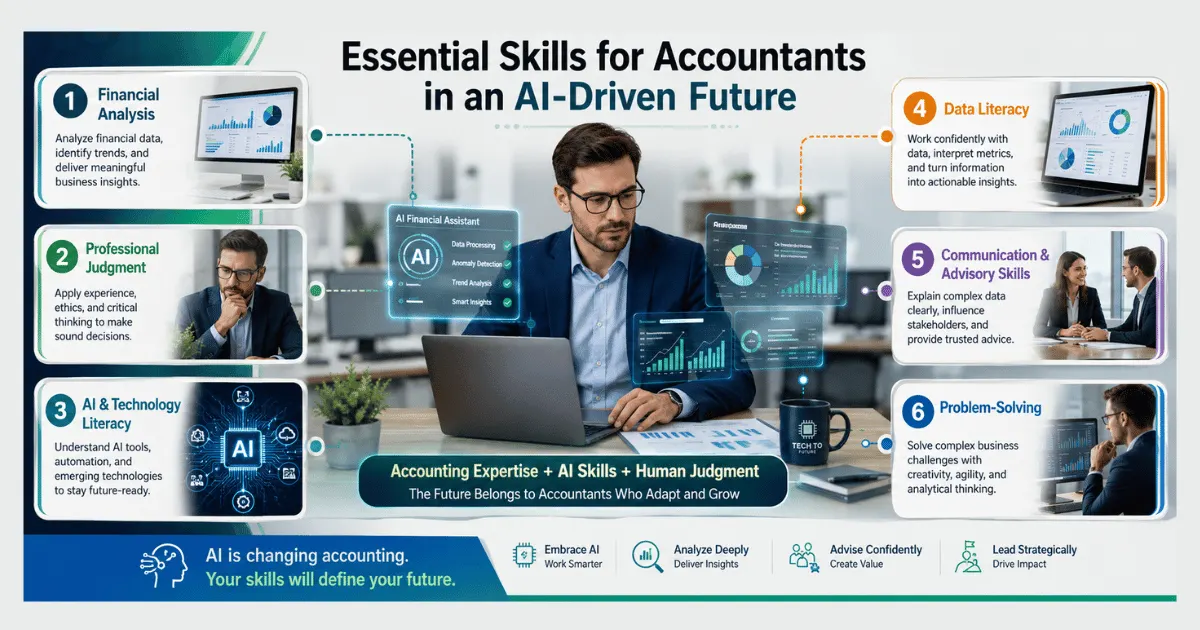
As AI changes accounting work, accountants will need to develop skills that go beyond routine data processing. Technical knowledge will remain important, but human judgment and the ability to use AI effectively may become increasingly valuable.
Key skills may include:
- Financial analysis: Understanding financial data and identifying meaningful patterns.
- Professional judgment: Evaluating complex situations and making informed decisions.
- AI and technology literacy: Understanding how AI tools and AI models work and recognizing their limitations.
- Data literacy: Working with financial data and evaluating the accuracy of AI-generated insights.
- Communication and advisory skills: Explaining financial information and helping clients or businesses make decisions.
- Problem-solving: Handling unusual situations that cannot be resolved through automated rules alone.
Accountants do not necessarily need to become AI engineers. However, professionals who understand how to work with AI, review its outputs, and combine technology with accounting expertise may be better prepared for the changing profession.
What Are the Risks of AI Replacing Accounting Jobs?
AI adoption can create challenges for the accounting profession, particularly for roles that depend heavily on routine and repetitive work.
The biggest risk is that automation may reduce the number of human hours needed for tasks such as data entry, transaction processing, basic bookkeeping, and routine reconciliation. This could change entry-level accounting jobs, where professionals traditionally gain experience by performing these tasks.
However, AI also creates new risks when it is used without proper oversight. AI-generated financial information can contain errors, incomplete analysis, or incorrect conclusions. Accountants must therefore review outputs and remain responsible for important financial decisions.
There is also a growing need to understand the limitations of AI systems. Like other technology, AI models can produce inaccurate or unreliable results, making professional judgment and human oversight essential when AI is used in accounting.
The challenge for accountants is not simply avoiding AI. It is learning how to use AI effectively while developing skills that are harder to automate.
Will AI Create New Opportunities for Accountants?
AI may automate some accounting tasks, but it can also create new opportunities for accountants. As businesses adopt AI tools, they still need professionals who can understand financial data, review AI-generated results, and make informed decisions.
New opportunities may include:
- AI-assisted financial analysis: Using AI to identify trends, risks, and patterns in financial data.
- Advisory and strategic roles: Helping businesses turn financial information into better decisions.
- AI oversight and governance: Reviewing AI outputs for accuracy, reliability, and appropriate use.
- Financial data management: Ensuring the data used by AI systems is accurate, relevant, and properly managed.
- Technology-focused accounting roles: Working with AI-powered accounting software and automated financial systems.
AI is therefore likely to shift accounting work toward higher-value responsibilities rather than simply eliminate the need for accountants. Professionals who combine accounting expertise with an understanding of emerging technologies may be better positioned for these new opportunities.
Conclusion: Will AI Replace Accountants?
AI is unlikely to completely replace accountants. Instead, it will automate many repetitive accounting tasks and change how accounting professionals work.
Tasks such as data entry, transaction processing, bookkeeping, and routine reporting are becoming easier to automate. However, professional judgment, complex problem-solving, client advisory, ethical responsibility, and accountability remain difficult to replace.
The future of accounting will likely involve people working with AI rather than being completely replaced by it. Accountants who develop strong analytical, advisory, and AI-related skills may be better prepared for the changes ahead.
Ultimately, the question is not simply whether AI will replace accountants. It is how accountants can adapt and use AI to create more value in their profession.
FAQs About AI and the Future of Accounting
Will AI replace bookkeepers?
AI can automate many bookkeeping tasks, including transaction categorization, invoice processing, and basic reconciliation. However, human oversight is still needed for errors, exceptions, and complex financial situations.
Will AI replace entry-level accountants?
Entry-level accountants may be affected because many routine tasks are easier to automate. However, these roles are more likely to change than disappear completely, with greater focus on reviewing AI outputs, analyzing data, and handling exceptions.
Will AI replace chartered accountants?
AI can support chartered accountants by automating data processing and analysis. However, professional judgment, regulatory interpretation, client advisory, and accountability remain important human responsibilities.
How soon will AI change the accounting profession?
AI is already changing accounting by automating routine tasks and improving financial data analysis. The impact will likely continue to grow as AI tools become more capable and widely adopted.
What should accountants learn to prepare for AI?
Accountants can prepare by developing financial analysis, data literacy, AI and technology knowledge, communication, problem-solving, and advisory skills.
Can AI completely run an accounting firm without humans?
AI can automate parts of an accounting firm’s workflow, but complete human removal is unlikely for complex work requiring professional judgment, client relationships, ethical responsibility, and accountability.






- Be Respectful
- Stay Relevant
- Stay Positive
- True Feedback
- Encourage Discussion
- Avoid Spamming
- No Fake News
- Don't Copy-Paste
- No Personal Attacks
- Be Respectful
- Stay Relevant
- Stay Positive
- True Feedback
- Encourage Discussion
- Avoid Spamming
- No Fake News
- Don't Copy-Paste
- No Personal Attacks
