Gemini vs ChatGPT vs Claude vs Perplexity: Which AI Model Is Best in 2026?
Published: 2 May 2026
Most people started 2026 using ChatGPT for everything, but that approach is breaking down. ChatGPT still leads in usage, with an estimated 64.5% market share, yet users are now relying on multiple AI tools for various tasks.
Gemini processes large datasets and multimodal inputs. Claude follows detailed instructions with high accuracy. Perplexity retrieves real-time, source-backed information faster than traditional search.
This guide compares Gemini, ChatGPT, Claude, and Perplexity across real-world use cases, performance, and pricing. You will see which tool best fits each task and when combining models produces better results than relying on a single one.
Table of Contents
Which AI model has the highest market share in 2026?
ChatGPT leads generative AI usage with ~64.5% share, down from 86.7%. Users now distribute tasks across multiple models instead of relying on a single tool.
Why do users adopt multiple AI tools?
Users adopt multiple tools because models specialize in different capabilities.
- Claude → ensures → high instruction accuracy
- Gemini → enables → multimodal data processing
- Perplexity → provides → real-time search results
- ChatGPT → excels at → creative generation
What do AI usage trends show in 2026?
AI usage trends show task-based tool selection.
- Marketers → use → ChatGPT for content
- Developers → rely on → Claude for coding
- Analysts → choose → Perplexity for research
- Workspace teams → adopt → Gemini for integration
Task performance now determines tool choice.
What are the core differences between Gemini, ChatGPT, Claude, and Perplexity?
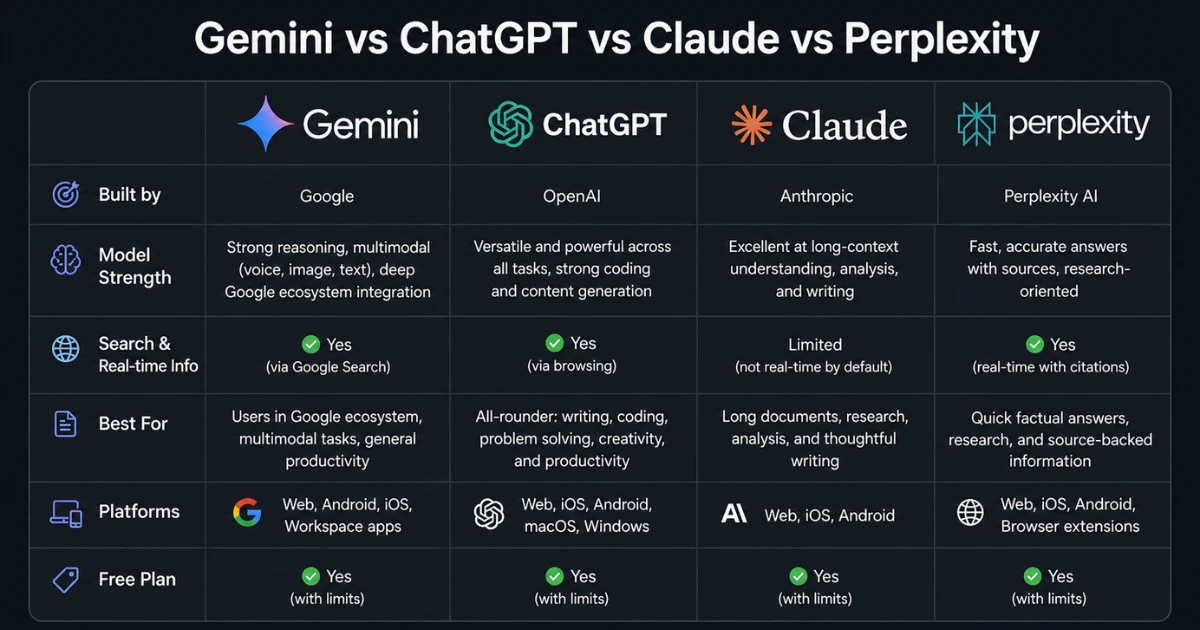
Each model differs by primary capability, context handling, and output type. No model dominates all attributes. Selection depends on task requirements such as creativity, precision, multimodal input, or real-time data.
How do the core capabilities of each AI model compare?
- ChatGPT → generates → creative and conversational text
- Claude → follows → structured instructions with high accuracy
- Gemini → processes → multimodal inputs (text, audio, video)
- Perplexity → retrieves → real-time, source-backed information
These capabilities define how each model performs in real workflows.
How does context window size differ across models?
Context window size determines how much data a model processes in one session.
| Model | Context Window |
| Gemini 3 Pro | up to 2,000,000 tokens |
| Claude Sonnet 4.5 | up to 200,000 tokens |
| GPT-5 | extended long-context (variable) |
| Perplexity | depends on underlying model |
Larger context enables better document analysis and memory retention.
How do these models differ in output quality?
Output quality depends on task type.
- ChatGPT → produces → high-variation, human-like text
- Claude → delivers → consistent, structured output
- Gemini → generates → multimodal insights with moderate text quality
- Perplexity → returns → factual, citation-based answers
Each model optimizes a different output format.
What are the key differences in real-world usage?
Real-world usage reflects specialization:
- Content creation → ChatGPT
- Technical documentation → Claude
- Data + media analysis → Gemini
- Research + fact-checking → Perplexity
Task alignment improves efficiency and output accuracy.
Next, you will see what makes Gemini effective for data-heavy workflows.
What makes Gemini effective for data-heavy and multimodal workflows?
Gemini is effective because it processes large-scale data and multimodal inputs within a single system. Gemini 3 Pro leads in context size and media analysis, while Gemini 2.5 supports lighter, less consistent tasks.
What does Gemini 3 Pro do best?
Gemini 3 Pro processes up to 2,000,000 tokens in one context. It analyzes documents, emails, images, and video in a single workflow.
- Gemini → processes → full document archives
- Gemini → analyzes → recorded meetings and videos
- Gemini → extracts → structured insights from mixed data
Large context improves cross-document reasoning and reduces fragmentation.
How does Gemini integrate with Google Workspace?
Gemini integrates directly with Google Workspace tools.
- Gemini → accesses → Google Drive files
- Gemini → operates within → Docs and Gmail
- Gemini → processes → data without external transfer
This integration reduces latency and improves data security by keeping processing inside Google’s ecosystem.
Why is Gemini 2.5 considered less reliable?
Gemini 2.5 produces inconsistent outputs across repeated tasks. It handles simple queries but fails in workflows requiring stable reasoning and strict formatting.
- Gemini 2.5 → generates → variable reasoning quality
- Gemini 2.5 → misses → structured constraints
Consistency issues limit its use in automation.
What are Gemini’s core strengths?
- Processes → multimodal inputs (text, audio, video)
- Supports → ultra-long context (2M tokens)
- Integrates → native Google ecosystem
Gemini exceeds Claude in context size and surpasses ChatGPT in multimodal processing.
What are Gemini’s main weaknesses?
- Misses → strict formatting instructions more than Claude
- Produces → lower linguistic variation than ChatGPT
- Delivers → less natural voice interaction
These limitations affect precision and conversational quality.
What does Gemini cost in 2026?
| Plan | Price |
| Individual (Google One AI) | $21.99/month |
| Business (Workspace) | ~$28/user/month |
| Free tier | Limited model access |
Pricing aligns with ChatGPT and Claude at the individual level.
Why is ChatGPT the leading AI for creative and conversational tasks?
ChatGPT leads because it generates high-variation, human-like text and delivers the most natural voice interaction. It balances creativity, usability, and broad task support better than other models.
What does ChatGPT 5.2 do best?
ChatGPT 5.2 produces persuasive and audience-aware content. It adapts tone, structure, and intent across formats.
- ChatGPT → generates → marketing copy and blog content
- ChatGPT → adapts → tone for different audiences
- ChatGPT → produces → conversational dialogue
It outperforms Claude and Gemini in creative variation and fluency.
How does GPT-5 improve reasoning and research?
GPT-5 improves structured reasoning and long-context understanding. Deep research mode aggregates and synthesizes web data into cohesive outputs.
- GPT-5 → compiles → multi-source reports
- GPT-5 → structures → long-form analysis
- GPT-5 → reduces → fragmented outputs
It performs better than ChatGPT 5.2 in analytical tasks but remains less precise than Claude.
What are ChatGPT’s core strengths?
- Generates → high-quality creative text
- Delivers → natural, dynamic voice interaction
- Produces → competitive image outputs
- Simplifies → non-technical workflows
ChatGPT surpasses Claude in creativity and exceeds Gemini in conversational quality.
What are ChatGPT’s main weaknesses?
- Fails → strict formatting consistency compared to Claude
- Lacks → advanced multimodal depth compared to Gemini
- Enforces → usage limits on Plus plans
These weaknesses affect structured workflows and high-volume usage.
How does ChatGPT compare in multimodal capabilities?
ChatGPT supports images and limited video analysis but lacks full audio processing.
- ChatGPT → analyzes → images effectively
- ChatGPT → supports → basic video understanding
- ChatGPT → does not process → audio natively like Gemini
Gemini exceeds ChatGPT in multimodal depth.
What does ChatGPT cost in 2026?
| Plan | Price |
| Plus | $20/month |
| Team | $25/user/month |
| Enterprise | Custom |
| Free tier | Limited access |
Pricing aligns closely with Gemini and Claude for individuals and teams.
Why is Claude the most reliable AI for precision, coding, and structured workflows?
Claude is the most reliable because it follows complex instructions with high accuracy and maintains consistency across long outputs. It minimizes hallucinations and executes structured tasks better than ChatGPT and Gemini.
What does Claude Sonnet 4.5 do best?
Claude Sonnet 4.5 executes detailed prompts with strict adherence to format and constraints.
- Claude → follows → multi-step instructions precisely
- Claude → maintains → consistent structure across long documents
- Claude → reduces → hallucination frequency
It outperforms ChatGPT in formatting accuracy and exceeds Gemini in structured reasoning.
What makes Claude unique for agentic workflows?
Claude enables system-level task execution through desktop interaction.
- Claude Cowork → accesses → local files and folders
- Computer Use → controls → mouse and keyboard actions
- Claude → automates → repetitive software tasks
Claude surpasses ChatGPT and Gemini in local environment automation.
Why is Claude strong for coding tasks?
Claude generates structured and scalable code across files and systems.
- Claude → writes → multi-file codebases
- Claude → maintains → logical consistency in large projects
- Claude → debugs → complex errors
It outperforms ChatGPT and Gemini in complex coding workflows.
What are Claude’s core strengths?
- Follows → strict instructions with high accuracy
- Processes → long documents (up to 200K tokens)
- Executes → agentic workflows on desktop
- Generates → reliable code outputs
Claude leads in precision and structured task execution.
What are Claude’s main weaknesses?
- Enforces → strict daily usage limits
- Produces → less expressive conversational text than ChatGPT
- Lacks → advanced image and video generation
These limitations reduce flexibility for creative and casual use.
How does Claude compare in context handling?
Claude supports up to 200,000 tokens per session.
- Claude → processes → large documents effectively
- Claude → maintains → coherence across long inputs
Gemini exceeds Claude in maximum context size, but Claude maintains higher consistency within its range.
What does Claude cost in 2026?
| Plan | Price |
| Pro | $20/month |
| Team | $25/user/month |
| Enterprise | Custom |
| Free tier | Limited access |
Pricing aligns with ChatGPT and remains competitive with Gemini.
Why is Perplexity the best AI tool for real-time research and search?
Perplexity is best for research because it retrieves live web data and provides source-backed answers. It prioritizes accuracy and timeliness over generative creativity.
What does Perplexity Pro do?
Perplexity Pro searches the web in real time and synthesizes results into structured responses with citations.
- Perplexity → retrieves → current web information
- Perplexity → cites → sources for verification
- Perplexity → aggregates → multiple references
It outperforms ChatGPT, Claude, and Gemini in time-sensitive queries.
How does Perplexity differ from generative AI models?
Perplexity acts as a retrieval system rather than a pure generator.
- Perplexity → focuses on → factual accuracy
- ChatGPT → focuses on → content generation
- Claude → focuses on → structured execution
- Gemini → focuses on → multimodal analysis
This difference defines its role as a research layer.
What are Perplexity’s core strengths?
- Retrieves → real-time, up-to-date information
- Provides → verifiable citations
- Reduces → hallucination risk through sourcing
- Supports → multiple underlying models (GPT, Claude)
Perplexity surpasses all models in current information retrieval.
What are Perplexity’s main weaknesses?
- Generates → low-variation, less engaging text
- Lacks → multimodal processing capabilities
- Does not support → complex creative workflows
These limitations prevent it from replacing writing tools.
How does Perplexity support professional workflows?
Perplexity accelerates research and validation tasks.
- Analysts → use → Perplexity for market research
- Marketers → verify → trends and data points
- Writers → fact-check → generated content
It complements ChatGPT, Claude, and Gemini rather than replacing them.
What does Perplexity cost in 2026?
| Plan | Price |
| Pro | $20/month |
| Enterprise | $40/user/month |
| Free tier | Limited daily searches |
Pricing is comparable at the individual level but higher for teams.
What are the most effective real-world workflows using these AI models?
The most effective workflows combine multiple models based on task specialization. ChatGPT handles creativity, Claude ensures precision, Gemini processes data, and Perplexity validates information.
How do you scale content and marketing campaigns?
You scale content by combining analysis with generation.
- Gemini → analyzes → high-performing content patterns
- ChatGPT → generates → multiple content variations
- Perplexity → validates → current trends and data
This workflow increases output volume and maintains relevance.
How do you optimize e-commerce operations?
You optimize e-commerce by combining data analysis with execution.
- Claude → identifies → cross-sell and bundle patterns
- Claude → generates → implementation code
- Gemini → creates → product descriptions using brand data
This workflow improves conversion and operational efficiency.
How do developers use multiple AI tools?
Developers combine precision with support tools.
- Claude → writes → structured, multi-file code
- ChatGPT → explains → concepts and debugging steps
- Gemini → suggests → cost-efficient solutions
This combination improves development speed and accuracy.
How do you perform accurate research and reporting?
You ensure research accuracy by separating retrieval and synthesis.
- Perplexity → retrieves → real-time, cited information
- Claude → structures → reports with strict formatting
- ChatGPT → refines → readability and tone
This workflow reduces hallucinations and improves clarity.
How do you handle daily productivity tasks?
You handle daily tasks by distributing simple workloads.
- ChatGPT → drafts → emails and summaries
- Gemini → processes → documents and files
- Perplexity → answers → quick factual queries
This approach improves efficiency across routine tasks.
What is the key advantage of multi-model workflows?
Multi-model workflows increase reliability and output quality.
- Reduces → dependency on a single model
- Improves → task-specific performance
- Prevents → workflow disruption during outages
Task specialization drives better results than single-tool usage.
How do pricing plans compare across Gemini, ChatGPT, Claude, and Perplexity?
All four tools price individual plans around $20/month. Differences appear in team pricing, enterprise controls, and included features.
Pricing Comparison Table (2026)
| Model | Free Tier | Individual Plan | Team Plan | Enterprise |
| Gemini | Yes (limited) | $21.99/month | ~$28/user/month | Custom |
| ChatGPT | Yes (limited) | $20/month | $25/user/month | Custom |
| Claude | Yes (limited) | $20/month | $25/user/month | Custom |
| Perplexity | Yes (limited) | $20/month | $40/user/month | Custom |
What are the key pricing differences?
- Gemini → costs → slightly higher for individuals
- ChatGPT → offers → balanced pricing and features
- Claude → matches → ChatGPT pricing with stricter limits
- Perplexity → charges → higher team pricing
Team and enterprise tiers create the biggest cost differences.
What do you get in free tiers?
Free tiers provide limited access.
- Gemini → restricts → model versions and usage
- ChatGPT → limits → messages and features
- Claude → caps → daily usage
- Perplexity → limits → daily searches
Free plans support testing but not heavy workflows.
How should you evaluate pricing?
You should evaluate pricing based on usage, not monthly cost.
- High-volume users → require → higher limits
- Teams → need → admin and privacy controls
- Businesses → prioritize → data security
Cost efficiency depends on task frequency and scale.
How does ecosystem integration affect AI model selection?
Ecosystem integration determines workflow efficiency. The model that connects directly to your tools reduces friction, latency, and data transfer.
Which ecosystem fits each AI model best?
- Gemini → integrates → Google Workspace (Drive, Docs, Gmail)
- ChatGPT → operates → standalone with broad tool support
- Claude → connects → local systems and developer workflows
- Perplexity → layers → on top of web-based research
Integration strength affects daily usability more than raw capability.
Why does integration matter for productivity?
Integration reduces operational steps and improves speed.
- Native access → eliminates → manual uploads
- Tool connectivity → accelerates → task execution
- Centralized data → improves → context accuracy
Gemini benefits most in Google environments. Claude benefits in local automation workflows.
How do different teams choose based on ecosystem?
- Google Workspace teams → adopt → Gemini
- Developer teams → rely on → Claude
- Marketing teams → prefer → ChatGPT
- Research-focused roles → use → Perplexity
Tool choice aligns with existing infrastructure.
How does ecosystem impact scalability?
Scalability depends on how well AI integrates with workflows.
- Integrated systems → reduce → operational overhead
- Disconnected tools → increase → workflow friction
Teams scale faster when AI fits their existing environment.
What risks and limitations should you consider when using AI tools in 2026?
AI tools introduce risks in accuracy, data privacy, usage limits, and dependency. All four models produce errors and require human validation.
What are the risks of hallucinations and incorrect outputs?
All models generate confident but incorrect information.
- ChatGPT → produces → plausible but unverifiable claims
- Claude → reduces → hallucination rate but not fully
- Gemini → misinterprets → complex inputs occasionally
- Perplexity → depends → on source quality
You must verify critical outputs in legal, financial, and medical contexts.
How does data privacy affect AI usage?
Data privacy risk depends on plan type and usage.
- Free tiers → may use → inputs for model improvement
- Team plans → provide → limited data controls
- Enterprise plans → ensure → data isolation
Sensitive business or customer data requires controlled environments.
How do usage limits impact workflows?
Usage limits restrict continuous productivity.
- Claude → enforces → strict daily caps
- ChatGPT → limits → high-volume usage on Plus
- Gemini → provides → higher tolerance for long sessions
- Perplexity → caps → daily search queries
Limits require backup tools for uninterrupted workflows.
What are the risks of relying on a single AI model?
Single-model dependency creates operational risk.
- Model outages → disrupt → workflows
- Updates → change → output behavior
- Restrictions → reduce → capability access
Multi-model strategies reduce these risks.
How can you mitigate AI-related risks?
You mitigate risks by combining tools and verifying outputs.
- Cross-check → critical information across models
- Use → enterprise plans for sensitive data
- Maintain → human review for key decisions
Risk management improves reliability and trust.
How do you choose the right AI model for your use case?
You choose the right model by matching task requirements to model strengths. ChatGPT fits creativity, Claude fits precision, Gemini fits data processing, and Perplexity fits real-time research.
Which AI model is best for content creation?
ChatGPT is best for content creation. It generates high-variation, audience-aware text.
- ChatGPT → creates → blog posts and marketing copy
- ChatGPT → adapts → tone and style
- Claude → supports → structured long-form writing
Use Claude when strict formatting is required.
Which AI model is best for coding and technical work?
Claude is best for coding and technical workflows. It maintains structure across complex systems.
- Claude → writes → multi-file codebases
- Claude → debugs → complex errors
- ChatGPT → explains → programming concepts
Use ChatGPT for learning and quick fixes.
Which AI model is best for data and media analysis?
Gemini is best for multimodal and large-scale data analysis.
- Gemini → processes → documents, audio, and video
- Gemini → analyzes → large datasets (up to 2M tokens)
- Claude → supports → structured document review
Use Gemini when input size and media type matter.
Which AI model is best for research and fact-checking?
Perplexity is best for research and validation.
- Perplexity → retrieves → real-time information
- Perplexity → provides → citations
- ChatGPT → summarizes → findings
Use Perplexity when accuracy and timeliness are critical.
Should you use more than one AI tool?
Yes. Multi-model usage improves results and reliability.
- Combines → strengths across models
- Reduces → individual limitations
- Improves → workflow efficiency
Most professionals use at least two tools.
FAQs
Which AI model is best in 2026?
No single AI model is best overall. ChatGPT leads creative tasks, Claude ensures precision, Gemini handles multimodal data, and Perplexity provides real-time research. The best choice depends on the task.
Is ChatGPT better than Claude?
ChatGPT is better for creative writing and conversation. Claude is better for instruction accuracy, long documents, and coding. Both serve different use cases and often work best in conjunction with each other.
Is Gemini better than ChatGPT?
Gemini is better for multimodal processing and large datasets. ChatGPT is better for writing quality and conversational tasks. Gemini excels in Google Workspace environments, whereas ChatGPT is suited for general use.
Which AI tool is best for coding?
Claude is the best AI for coding. It generates structured, multi-file code and maintains consistency. ChatGPT supports simpler coding tasks, while Gemini offers cost-efficient assistance.
Which AI is best for content creation?
ChatGPT is the best for content creation. It produces high-quality, human-like text for blogs, ads, and campaigns. Claude supports structured writing when strict formatting is required.
Which AI tool is best for research?
Perplexity is the best for research. It retrieves real-time information and provides citations. It is more reliable for current data than generative AI models.
Can you use these AI tools for free?
Yes. ChatGPT, Claude, Gemini, and Perplexity offer free tiers. Free plans limit usage, features, and model access.
Which AI is safest for business data?
Enterprise plans across all tools provide the highest data security. Free and basic plans may use inputs for model improvement. Sensitive data requires controlled environments.
Should you use multiple AI tools?
Yes. Using multiple AI tools improves performance and reliability. Each model specializes in different tasks, and combining them produces better results.
What are the main limitations of AI tools?
AI tools can generate incorrect information, enforce usage limits, and create dependency risks. Human verification and multi-model workflows reduce these issues.





- Be Respectful
- Stay Relevant
- Stay Positive
- True Feedback
- Encourage Discussion
- Avoid Spamming
- No Fake News
- Don't Copy-Paste
- No Personal Attacks
- Be Respectful
- Stay Relevant
- Stay Positive
- True Feedback
- Encourage Discussion
- Avoid Spamming
- No Fake News
- Don't Copy-Paste
- No Personal Attacks
