Artificial Intelligence (AI) Guide: Meaning, Types, Applications & Future
Published: 3 Mar 2026
Artificial intelligence (AI) is no longer a futuristic concept reserved for research laboratories or science fiction. It has become an essential part of everyday life, powering the technologies people use to search the web, navigate with GPS, shop online, detect financial fraud, translate languages, receive personalized recommendations, and interact with virtual assistants. Businesses across healthcare, cybersecurity, manufacturing, finance, education, and transportation are also adopting AI to automate processes, analyze data, and make faster, more informed decisions.
Unlike traditional computer programs that follow predefined instructions, artificial intelligence can learn from data, recognize patterns, solve problems, and improve its performance over time. This ability allows AI systems to handle complex tasks that would be difficult or impossible for conventional software. Modern advances in machine learning, deep learning, large language models (LLMs), and AI agents have accelerated AI innovation, making intelligent systems more capable, accessible, and widely adopted than ever before.
The rapid growth of AI has also introduced new technologies that are reshaping how intelligent systems operate. Concepts such as Agentic AI, multimodal models, and edge AI enable machines to complete multi-step tasks, understand different types of information, and make decisions with increasing levels of autonomy. As organizations generate larger volumes of data, understanding how these technologies work together has become essential for anyone looking to study, implement, or evaluate artificial intelligence.
However, artificial intelligence is much broader than chatbots and image generators. It is an interdisciplinary field that combines computer science, mathematics, statistics, and cognitive science to create systems capable of learning, reasoning, perceiving, and making decisions. Understanding AI requires more than knowing its definition. It involves exploring how intelligent systems learn from data, the different types of AI, the technologies behind them, their real-world applications, and the ethical and technical challenges that come with their adoption. Topics such as AI inference vs. training, AI model quantization, and context engineering vs. prompt engineering further explain how modern AI systems are built, optimized, and deployed.
In this comprehensive guide, you’ll learn what artificial intelligence is, how AI works step by step, the different types of AI, practical examples, real-world applications, key benefits, major challenges, and future trends. Whether you’re a student, technology enthusiast, developer, or business professional, this guide will provide a strong foundation for understanding one of the most transformative technologies shaping the future of the digital world.
Artificial intelligence (AI) is a branch of computer science that enables machines to perform tasks that normally require human intelligence, such as learning, reasoning, problem-solving, understanding language, and making decisions. Unlike traditional software, AI systems can learn from data and improve their performance over time. Today, AI powers technologies such as virtual assistants, recommendation systems, medical diagnostics, fraud detection, and autonomous vehicles.
Table of Contents
What Is Artificial Intelligence?
Artificial intelligence (AI) is a branch of computer science that develops systems capable of performing tasks that typically require human intelligence. These tasks include learning from data, recognizing patterns, understanding language, solving problems, making decisions, and generating content. Rather than following only predefined instructions, many AI systems analyze information, identify relationships, and improve their performance as they process more data.
The primary goal of artificial intelligence is to enable machines to perform cognitive tasks that help humans make better decisions, automate repetitive work, and solve complex problems more efficiently. Today, AI supports everything from virtual assistants and recommendation engines to medical diagnostics, fraud detection, industrial automation, and autonomous vehicles.
Unlike traditional software, which produces the same output when given the same input, AI systems can adapt their behavior based on experience. This adaptability allows intelligent systems to improve prediction accuracy, recognize new patterns, and respond to situations that were not explicitly programmed during development.
Artificial intelligence is often confused with robots. In reality, AI is software or algorithms that enable intelligent behavior, while a robot is a physical machine that may or may not use AI. For example, ChatGPT is an AI system but not a robot, whereas a warehouse robot becomes intelligent only when AI enables it to perceive, learn, or make decisions.
As artificial intelligence continues to evolve, it is becoming more capable of understanding language, interpreting images, generating content, and supporting complex decision-making. To understand why these systems perform so effectively, it is important to first examine how artificial intelligence works, from collecting data to producing intelligent outputs.
How Does Artificial Intelligence Work?
Artificial intelligence works by processing large amounts of data, identifying patterns within that data, and using those patterns to make predictions, recommendations, or decisions. Instead of relying solely on predefined rules, modern AI systems learn from examples, allowing them to improve their accuracy as they receive new information.
Although different AI technologies operate in different ways, most intelligent systems follow a similar workflow. They begin by collecting relevant data, transform that data into a format suitable for analysis, train mathematical models to recognize relationships, and then use those trained models to solve real-world problems.
The process starts with data acquisition, where information is gathered from sources such as databases, sensors, cameras, documents, websites, or user interactions. The quality of this data directly affects the performance of an AI system because accurate, diverse, and unbiased datasets produce more reliable results.
After the data is collected, it is cleaned and prepared for training. During this stage, duplicate records, missing values, and incorrect information are removed to improve data quality. The processed data is then used to train an AI model, enabling it to identify patterns and relationships that humans may not easily recognize.
Once training is complete, the model enters the inference stage. During inference, the AI system applies what it has learned to new data. For example, an email filtering system uses a trained model to determine whether an incoming message is legitimate or spam, while an image recognition model identifies objects it has never seen before by comparing them with patterns learned during training.
A streaming platform such as Netflix analyzes your viewing history, watch time, ratings, and browsing behavior to recommend movies and TV shows you are likely to enjoy. The recommendations improve over time because the AI continuously learns from your interactions and updates its predictions.
The final step is continuous improvement. Many AI systems collect feedback from their predictions, allowing developers to retrain models with newer data. This ongoing learning process helps maintain accuracy as user behavior, business requirements, and real-world conditions change.
Core Components of Artificial Intelligence
Artificial intelligence is not powered by a single technology. Instead, it combines several interconnected components that enable machines to learn from data, make decisions, and continuously improve their performance. Each component performs a specific role, and together they create intelligent systems capable of solving complex problems across different industries.
Data
Data is the foundation of every AI system. It provides the information that algorithms use to identify patterns, learn relationships, and make predictions. AI models can be trained using text, images, videos, audio recordings, sensor readings, financial transactions, medical records, and many other forms of structured and unstructured data.
The quality of the data is just as important as its quantity. Incomplete, inaccurate, or biased data can produce unreliable predictions, while high-quality datasets improve the accuracy and fairness of AI systems.
Algorithms
Algorithms are the instructions that tell an AI system how to process data and solve a problem. Different algorithms are designed for different tasks, such as classifying emails, recognizing faces, translating languages, or predicting customer behavior. During training, these algorithms analyze data to discover patterns that can later be applied to new situations.
Machine Learning Models
A machine learning model is the result of training an algorithm with data. Once trained, the model can make predictions or decisions without being explicitly programmed for every possible scenario. Different models are optimized for different tasks, including image recognition, speech processing, fraud detection, and recommendation systems.
Understanding machine learning is essential because it powers most modern AI applications used today.
Computing Power
Training modern AI models requires significant computing resources. High-performance processors such as Graphics Processing Units (GPUs) and Tensor Processing Units (TPUs) accelerate billions of mathematical calculations, allowing AI models to learn from massive datasets much faster than traditional CPUs.
As AI models continue to grow in size and complexity, access to powerful computing infrastructure has become one of the key drivers of AI innovation.
Feedback and Continuous Learning
Artificial intelligence is not always static after deployment. Many AI systems are periodically retrained using new data to improve accuracy and adapt to changing conditions. This continuous learning process helps models remain effective as user behavior, business requirements, and real-world environments evolve.
Real-World Example
A fraud detection system used by a bank continuously learns from newly identified fraudulent transactions. As criminals adopt new tactics, the AI model is retrained with updated data, allowing it to detect emerging fraud patterns more accurately while reducing false alerts.
Together, these components enable artificial intelligence to transform raw data into meaningful insights, automate complex tasks, and support decision-making across industries. Understanding these building blocks also makes it easier to explore the different types of artificial intelligence, where these technologies are applied in different ways depending on the problem being solved.
Types of Artificial Intelligence
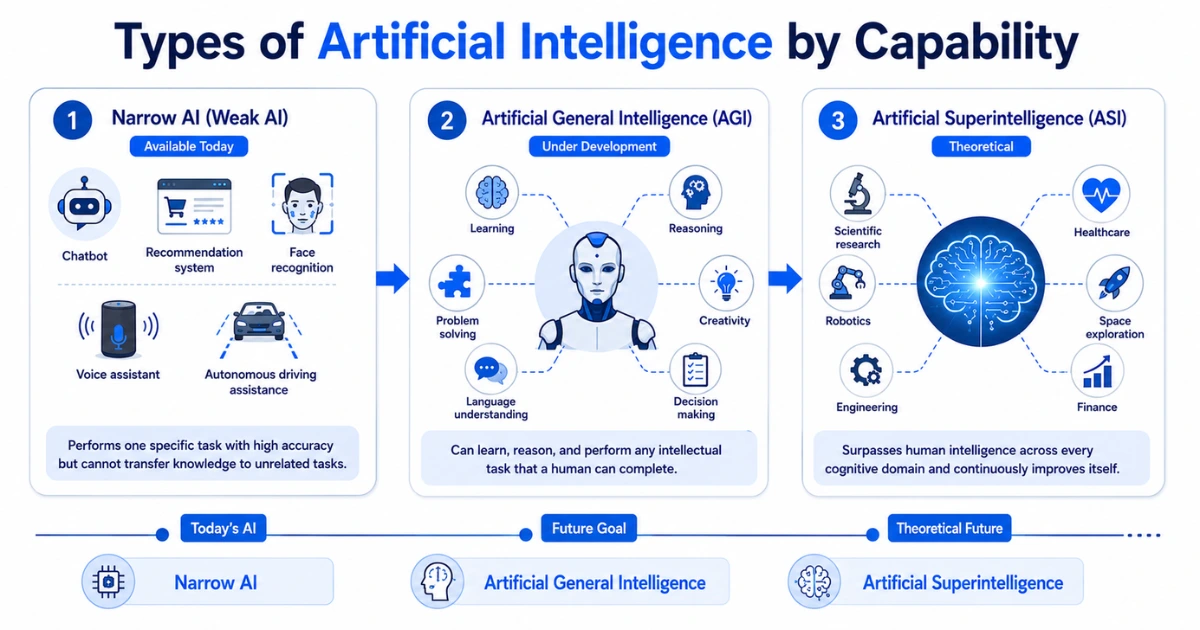
Artificial intelligence can be classified in different ways depending on its capabilities and how it performs tasks. The most widely accepted classification groups AI into three categories based on its level of intelligence: Narrow AI, General AI, and Super AI. While only Narrow AI exists today, understanding all three categories helps explain the current state of AI and its future direction.
| Type | Current Status | Primary Capability |
| Narrow AI (Weak AI) | Widely used today | Performs specific tasks |
| General AI (AGI) | Under development | Performs any intellectual task like a human |
| Super AI | Theoretical | Surpasses human intelligence across all domains |
Narrow AI (Weak AI)
Narrow AI is designed to perform a specific task or a limited set of related tasks. It cannot think beyond the purpose for which it was trained. Nearly every AI system used today falls into this category.
Examples of Narrow AI include spam filters, recommendation engines, facial recognition systems, virtual assistants, fraud detection software, language translation tools, and generative AI applications such as ChatGPT. Although these systems often appear intelligent, they cannot apply their knowledge to unrelated problems without additional training.
A navigation app uses Narrow AI to calculate the fastest route by analyzing traffic conditions and historical travel data. While it excels at route optimization, it cannot diagnose a medical condition or write software because those tasks fall outside its trained capabilities.
General AI (Artificial General Intelligence)
Artificial General Intelligence, commonly called AGI, refers to an AI system capable of understanding, learning, and performing any intellectual task that a human can complete. Unlike Narrow AI, AGI would transfer knowledge between different domains, solve unfamiliar problems, and adapt without requiring task-specific programming.
Although researchers continue to make significant advances in AI, General AI has not yet been achieved. It remains an active area of research and is one of the long-term goals of the AI community.
Super AI (Artificial Superintelligence)
Artificial Superintelligence describes a hypothetical stage where AI surpasses human intelligence in every cognitive area, including scientific reasoning, creativity, problem-solving, strategic planning, and emotional understanding.
Super AI currently exists only as a theoretical concept. Researchers, policymakers, and technology leaders often discuss its potential benefits and risks, but no existing AI system has reached this level of capability.
Many people believe ChatGPT and similar AI systems are examples of Artificial General Intelligence (AGI). In reality, they are forms of Narrow AI because they are designed for specific tasks and cannot independently understand or perform every intellectual activity that humans can.
Understanding these three categories provides a high-level view of AI’s evolution. However, intelligent systems can also be grouped by how they function, which offers another useful way to understand the capabilities and limitations of artificial intelligence.
Artificial Intelligence vs Machine Learning vs Deep Learning
Artificial intelligence, machine learning, and deep learning are often used interchangeably, but they are not the same. Artificial intelligence is the broad field of creating systems that can perform tasks requiring human intelligence. Machine learning is a subset of AI that enables computers to learn from data without being explicitly programmed for every scenario. Deep learning is a specialized branch of machine learning that uses multi-layered neural networks to solve highly complex problems.
The relationship between these technologies can be viewed as a hierarchy. Artificial intelligence is the largest field, machine learning is one of the primary approaches used to build AI systems, and deep learning is an advanced machine learning technique designed to process large volumes of complex data.
| Technology | Description | Common Applications |
| Artificial Intelligence (AI) | The broad field of building intelligent systems | Virtual assistants, robotics, expert systems, autonomous vehicles |
| Machine Learning (ML) | AI systems that learn patterns from data | Spam filtering, fraud detection, and recommendation systems |
| Deep Learning (DL) | Machine learning using deep neural networks | Image recognition, speech recognition, and large language models |
Traditional AI systems often relied on predefined rules created by human experts. Modern AI increasingly depends on machine learning because it allows systems to improve their performance by learning from experience rather than following fixed instructions. Deep learning extends this capability by automatically discovering complex patterns in large datasets, making it particularly effective for tasks such as computer vision, speech recognition, and natural language processing.
Many of today’s most advanced AI applications, including ChatGPT, autonomous driving systems, and medical image analysis, are powered by deep learning models trained on massive amounts of data. However, not every AI system requires deep learning. Rule-based expert systems and decision trees are also forms of artificial intelligence that remain valuable for many business and industrial applications.
Understanding the relationship between AI, machine learning, and deep learning provides the foundation for exploring where these technologies are used in everyday life and across different industries. The next section examines the most common applications of artificial intelligence and how they are transforming the way people live and work.
What Are the Applications of Artificial Intelligence?
Artificial intelligence is used across nearly every industry to automate repetitive tasks, analyze large volumes of data, improve decision-making, and deliver personalized experiences. From healthcare and finance to manufacturing and education, AI helps organizations solve complex problems more efficiently while reducing costs and increasing productivity.
Healthcare
Artificial intelligence supports healthcare professionals by analyzing medical images, assisting with disease diagnosis, monitoring patients remotely, predicting health risks, and accelerating drug discovery. AI-powered systems can identify patterns in medical data that help doctors make faster and more accurate clinical decisions.
Cybersecurity
In cybersecurity, AI continuously monitors networks, detects suspicious activities, identifies malware, and responds to emerging threats in real time. By recognizing unusual behavior, AI helps security teams detect cyberattacks before they cause significant damage.
Finance
Banks and financial institutions use AI to detect fraudulent transactions, assess credit risk, automate customer support, and provide personalized financial recommendations. AI also plays an important role in algorithmic trading and risk management by analyzing market trends and historical data.
Manufacturing
Manufacturers use AI to improve production efficiency through predictive maintenance, quality inspection, robotics, and process automation. AI systems analyze sensor data from industrial equipment to predict failures before they occur, reducing downtime and maintenance costs.
Retail and E-commerce
Retailers use artificial intelligence to recommend products, forecast demand, optimize inventory, and personalize shopping experiences. AI-powered chatbots also provide instant customer support, while recommendation engines increase customer engagement and sales.
Transportation and Logistics
Artificial intelligence improves route planning, fleet management, demand forecasting, warehouse automation, and autonomous driving technologies. Logistics companies use AI to optimize delivery routes, reduce fuel consumption, and improve supply chain visibility.
Education
Educational platforms use AI to personalize learning experiences, recommend study materials, automate grading, and provide intelligent tutoring systems that adapt to each student’s learning pace and progress.
Agriculture
Farmers use AI to monitor crop health, detect plant diseases, optimize irrigation, predict crop yields, and improve resource management. Combining AI with connected sensors allows precision agriculture to increase productivity while reducing water, fertilizer, and pesticide usage.
Business and Customer Service
Organizations use AI to automate repetitive workflows, analyze customer behavior, generate reports, improve marketing campaigns, and enhance customer support through intelligent virtual assistants. These capabilities enable businesses to operate more efficiently while delivering faster and more personalized services.
| Industry | Common AI Applications |
| Healthcare | Disease diagnosis, medical imaging, patient monitoring |
| Cybersecurity | Threat detection, fraud prevention, anomaly detection |
| Finance | Credit scoring, fraud detection, and algorithmic trading |
| Manufacturing | Predictive maintenance, quality inspection, robotics |
| Retail | Product recommendations, inventory optimization, chatbots |
| Transportation | Route optimization, fleet management, autonomous vehicles |
| Education | Personalized learning, intelligent tutoring, automated grading |
| Agriculture | Crop monitoring, precision farming, yield prediction |
Artificial intelligence continues to expand into new industries as computing power, data availability, and machine learning techniques improve. Whether enhancing customer experiences, increasing operational efficiency, or supporting complex decision making, AI has become a core technology driving digital transformation across the modern economy.
What Are the Benefits of Artificial Intelligence?
Artificial intelligence offers significant advantages for individuals and organizations by improving efficiency, reducing manual effort, and enabling faster, data-driven decisions. As AI systems analyze large volumes of information in real time, they help businesses automate routine tasks, identify hidden patterns, and solve complex problems with greater speed and accuracy.
Increased Efficiency
AI automates repetitive and time-consuming tasks, allowing employees to focus on strategic and creative work. From processing documents to managing customer inquiries, automation improves productivity while reducing operational costs.
Better Decision-Making
AI can analyze massive datasets far more quickly than humans. By identifying trends and relationships, it provides insights that help organizations make informed decisions in areas such as healthcare, finance, manufacturing, and marketing.
Improved Accuracy
When trained with high-quality data, AI systems can perform specific tasks with remarkable precision. Medical imaging systems can assist doctors in detecting diseases, while fraud detection models can identify suspicious financial transactions within seconds.
Personalized User Experiences
Many digital services use AI to tailor recommendations based on user behavior and preferences. Streaming platforms suggest movies, online stores recommend products, and news apps personalize content to improve user engagement.
Continuous Availability
Unlike humans, AI-powered systems can operate around the clock without fatigue. Virtual assistants, chatbots, and automated monitoring systems provide continuous support, helping organizations deliver faster responses and uninterrupted services.
Enhanced Safety
AI reduces human exposure to hazardous environments by supporting automation in industries such as mining, manufacturing, and disaster response. It also improves safety through predictive maintenance, which identifies equipment failures before they lead to accidents.
| Benefit | How AI Creates Value |
| Higher efficiency | Automates repetitive tasks and workflows |
| Better decisions | Analyzes large datasets to uncover insights |
| Improved accuracy | Reduces errors in specialized tasks |
| Personalized experiences | Delivers tailored recommendations and services |
| Continuous operation | Provides 24/7 monitoring and customer support |
| Enhanced safety | Supports predictive maintenance and hazardous operations |
While these benefits explain why AI adoption continues to accelerate worldwide, no intelligent system is perfect. Artificial intelligence also presents technical, ethical, and societal challenges that organizations must address to ensure responsible and trustworthy deployment. That balance is explored in the next section.
What Are the Challenges and Risks of Artificial Intelligence?
Despite its many advantages, artificial intelligence also presents technical, ethical, and societal challenges. The effectiveness of an AI system depends on the quality of its data, the transparency of its decisions, and how responsibly it is designed and deployed. Understanding these limitations helps organizations adopt AI more effectively while minimizing potential risks.
Data Bias
AI systems learn from historical data. If the training data contains bias or lacks diversity, the AI model may produce unfair or inaccurate outcomes. Biased AI can affect areas such as hiring, lending, healthcare, and law enforcement, making high-quality and representative data essential for responsible AI development.
Privacy and Data Security
Many AI applications rely on large amounts of personal or business data. Without proper security measures, sensitive information may be exposed to unauthorized access or misuse. Organizations must implement strong data protection practices and comply with privacy regulations when developing AI solutions.
Lack of Transparency
Some advanced AI models make decisions that are difficult for humans to interpret. This challenge, often referred to as the “black box” problem, can reduce trust in AI systems, particularly in high-stakes fields such as healthcare, finance, and criminal justice where understanding the reasoning behind a decision is critical.
Job Displacement
Automation powered by AI can replace repetitive and routine tasks, changing the nature of many jobs. While AI creates new career opportunities in areas such as data science, machine learning, and AI engineering, workers may need to develop new skills as industries continue to evolve.
Security Threats
Artificial intelligence can strengthen cybersecurity by detecting threats faster, but it can also be exploited by attackers. Cybercriminals increasingly use AI to create convincing phishing campaigns, automate attacks, and develop more sophisticated malware, making cyber defense more challenging.
High Development Costs
Building reliable AI systems often requires significant investment in computing infrastructure, high-quality datasets, specialized talent, and ongoing model maintenance. For many organizations, these costs can present a barrier to large-scale AI adoption.
| Challenge | Potential Impact |
| Data bias | Unfair or inaccurate decisions |
| Privacy concerns | Exposure of sensitive information |
| Lack of transparency | Reduced trust and accountability |
| Job displacement | Changing workforce requirements |
| Security threats | AI-powered cyberattacks and misuse |
| High implementation costs | Increased investment and maintenance |
Successfully adopting artificial intelligence requires more than advanced technology. Organizations must also prioritize fairness, transparency, security, and responsible governance to ensure AI systems deliver reliable and trustworthy outcomes. As research continues to advance, many of these challenges are being addressed through improved algorithms, stronger regulations, and the development of explainable AI techniques.
This progress is shaping the next generation of intelligent systems and provides insight into the future of artificial intelligence, which is explored in the following section.
What Is the Future of Artificial Intelligence?
Artificial intelligence is evolving rapidly as advances in computing power, data availability, and machine learning continue to expand what intelligent systems can achieve. While today’s AI is primarily designed for specific tasks, future developments are expected to make AI systems more capable, efficient, and collaborative across a wide range of industries.
One of the most significant trends is the growth of generative AI, which enables machines to create text, images, videos, software code, and other forms of content. At the same time, AI agents are becoming more autonomous, allowing them to plan tasks, use external tools, and complete multi-step workflows with minimal human intervention.
Another major advancement is edge AI, where AI models run directly on devices such as smartphones, cameras, vehicles, and industrial equipment instead of relying entirely on cloud computing. This approach reduces latency, improves privacy, and enables real-time decision-making in environments where fast responses are essential.
Researchers are also developing more explainable AI systems that provide clearer reasons for their predictions and decisions. Improving transparency will be particularly important in industries such as healthcare, finance, and law, where users must understand how an AI system reached a particular conclusion.
As AI adoption grows, governments and international organizations are introducing regulations to encourage responsible development. Future AI systems will likely place greater emphasis on privacy, security, fairness, and accountability while continuing to deliver more powerful capabilities.
Although Artificial General Intelligence (AGI) remains a long-term research goal, current AI systems are expected to become increasingly specialized, efficient, and integrated into everyday life. Rather than replacing human intelligence, the most successful AI solutions will continue to assist people by automating routine work, supporting decision-making, and enhancing creativity across industries.
The future of artificial intelligence will not be defined by a single breakthrough but by continuous improvements in how humans and intelligent systems work together. Organizations that understand both the opportunities and the limitations of AI will be better prepared to adapt to an increasingly intelligent digital world.
Conclusion
Artificial intelligence has evolved from a research concept into one of the most influential technologies shaping the modern world. By enabling machines to learn from data, recognize patterns, make decisions, and automate complex tasks, AI is transforming industries such as healthcare, cybersecurity, finance, manufacturing, education, and transportation.
Understanding artificial intelligence begins with its core concepts, including how AI works, its main components, different types, and the relationship between machine learning and deep learning. Equally important is recognizing both the opportunities and challenges that accompany AI adoption, from increased efficiency and innovation to concerns about privacy, bias, and responsible use.
As AI continues to advance, organizations and individuals who understand its capabilities and limitations will be better prepared to use it effectively. Whether you are exploring AI for education, business, software development, or everyday productivity, building a strong foundation will help you make informed decisions in an increasingly AI-driven world.
Frequently Asked Questions About Artificial Intelligence
What is artificial intelligence in simple words?
Artificial intelligence is a technology that enables computers and machines to perform tasks that normally require human intelligence, such as learning from data, recognizing patterns, understanding language, solving problems, and making decisions.
What is the difference between artificial intelligence and machine learning?
Artificial intelligence is the broader field of creating intelligent systems, while machine learning is a subset of AI that enables computers to learn from data without being explicitly programmed for every task. Machine learning is one of the primary technologies used to build modern AI systems.
How does artificial intelligence learn?
Artificial intelligence learns by analyzing large amounts of data to identify patterns and relationships. During training, machine learning algorithms adjust their internal parameters based on examples, allowing the model to make increasingly accurate predictions when presented with new data.
What are the main types of artificial intelligence?
Artificial intelligence is commonly classified into three categories based on capability: Narrow AI, Artificial General Intelligence (AGI), and Artificial Superintelligence (ASI). Today, all commercially available AI systems belong to the Narrow AI category.
Where is artificial intelligence used?
Artificial intelligence is used across many industries, including healthcare, cybersecurity, finance, manufacturing, education, agriculture, transportation, retail, and customer service. Common applications include medical diagnosis, fraud detection, recommendation systems, predictive maintenance, virtual assistants, and autonomous vehicles.
Is ChatGPT artificial intelligence?
Yes. ChatGPT is an artificial intelligence application built on a large language model (LLM). It uses deep learning to understand natural language, generate human-like text, answer questions, assist with writing, and perform many language-based tasks.
Will artificial intelligence replace human jobs?
Artificial intelligence is expected to automate many repetitive and routine tasks, but it is also creating new career opportunities in AI development, data science, cybersecurity, and related fields. In most industries, AI is more likely to augment human work rather than completely replace it.
What are the biggest risks of artificial intelligence?
Some of the biggest challenges include biased training data, privacy concerns, lack of transparency, cybersecurity threats, misinformation, and the ethical use of AI. Responsible development and proper governance are essential to reduce these risks.
What is the future of artificial intelligence?
The future of artificial intelligence is expected to focus on more capable AI agents, generative AI, edge AI, explainable AI, and responsible AI systems. As research advances, AI will continue to improve productivity, decision-making, and automation across industries while placing greater emphasis on transparency, security, and human oversight.






- Be Respectful
- Stay Relevant
- Stay Positive
- True Feedback
- Encourage Discussion
- Avoid Spamming
- No Fake News
- Don't Copy-Paste
- No Personal Attacks
- Be Respectful
- Stay Relevant
- Stay Positive
- True Feedback
- Encourage Discussion
- Avoid Spamming
- No Fake News
- Don't Copy-Paste
- No Personal Attacks
