Edge Computing in IoT: How It Works, Benefits, Architecture, and Real-World Applications
Published: 8 Jul 2026
The Internet of Things (IoT) has transformed how devices collect, share, and respond to data. From smart home thermostats and wearable fitness trackers to industrial machines and connected vehicles, billions of IoT devices continuously generate massive amounts of information. Traditionally, much of this data has been sent to centralized cloud servers for processing. However, as IoT networks continue to expand, relying solely on cloud computing introduces challenges such as higher latency, increased bandwidth consumption, and slower decision-making.
This is where edge computing in IoT becomes essential. Instead of transmitting every piece of data to the cloud, edge computing processes information closer to where it is generated—on the device itself or at a nearby edge gateway. By reducing the distance that data must travel, edge computing enables faster responses, improves reliability, conserves network bandwidth, and supports real-time applications where even a small delay can have significant consequences.
Understanding edge computing is an important step in learning how modern IoT systems operate. If you’re already familiar with IoT architecture and the roles of sensors, gateways, and communication protocols, edge computing completes the picture by explaining where data is processed and why that location matters. It also lays the foundation for advanced technologies such as Edge AI, autonomous systems, and intelligent Industrial IoT (IIoT) deployments.
In this guide, you’ll learn what edge computing in IoT is, how it works, why it’s important, its core architecture and components, the benefits and challenges it brings, how it compares with cloud computing, and the real-world applications that are driving the next generation of connected systems.
Table of Contents
What Is Edge Computing in IoT?
Edge computing in IoT is a computing model that processes data closer to where it is generated instead of sending all of it to a centralized cloud server. In an IoT system, this means data collected by sensors, cameras, machines, or other connected devices is analyzed at or near the network’s edge—such as on the device itself, an edge gateway, or a local edge server. By processing data locally, edge computing reduces latency, conserves bandwidth, and enables faster decision-making for time-sensitive applications.
To understand why edge computing matters, it’s helpful to first look at how a traditional IoT system operates. In a cloud-centric model, IoT devices continuously collect data and transmit it over the internet to cloud platforms, where the information is processed, analyzed, and stored before results are sent back to users or devices. While this approach works well for many applications, it can introduce delays when large amounts of data must travel over long distances or when a stable internet connection is unavailable.
Edge computing changes this workflow by moving computing resources closer to the data source. Instead of relying exclusively on the cloud, an edge device or gateway can filter, analyze, and respond to incoming data almost instantly. Only the most important information, summaries, or long-term records are then forwarded to the cloud for additional analytics or storage. This distributed approach allows the Internet of Things systems to operate more efficiently while reducing unnecessary network traffic.
For example, imagine a smart factory equipped with hundreds of sensors monitoring production equipment. If every sensor reading were sent directly to the cloud for analysis, even a small network delay could slow responses to equipment failures. With edge computing, an edge gateway can analyze sensor data locally, detect abnormal vibrations or temperature spikes within milliseconds, and immediately trigger maintenance alerts before the problem escalates. The cloud can still receive historical data for reporting and predictive analytics, but the critical decision happens much closer to the machines.
The same principle applies across many IoT environments. A smart security camera can identify suspicious movement locally before sending only relevant video clips to the cloud. A connected vehicle can process data from cameras and sensors in real time to support driving decisions. Wearable healthcare devices can monitor a patient’s vital signs continuously and generate immediate alerts if dangerous conditions are detected, even when internet connectivity is limited.
In simple terms, edge computing brings intelligence closer to IoT devices, allowing them to react faster, operate more reliably, and reduce dependence on cloud-based processing. Rather than replacing cloud computing, edge computing complements it by creating a more efficient architecture where data is processed in the most appropriate location based on speed, bandwidth, security, and application requirements.
An edge gateway performs protocol translation and local data processing before information reaches cloud platforms. Our guide to IoT Gateways Explained provides a detailed examination of this component.
Why Is Edge Computing Important for IoT?
The rapid growth of IoT has significantly increased the volume of data generated by connected devices. Every second, sensors, cameras, industrial machines, wearable devices, and smart appliances produce continuous streams of information that must be processed to deliver useful insights or trigger immediate actions. If every piece of this data were transmitted to a centralized cloud server, IoT networks would face higher latency, increased bandwidth consumption, and greater dependence on stable internet connectivity. Edge computing addresses these challenges by processing data much closer to its source.
Reduces Latency for Real-Time Decisions
One of the biggest advantages of edge computing is its ability to minimize latency—the delay between collecting data and responding to it. In many IoT applications, even a few seconds of delay can lead to poor performance or safety risks.
For example, an autonomous vehicle cannot wait for sensor data to travel to a cloud server and back before deciding whether to brake or avoid an obstacle. Similarly, machines in a manufacturing plant must detect equipment failures instantly to prevent costly downtime. By processing data locally, edge computing enables IoT systems to make decisions within milliseconds, making real-time operations possible.
Reduces Network Bandwidth Usage
IoT devices generate enormous amounts of data, but not every data point needs to be stored or analyzed in the cloud. Continuously transmitting raw data across the internet consumes valuable bandwidth and increases communication costs.
Edge computing filters, processes, and summarizes data before sending only relevant information to cloud platforms. This reduces unnecessary network traffic while allowing organizations to retain important insights for long-term analysis and storage.
Improves Reliability During Network Disruptions
Many IoT deployments operate in environments where internet connectivity is limited or unreliable. Factories, farms, offshore facilities, and remote infrastructure often cannot depend on a constant cloud connection.
Because edge computing performs critical processing locally, IoT devices can continue functioning even when the internet becomes unavailable. Once connectivity is restored, important data can be synchronized with cloud systems without interrupting normal operations.
Enhances Privacy and Security
Not all IoT data should leave the local network. Healthcare devices, industrial control systems, and smart surveillance equipment often collect sensitive or confidential information that requires stronger privacy protection.
By processing sensitive data at the edge, organizations reduce the amount of information transmitted across public networks. This approach lowers the exposure of sensitive data while giving administrators greater control over what information is shared with cloud services. Although edge computing introduces its own security considerations, limiting unnecessary data transmission helps reduce certain privacy risks.
Supports Scalable IoT Deployments
As organizations deploy thousands—or even millions—of connected devices, cloud-only architectures become increasingly difficult to scale efficiently. More devices mean more data, greater bandwidth requirements, and higher cloud processing costs.
Edge computing distributes processing workloads across multiple edge devices and gateways instead of relying on a single centralized infrastructure. This distributed architecture improves scalability, allowing IoT systems to expand without overwhelming cloud resources.
Enables Intelligent IoT Applications
Modern IoT systems increasingly rely on artificial intelligence (AI) and machine learning (ML) to automate decisions and identify patterns. Many of these AI-powered applications require immediate responses that cannot tolerate network delays.
Edge computing makes it possible to run AI models directly on edge devices, enabling applications such as predictive maintenance, intelligent surveillance, autonomous robots, and smart traffic management. This combination of edge computing and AI—often called Edge AI or AIoT—is becoming a key technology for next-generation IoT deployments.
In short, edge computing is important because it transforms IoT from a system that simply collects data into one that can analyze, respond, and make intelligent decisions in real time. Rather than replacing cloud computing, it complements it by ensuring that data is processed where it delivers the greatest value—whether at the device, the network edge, or in the cloud.
An IoT gateway plays a central role in this process by collecting data from connected devices, performing local processing, and forwarding only the necessary information to cloud platforms. Learn more about IoT gateways and how they support modern IoT systems.
How Does Edge Computing in IoT Work?
Edge computing in IoT works by processing data as close as possible to where it is generated rather than sending every piece of information to a distant cloud server. Instead of relying on a centralized computing model, IoT systems distribute computing resources across edge devices, gateways, and local servers. This allows critical data to be analyzed immediately while only selected information is transmitted to the cloud for long-term storage, advanced analytics, or centralized management.
To understand the process, let’s follow the journey of data through a typical IoT system.
Step 1: IoT Devices Collect Data
Every IoT system begins with connected devices that monitor the physical environment. These devices use sensors to continuously collect information such as temperature, humidity, pressure, motion, vibration, location, or energy consumption.
For example, in a smart factory, sensors attached to production equipment constantly measure machine performance and operating conditions. In a smart home, connected devices monitor lighting, occupancy, security, and indoor climate.
At this stage, the devices are generating raw data but have not yet determined what the information means.
Step 2: Data Is Sent to an Edge Device or Gateway
Instead of transmitting all collected data directly to the cloud, the information is first sent to a nearby edge device. Depending on the IoT deployment, this could be an edge gateway, industrial controller, embedded computer, or another local processing unit.
The edge device acts as the first point of intelligence within the network. It receives data from multiple IoT devices and prepares it for processing.
For example, an edge gateway in a manufacturing plant may receive temperature readings from hundreds of sensors across different machines.
Step 3: Local Processing and Decision-Making
This is where edge computing provides its greatest advantage.
The edge device analyzes incoming data locally and determines whether immediate action is required. Instead of waiting for cloud processing, the system can respond within milliseconds.
Examples include:
- Detecting abnormal machine vibrations and triggering an emergency shutdown.
- Unlocking a smart door after verifying a user’s credentials.
- Alerting medical staff when a patient’s heart rate exceeds a safe threshold.
- Adjusting traffic signals based on real-time vehicle congestion.
Because processing occurs close to the data source, these decisions happen much faster than in cloud-only systems.
Step 4: Important Data Is Sent to the Cloud
Not all information needs to remain at the edge. After local processing is complete, only valuable or summarized data is transmitted to cloud platforms.
The cloud typically handles tasks such as:
- Long-term data storage
- Historical reporting
- Machine learning model training
- Fleet management
- Software updates
- Business analytics
By sending only meaningful information instead of continuous raw sensor data, organizations significantly reduce bandwidth usage and cloud processing costs.
Step 5: Continuous Learning and Optimization
Many modern IoT systems combine edge computing with cloud computing to create a hybrid architecture.
The cloud analyzes historical data collected from thousands of devices to identify patterns and improve predictive models. These updated models can then be deployed back to edge devices, allowing them to make even smarter local decisions over time.
For example, a predictive maintenance model trained in the cloud can later run on an edge gateway to identify equipment failures before they occur.
This continuous feedback loop combines the speed of edge computing with the large-scale computing power of the cloud.
A Simple Example of Edge Computing in Action
Imagine a smart traffic intersection equipped with cameras and vehicle sensors.
Without edge computing:
- Cameras capture traffic data.
- Data is sent to a cloud server.
- The cloud analyzes congestion.
- Traffic signals receive updated instructions.
This process depends on network connectivity and introduces communication delays.
With edge computing:
- Cameras capture traffic data.
- A nearby edge computer analyzes traffic locally.
- The system immediately adjusts traffic lights based on current conditions.
- Summary reports are later uploaded to the cloud for long-term analysis.
By processing data at the edge, traffic flow improves in real time while reducing the amount of information sent across the network.
Edge Computing and Cloud Computing Work Together
A common misconception is that edge computing replaces cloud computing. In reality, the two technologies complement each other.
Edge computing is responsible for real-time processing, low-latency responses, and immediate decision-making, while cloud computing provides centralized storage, large-scale analytics, AI model training, and system-wide management.
Together, they create a balanced IoT architecture that combines speed, scalability, and intelligence.
Edge Computing Architecture in IoT
Edge computing architecture in IoT defines how data flows through an IoT system—from connected devices to local processing units and, when necessary, to cloud platforms. Unlike traditional cloud-centric architectures, which send all data to remote servers, edge computing distributes computing resources across different layers of the network. This enables IoT systems to process time-sensitive information closer to where it is generated while still benefiting from the cloud’s storage and analytical capabilities.
A typical edge computing architecture consists of five core layers that work together to collect, process, transmit, and analyze data.
1. IoT Devices and Sensors
Every edge computing architecture begins with IoT devices that interact with the physical world. These include sensors, cameras, wearable devices, smart appliances, industrial machines, and other connected equipment.
Their primary role is to collect real-time data such as:
- Temperature
- Pressure
- Humidity
- Motion
- Location
- Vibration
- Video and images
- Energy consumption
At this stage, devices simply generate data. They usually have limited processing power and depend on nearby edge infrastructure for more advanced computing tasks.
2. Edge Devices and Edge Gateways
The collected data is then transmitted to an edge device or edge gateway, which serves as the local processing center.
An edge gateway acts as an intelligent bridge between IoT devices and cloud platforms. Instead of forwarding every piece of raw data, it can:
- Filter unnecessary data
- Process information locally
- Detect abnormal events
- Execute predefined rules
- Control connected devices
- Forward only relevant data to the cloud
For example, in a smart manufacturing plant, an edge gateway may monitor hundreds of sensors simultaneously. If it detects excessive machine vibration, it can immediately stop the equipment and notify operators without waiting for cloud-based analysis.
This local decision-making significantly improves response times while reducing network traffic.
Learn more: Read our guide on What Is an IoT Gateway? to understand how gateways connect devices, networks, and cloud platforms.
3. Communication Network
After local processing, data travels through a communication network whenever cloud services or remote monitoring are required.
Depending on the deployment, IoT systems may use communication technologies such as:
- Wi-Fi
- Ethernet
- Cellular (4G/5G)
- LoRaWAN
- Zigbee
- Bluetooth Low Energy (BLE)
- MQTT messaging
The choice of communication protocol depends on factors such as range, bandwidth, power consumption, and application requirements.
Unlike traditional architectures that continuously transmit raw sensor data, edge computing sends only filtered or processed information, reducing bandwidth usage and improving overall network efficiency.
4. Cloud Platform
Although edge computing performs many tasks locally, cloud computing remains an essential part of modern IoT architecture.
The cloud is responsible for functions that require greater computing power or centralized management, including:
- Long-term data storage
- Historical analysis
- Machine learning model training
- Fleet management
- Software updates
- Business intelligence dashboards
- Backup and disaster recovery
Because only meaningful data reaches the cloud, organizations reduce storage costs while maintaining access to valuable insights.
Rather than competing with edge computing, the cloud complements it by handling large-scale processing that doesn’t require immediate responses.
5. Applications and User Interface
The final layer consists of the applications that present processed information to users or automate business processes.
Depending on the IoT deployment, these applications may:
- Display dashboards
- Generate reports
- Send alerts
- Trigger automated actions
- Support predictive maintenance
- Monitor system performance
- Control connected devices remotely
For example, a smart agriculture platform can display soil moisture levels collected from field sensors while automatically activating irrigation systems based on decisions made by edge devices.
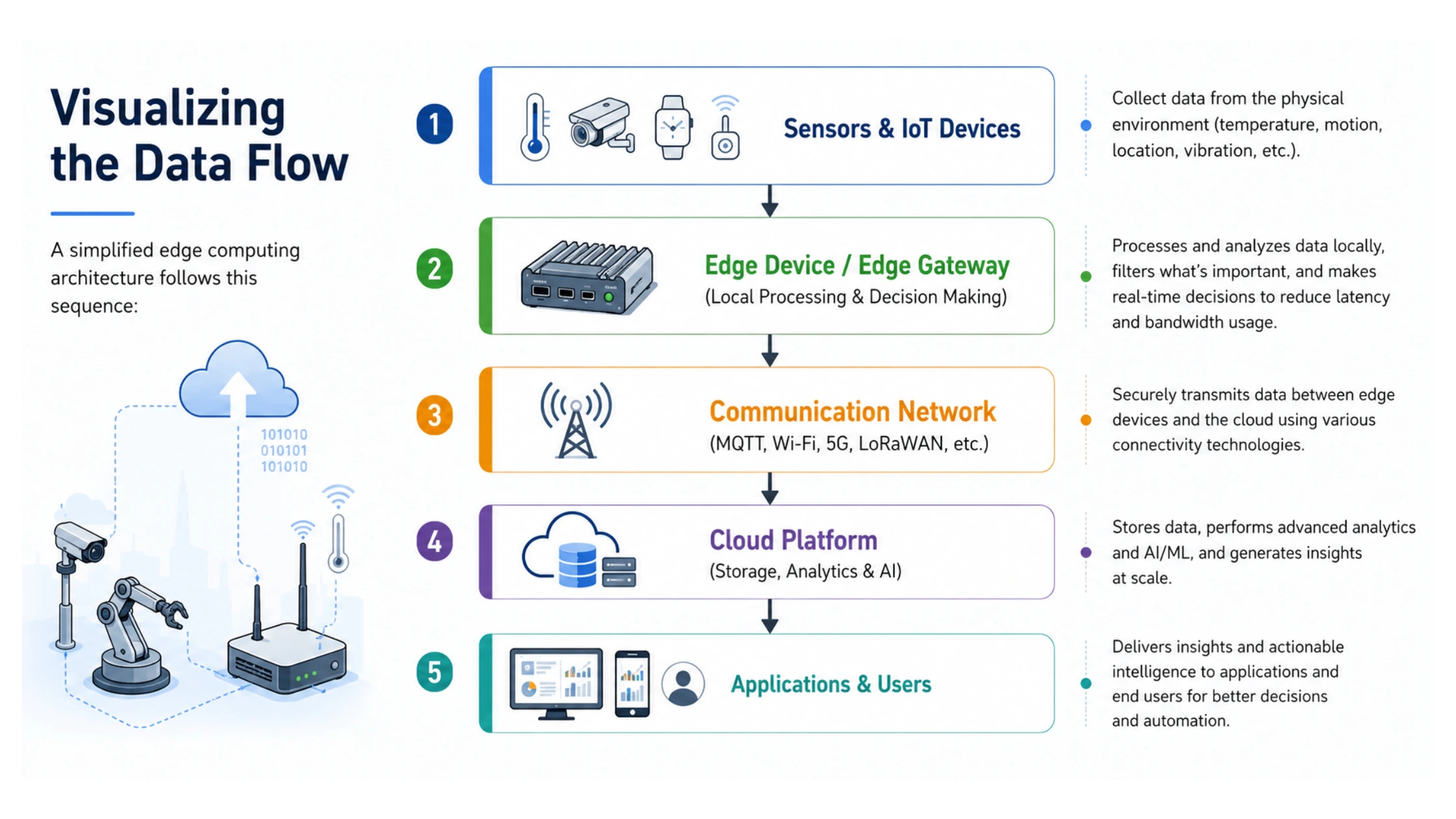
Each layer has a specific role, but together they create an efficient architecture capable of supporting real-time decision-making while maintaining the scalability and analytical power of cloud computing.
The communication layer relies on messaging and networking technologies that allow IoT devices to exchange data efficiently. One of the most widely used messaging protocols is MQTT, which enables lightweight communication between devices and cloud platforms.
Benefits of Edge Computing in IoT
Edge computing has become a fundamental part of modern IoT systems because it addresses many of the limitations of cloud-only architectures. By processing data closer to connected devices, organizations can improve system performance, reduce operational costs, and enable applications that require immediate responses. While the exact benefits vary depending on the deployment, several advantages apply across nearly every IoT environment.
1. Faster Response Times
One of the primary benefits of edge computing is its ability to process data almost instantly. Since information is analyzed near the source rather than traveling to a distant cloud server, devices can react much more quickly.
This low-latency processing is essential for applications where delays could affect safety, productivity, or user experience. Examples include autonomous vehicles, industrial automation, medical monitoring systems, and smart traffic management, where decisions often need to be made within milliseconds.
2. Reduced Network Latency
Every time data travels across the internet, it experiences some level of delay. In traditional cloud-based IoT systems, this latency increases as the distance between devices and cloud servers grows.
Edge computing minimizes this delay by keeping processing local. Instead of sending every sensor reading to the cloud, edge devices analyze the data immediately and only transmit important information when necessary. As a result, IoT systems become more responsive and reliable.
3. Lower Bandwidth Consumption
IoT devices generate enormous volumes of data every day. Continuously transmitting raw sensor data to cloud platforms consumes significant network bandwidth and increases communication costs.
Edge computing helps solve this problem by filtering and processing data locally. Only relevant events, summaries, or processed results are sent to the cloud, dramatically reducing unnecessary network traffic.
This is particularly valuable in environments with thousands of connected devices, such as manufacturing plants, smart cities, and large commercial buildings.
4. Greater Reliability
Many IoT deployments operate in locations where internet connectivity cannot always be guaranteed. Remote industrial sites, agricultural fields, offshore facilities, and transportation systems may experience network interruptions.
Because edge computing performs critical processing locally, devices can continue operating even when cloud connectivity is temporarily unavailable. Once the connection is restored, important data can be synchronized with centralized systems without disrupting operations.
This makes IoT deployments more resilient and dependable.
5. Improved Privacy and Data Security
Not every piece of IoT data needs to leave the local network. Healthcare organizations, financial institutions, and industrial facilities often handle sensitive information that requires strict privacy protection.
Edge computing allows much of this data to be processed locally before transmission. By limiting the amount of sensitive information sent over public networks, organizations reduce their exposure to certain security and privacy risks.
Although edge devices must still be properly secured, local processing provides greater control over how data is handled and shared.
6. Better Scalability
As IoT ecosystems continue to grow, relying solely on centralized cloud infrastructure becomes increasingly challenging. More connected devices generate more data, placing greater demands on bandwidth, cloud storage, and computing resources.
Edge computing distributes workloads across multiple edge devices and gateways instead of concentrating everything in one location. This decentralized approach allows organizations to expand their IoT deployments more efficiently while maintaining consistent performance.
7. Lower Cloud Processing Costs
Cloud computing offers virtually unlimited storage and processing power, but these services often come with ongoing operational costs.
Since edge computing processes much of the data locally, organizations send significantly less information to cloud platforms. This reduces cloud storage requirements, lowers data transfer costs, and decreases the amount of cloud computing resources needed for routine processing.
For large-scale IoT deployments, these savings can become substantial over time.
8. Supports Artificial Intelligence at the Edge
Modern IoT systems increasingly rely on artificial intelligence (AI) and machine learning (ML) to automate decision-making. Running AI models directly on edge devices enables systems to recognize patterns and respond immediately without depending on cloud connectivity.
Examples include:
- Smart security cameras detecting unauthorized access in real time.
- Manufacturing equipment predicting mechanical failures before they occur.
- Healthcare devices continuously monitoring patients and issuing instant alerts.
- Autonomous robots navigating dynamic environments without waiting for cloud instructions.
This combination of edge computing and AI—often referred to as Edge AI—is becoming one of the most important developments in the future of IoT.
Summary of Key Benefits
| Benefit | How It Improves IoT Systems |
| Faster response times | Enables real-time decision-making |
| Lower latency | Reduces delays between devices and processing |
| Reduced bandwidth usage | Sends only relevant data to the cloud |
| Greater reliability | Continues operating during network interruptions |
| Improved privacy | Keeps sensitive data closer to its source |
| Better scalability | Supports growing numbers of connected devices |
| Lower cloud costs | Reduces storage and processing expenses |
| AI readiness | Enables intelligent decision-making at the edge |
Edge computing is not simply about moving computing closer to IoT devices. It fundamentally changes how connected systems process information by balancing local intelligence with cloud capabilities. As IoT deployments become larger and more complex, these advantages make edge computing an essential component of modern connected ecosystems.
Although edge computing processes data locally, cloud platforms remain essential for large-scale analytics and long-term storage.
Challenges of Edge Computing in IoT
While edge computing offers significant advantages for IoT systems, it also introduces new technical and operational challenges. Processing data closer to connected devices improves speed and efficiency, but it requires organizations to manage more distributed infrastructure, maintain additional hardware, and implement stronger security controls. Understanding these challenges is essential when designing scalable and reliable IoT deployments.
1. Increased Infrastructure Costs
Unlike cloud computing, where most processing occurs in centralized data centers, edge computing requires computing resources to be deployed across multiple locations. Organizations may need to invest in edge servers, gateways, embedded computers, and other specialized hardware.
For small IoT deployments, these additional infrastructure costs may be manageable. However, organizations operating thousands of connected devices across multiple sites must carefully plan hardware investments and maintenance expenses.
Although edge computing can reduce long-term cloud costs, the initial deployment often requires a higher upfront investment.
2. More Complex Device Management
A cloud-only architecture is relatively straightforward because applications and services are managed from a centralized platform. Edge computing distributes intelligence across many devices, making system management more complex.
Administrators must monitor and maintain:
- Edge gateways
- Edge servers
- IoT devices
- Firmware versions
- Software updates
- Configuration settings
As the number of edge devices grows, managing them efficiently becomes increasingly important to ensure consistent performance and security.
3. Security Risks at the Edge
Every connected edge device represents another potential entry point for cyberattacks. Unlike centralized cloud infrastructure, which is typically protected by dedicated security teams, edge devices are often deployed in remote or physically accessible locations.
Potential security risks include:
- Unauthorized physical access
- Malware infections
- Device tampering
- Weak authentication
- Outdated firmware
- Data interception
To reduce these risks, organizations should implement strong authentication, encrypt data both in transit and at rest, regularly update device software, and continuously monitor network activity.
Learn more: Explore our guide on IoT Security Challenges to understand the common threats affecting connected devices and edge infrastructure.
4. Limited Computing Resources
Edge devices are generally much smaller and less powerful than cloud servers. While they can process data quickly, they have limitations in terms of processing power, memory, and storage.
As a result, resource-intensive tasks such as large-scale data analytics, AI model training, or long-term data storage are still better suited for cloud platforms.
Successful IoT architectures divide workloads appropriately, allowing edge devices to handle real-time processing while the cloud manages computationally intensive operations.
5. Data Synchronization Challenges
Because data is processed across multiple locations, organizations must ensure that information remains synchronized between edge devices and cloud platforms.
Challenges may include:
- Duplicate data
- Version conflicts
- Delayed synchronization
- Temporary network outages
- Inconsistent records across systems
A well-designed synchronization strategy is essential to maintain accurate and reliable data throughout the IoT ecosystem.
6. Scalability and Maintenance
As IoT deployments expand, maintaining hundreds or thousands of distributed edge devices becomes increasingly complex.
Organizations must plan for:
- Hardware replacement
- Remote monitoring
- Device provisioning
- Software deployment
- Performance optimization
- Fault detection
Without centralized management tools, maintaining large-scale edge infrastructures can quickly become resource-intensive.
7. Compatibility and Integration
IoT ecosystems often include devices from multiple manufacturers that use different hardware platforms, operating systems, and communication protocols.
Integrating these diverse technologies into a unified edge computing environment can present challenges related to interoperability and compatibility. Organizations frequently need middleware, standardized communication protocols, or custom software to ensure devices can communicate effectively.
Balancing Challenges with Benefits
Although these challenges require careful planning, they rarely outweigh the advantages of edge computing. Instead of replacing cloud computing, most modern IoT deployments adopt a hybrid architecture, where edge devices handle real-time processing while cloud platforms provide centralized storage, large-scale analytics, and long-term management.
By selecting appropriate hardware, implementing strong security practices, and designing scalable architectures, organizations can overcome these challenges while maximizing the performance and reliability of their IoT systems.
Edge Computing vs Cloud Computing in IoT
Edge computing and cloud computing are often viewed as competing technologies, but in reality, they are designed to work together. Both play essential roles in modern IoT systems, yet they solve different problems. Edge computing focuses on processing data close to IoT devices for real-time decision-making, while cloud computing provides centralized storage, large-scale analytics, and virtually unlimited computing resources.
Understanding the differences between these two approaches helps organizations choose the right architecture for their IoT deployments.
What Is the Main Difference?
The primary difference lies in where data is processed.
With edge computing, data is analyzed locally on an edge device, gateway, or nearby server before any necessary information is sent to the cloud.
With cloud computing, IoT devices transmit data over the internet to centralized cloud servers, where processing, storage, and analysis take place.
This distinction directly affects speed, bandwidth usage, reliability, scalability, and application performance.
Edge Computing vs Cloud Computing Comparison
| Feature | Edge Computing | Cloud Computing |
| Data Processing | Near the IoT device | Centralized data centers |
| Response Time | Very fast (milliseconds) | Higher latency |
| Internet Dependency | Can operate with limited connectivity | Requires reliable internet access |
| Bandwidth Usage | Lower, since only processed data is transmitted | Higher, because more raw data is uploaded |
| Data Storage | Limited local storage | Virtually unlimited storage |
| Computing Power | Limited by edge hardware | Highly scalable computing resources |
| Real-Time Processing | Excellent | Less suitable for time-critical applications |
| Deployment Cost | Higher initial hardware investment | Lower hardware cost but ongoing cloud expenses |
| Best Use Cases | Real-time automation, autonomous systems, industrial control | Big data analytics, reporting, AI model training, long-term storage |
When Is Edge Computing the Better Choice?
Edge computing is the preferred solution when applications require immediate responses or must continue operating even if internet connectivity is interrupted.
Common scenarios include:
- Autonomous vehicles making split-second driving decisions.
- Industrial equipment detecting faults before failures occur.
- Smart surveillance systems recognizing suspicious activity in real time.
- Healthcare devices continuously monitoring patient conditions.
- Smart manufacturing systems controlling robotic equipment.
In these situations, sending every piece of data to a cloud server would introduce unnecessary delays that could reduce performance or create safety risks.
When Is Cloud Computing the Better Choice?
Cloud computing remains the best option for tasks that require extensive computing resources, centralized management, or long-term data analysis.
Typical cloud workloads include:
- Historical data storage
- Business reporting
- Machine learning model training
- Predictive analytics
- Device fleet management
- Software updates
- Backup and disaster recovery
Because cloud platforms can process enormous volumes of information from thousands of connected devices, they are well suited for organization-wide analysis and strategic decision-making.
Why Modern IoT Systems Use Both
Most real-world IoT deployments do not choose between edge computing and cloud computing—they combine them.
A hybrid architecture allows each technology to perform the tasks it handles best.
For example, in a smart factory:
- Sensors continuously monitor machine performance.
- An edge gateway immediately detects abnormal vibration and stops a machine to prevent damage.
- Processed data is then uploaded to the cloud.
- Cloud platforms analyze long-term trends across multiple factories.
- Machine learning models are trained in the cloud and later deployed back to edge devices.
This approach delivers both real-time responsiveness and powerful centralized analytics, creating a more efficient and scalable IoT ecosystem.
Which One Should You Choose?
The answer depends on your application’s requirements.
Choose edge computing if your IoT system requires:
- Instant decision-making
- Low latency
- Reliable operation during network outages
- Reduced bandwidth usage
- Local processing of sensitive data
Choose cloud computing if your priority is:
- Large-scale data storage
- Advanced analytics
- AI model training
- Centralized device management
- Long-term reporting
For most organizations, the most effective solution is not choosing one over the other but combining both within a hybrid architecture that balances speed, scalability, and intelligence.
Real-World Applications of Edge Computing in IoT
Edge computing delivers the greatest value when IoT systems must process data quickly, reduce network dependency, or make autonomous decisions. Across industries, organizations use edge computing to analyze information locally, allowing connected devices to respond in real time while reducing the amount of data transmitted to cloud platforms. These capabilities make edge computing a critical component of modern IoT deployments.
Smart Manufacturing and Industrial IoT
Manufacturing is one of the largest adopters of edge computing. Modern production facilities rely on thousands of connected sensors to monitor machine health, production quality, energy consumption, and equipment performance.
Instead of continuously sending raw sensor data to cloud servers, edge gateways process information locally to detect abnormal conditions such as overheating, excessive vibration, or unexpected pressure changes. If a problem is identified, the system can immediately alert operators or automatically stop machinery to prevent equipment damage and production downtime.
This approach enables predictive maintenance, improves operational efficiency, and reduces maintenance costs while supporting continuous industrial operations.
Smart Homes
Smart home ecosystems generate a constant stream of data from security cameras, thermostats, smart locks, lighting systems, voice assistants, and connected appliances.
With edge computing, many routine decisions are made directly within the home rather than relying on cloud services. For example, a smart security camera can recognize motion locally and send an alert only when unusual activity is detected. Likewise, a smart thermostat can adjust indoor temperatures based on occupancy patterns without requiring every sensor reading to be processed remotely.
Local processing improves response times while enhancing user privacy by keeping much of the data within the home network.
Healthcare and Remote Patient Monitoring
Healthcare IoT devices continuously monitor patients by collecting information such as heart rate, blood pressure, oxygen saturation, glucose levels, and body temperature.
Edge computing enables these devices to analyze patient data in real time and immediately notify healthcare providers if dangerous conditions are detected. This rapid response is particularly important for wearable medical devices and remote patient monitoring systems where delays could affect patient safety.
By processing sensitive health information locally before transmitting selected data to secure cloud systems, healthcare organizations can also strengthen data privacy and reduce network usage.
Smart Cities
Cities deploy thousands of connected devices to improve transportation, energy management, environmental monitoring, and public safety.
Edge computing allows traffic cameras, parking sensors, environmental monitors, and surveillance systems to process information locally. Traffic signals can adjust based on current congestion, street lighting can respond to pedestrian activity, and environmental sensors can immediately report hazardous conditions.
Because decisions occur close to the source of the data, smart city infrastructure becomes more responsive while reducing the volume of information sent to centralized data centers.
Autonomous Vehicles
Connected and autonomous vehicles rely on cameras, radar, LiDAR, GPS, and numerous onboard sensors to understand their surroundings.
These systems cannot depend solely on cloud computing because every driving decision must occur within milliseconds. Edge computing processes sensor data directly inside the vehicle, allowing it to recognize obstacles, maintain lane positioning, detect pedestrians, and apply emergency braking almost instantly.
Cloud platforms still play an important role by collecting historical driving data, improving navigation systems, and training artificial intelligence models, but the vehicle’s immediate decisions are made at the edge.
Smart Agriculture
Agricultural IoT systems use sensors to monitor soil moisture, weather conditions, crop health, irrigation systems, and livestock.
With edge computing, irrigation controllers can immediately activate watering systems when soil moisture falls below a predefined threshold. Farmers receive timely alerts about equipment failures or changing environmental conditions without waiting for cloud-based analysis.
This localized processing improves resource efficiency while helping farmers respond more quickly to changing field conditions.
Retail and Inventory Management
Retail businesses increasingly use IoT devices to monitor inventory, track customer movement, and optimize store operations.
Edge computing allows smart shelves, inventory sensors, and checkout systems to process information locally, providing faster inventory updates and reducing delays during customer transactions. Retailers can also analyze in-store activity in real time while minimizing the amount of video and sensor data sent to cloud servers.
Energy and Utilities
Utility companies use connected sensors to monitor electrical grids, renewable energy systems, water distribution networks, and gas pipelines.
Edge computing enables rapid fault detection and automated responses when abnormal conditions occur. For example, an edge device can isolate a damaged section of the electrical grid before a localized fault spreads to a wider area, improving service reliability and reducing outage durations.
Why These Applications Benefit from Edge Computing
Although these industries differ significantly, they all share common requirements:
- Fast decision-making
- Continuous system availability
- Reduced network latency
- Lower bandwidth usage
- Improved privacy
- Reliable operation in distributed environments
Edge computing addresses these needs by bringing computing resources closer to connected devices, making IoT systems more responsive, scalable, and efficient.
FAQs
Does Edge Computing Replace Cloud Computing?
No. Edge computing does not replace cloud computing; it complements it. Edge devices handle tasks that require low latency and real-time decision-making, while cloud platforms provide centralized storage, large-scale analytics, machine learning model training, and long-term data management. Most modern IoT deployments use a hybrid architecture that combines the strengths of both technologies.
What Is an Edge Device in IoT?
An edge device is any hardware that processes data near where it is generated instead of sending all information to the cloud. Examples include IoT gateways, industrial controllers, smart cameras, embedded computers, and intelligent sensors. These devices analyze local data, execute automated actions, and transmit only relevant information to cloud platforms when needed.
What Is the Difference Between an Edge Device and an IoT Gateway?
Although the terms are sometimes used interchangeably, they are not exactly the same.
An edge device performs local computing and data processing. An IoT gateway connects multiple IoT devices to a network while often performing edge computing tasks such as filtering, protocol translation, and local analytics. Many modern IoT gateways also function as edge devices because they combine communication and processing capabilities in a single system.
Is Edge Computing Faster Than Cloud Computing?
Yes. For real-time processing, edge computing is significantly faster because data is analyzed close to its source instead of traveling to a remote cloud data center. This reduces latency and allows IoT systems to respond within milliseconds, making edge computing ideal for applications such as autonomous vehicles, industrial automation, healthcare monitoring, and smart manufacturing.
Is Edge Computing More Secure?
Edge computing can improve data privacy by keeping sensitive information closer to where it is generated, reducing the amount of data transmitted across public networks. However, edge devices must still be protected against cyber threats through encryption, strong authentication, secure firmware updates, and continuous monitoring. The overall security of an IoT system depends on how well both edge and cloud components are secured.
Which Industries Benefit Most from Edge Computing?
Many industries use edge computing to improve performance and reliability, including:
- Manufacturing and Industrial IoT
- Smart Cities
- Healthcare
- Transportation
- Agriculture
- Retail
- Energy and Utilities
- Logistics and Supply Chain
Any environment that requires fast decision-making or generates large volumes of sensor data can benefit from processing information closer to connected devices.
Can Edge Computing Work Without the Internet?
Yes. One of the major advantages of edge computing is that it can continue processing data locally even when internet connectivity is unavailable. Devices can monitor conditions, execute automated actions, and store information until communication with cloud services is restored. This makes edge computing particularly valuable in remote locations and mission-critical environments.
What Is the Future of Edge Computing in IoT?
As IoT networks continue to expand, edge computing will become even more important. The growth of 5G, Edge AI, Industrial IoT (IIoT), autonomous systems, and real-time analytics is driving greater demand for local processing capabilities. Future IoT deployments will increasingly rely on hybrid architectures where edge devices and cloud platforms work together to deliver faster, more intelligent, and more scalable connected systems.
Key Takeaways
- Edge computing processes IoT data close to where it is generated, reducing latency and enabling real-time decision-making.
- It complements cloud computing rather than replacing it, creating a hybrid architecture that balances speed, scalability, and centralized analytics.
- Key benefits include faster response times, lower bandwidth usage, improved reliability, enhanced privacy, and better support for AI-powered applications.
- Common use cases include smart manufacturing, healthcare, autonomous vehicles, smart homes, agriculture, and smart cities.
- While edge computing introduces challenges such as device management and security, proper planning and infrastructure design help organizations maximize its advantages.
- As IoT ecosystems continue to grow, edge computing will play an increasingly important role in supporting intelligent, responsive, and scalable connected environments.
Conclusion
Edge computing has become a foundational technology for modern IoT systems by bringing computing power closer to connected devices. Instead of relying solely on centralized cloud servers, organizations can process data where it is generated, enabling faster decisions, reducing network congestion, improving reliability, and supporting applications that demand real-time performance.
The most effective IoT deployments do not choose between edge computing and cloud computing. Instead, they combine both approaches to create intelligent, scalable architectures that deliver immediate local responses while leveraging the cloud for long-term storage, advanced analytics, and artificial intelligence.
As technologies such as 5G, Edge AI, and Industrial IoT continue to evolve, edge computing will play an even greater role in enabling smarter, more autonomous systems across industries. Understanding how edge computing fits into the broader IoT ecosystem provides the foundation for designing connected solutions that are faster, more efficient, and ready for the future.




- Be Respectful
- Stay Relevant
- Stay Positive
- True Feedback
- Encourage Discussion
- Avoid Spamming
- No Fake News
- Don't Copy-Paste
- No Personal Attacks
- Be Respectful
- Stay Relevant
- Stay Positive
- True Feedback
- Encourage Discussion
- Avoid Spamming
- No Fake News
- Don't Copy-Paste
- No Personal Attacks
