What Is LPWAN in IoT? How It Works, Types & Applications
Published: 16 Aug 2026
IoT devices are often deployed in locations where traditional wireless networks are not the best option. A smart water meter, agricultural sensor, asset tracker, or environmental monitoring device may need to send small amounts of data over several kilometers while operating on a battery for years. Wi-Fi and Bluetooth usually offer shorter ranges, while conventional cellular networks can consume more power and increase connectivity costs.
This is where Low-Power Wide-Area Networks (LPWANs) play an important role in the Internet of Things. LPWAN technology is designed to connect large numbers of IoT devices over long distances while using very little energy. Instead of supporting high-bandwidth activities such as video streaming, LPWAN networks are optimized for devices that transmit small amounts of data periodically.
Technologies such as LoRaWAN, NB-IoT, LTE-M, and Sigfox use different approaches to provide long-range IoT connectivity. They are used in applications such as smart cities, agriculture, industrial IoT, asset tracking, smart metering, and environmental monitoring.
In this guide, you will learn what LPWAN is in IoT, how LPWAN works, its key characteristics, major LPWAN technologies, network architecture, advantages, limitations, and real-world applications.
Quick Answer
LPWAN, or Low-Power Wide-Area Network, is a wireless communication technology designed to connect IoT devices over long distances while using very little power. It is ideal for devices that send small amounts of data, such as sensors, smart meters, asset trackers, and environmental monitoring systems. Common LPWAN technologies include LoRaWAN, NB-IoT, LTE-M, and Sigfox.
Table of Contents
What Is LPWAN in IoT?
LPWAN stands for Low-Power Wide-Area Network. In IoT, it refers to a type of wireless network designed to connect devices over long distances while consuming very little power.
LPWAN is mainly used by IoT devices that do not need to send large amounts of data continuously. Instead, devices such as sensors, smart meters, trackers, and monitoring systems can transmit small amounts of information periodically while operating on batteries for years.
The main purpose of LPWAN technology is to balance long-range coverage, low energy consumption, and cost-efficient connectivity. Depending on the technology and deployment environment, an LPWAN network can connect devices across buildings, cities, rural areas, and other large geographic locations.
Common LPWAN technologies include LoRaWAN, NB-IoT, LTE-M, and Sigfox. Although they use different network technologies and communication methods, they are designed to support IoT applications where long range and low power consumption are more important than high data speeds.
In simple terms, LPWAN provides the wireless connectivity layer that allows many low-power IoT devices to communicate over a wide area without requiring frequent battery replacement or high-bandwidth network connections.
How Does LPWAN Work?
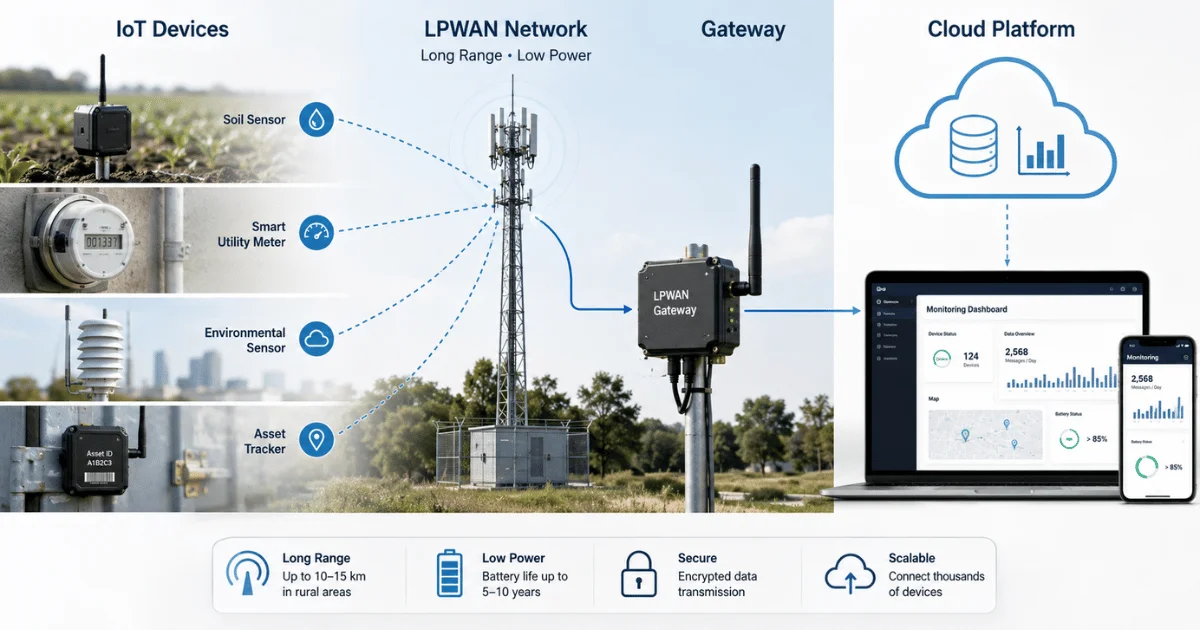
LPWAN enables IoT devices to send small amounts of data over long distances using wireless communication. Instead of maintaining a continuous, high-bandwidth connection, an IoT device typically transmits data only when needed or at scheduled intervals.
A typical LPWAN communication process involves several components:
- IoT Device or Sensor: The device collects information from its environment, such as temperature, location, water level, or energy usage.
- LPWAN Connectivity: The device sends this data through an LPWAN technology, such as LoRaWAN, NB-IoT, LTE-M, or Sigfox. These networks are designed to transmit small data packets while minimizing power consumption.
- Gateway or Base Station: Depending on the LPWAN technology, the transmitted data is received by a gateway, base station, or cellular network infrastructure.
- Network Server: The network processes, manages, and routes the data from connected IoT devices.
- Cloud Platform or Application: The data is then delivered to an IoT platform or application, where it can be analyzed, displayed, or used to trigger an action.
This process allows IoT devices to remain in low-power modes for most of the time and activate their communication components only when data needs to be transmitted. As a result, devices can operate for long periods without frequent battery replacement.
For a broader explanation of how connected devices collect, transmit, and process information, see our guide on how an IoT system works.
Key Characteristics of LPWAN
LPWAN is designed for IoT applications where devices need to communicate across a wide area without consuming large amounts of power. Its characteristics make it different from short-range networks such as Wi-Fi and Bluetooth or high-bandwidth cellular connections.
Long-Range Coverage
One of the main characteristics of LPWAN is its ability to connect IoT devices across long distances. Depending on the technology, network infrastructure, and environment, LPWAN can provide coverage across urban areas, rural locations, industrial sites, and other large geographic areas.
Low Power Consumption
LPWAN devices are designed to use very little energy during communication. Many devices remain in a low-power or sleep mode and activate only when they need to send or receive data. This makes LPWAN suitable for battery-powered IoT devices.
Long Battery Life
Because LPWAN communication requires relatively little power, compatible IoT devices can operate for years without frequent battery replacement. Actual battery life depends on factors such as transmission frequency, data size, device configuration, and network technology.
Low Data Rates
LPWAN is designed primarily for transmitting small amounts of data rather than high-bandwidth content. It is well suited for information such as sensor readings, location updates, meter data, and device status messages.
Cost-Efficient Connectivity
LPWAN can provide connectivity for large numbers of IoT devices without requiring expensive, high-bandwidth connections for every device. This makes it useful for large-scale deployments such as smart metering, agriculture, asset tracking, and environmental monitoring.
Support for Large IoT Deployments
LPWAN networks can connect a large number of low-power devices across a wide area. This capability is especially important for IoT environments where hundreds or thousands of sensors and connected devices need to communicate with a central network or application.
Together, these characteristics make LPWAN a practical connectivity option for IoT systems where range, battery life, scalability, and low power consumption are more important than high data speeds.
LPWAN Technologies and Protocols
LPWAN is not a single technology. It is a category of wireless communication technologies designed to support long-range, low-power IoT connectivity. Different LPWAN technologies use different network architectures, spectrum, communication methods, and deployment models.
The most widely recognized LPWAN technologies include LoRaWAN, NB-IoT, LTE-M, and Sigfox. Each is designed for IoT devices that transmit relatively small amounts of data, but they differ in areas such as coverage, data rate, power consumption, cost, and network availability.
LoRaWAN
LoRaWAN is an LPWAN communication protocol commonly used for connecting battery-powered IoT devices over long distances. It is widely used in smart cities, agriculture, environmental monitoring, and asset tracking. LoRaWAN networks typically use gateways to receive data from IoT devices and forward it to a network server.
For a deeper explanation of its architecture and communication process, see our guide on what LoRaWAN is and how it works.
NB-IoT
NB-IoT, or Narrowband IoT, is a cellular LPWAN technology designed for devices that require wide-area coverage and low power consumption. It uses licensed cellular spectrum and is commonly used for smart meters, utility monitoring, and other stationary IoT devices that send small amounts of data.
LTE-M
LTE-M, also known as LTE Cat-M, is another cellular IoT technology designed for low-power connected devices. Compared with NB-IoT, LTE-M can support higher data rates and mobility, making it suitable for applications such as asset tracking, wearable devices, and mobile IoT systems.
Sigfox
Sigfox is an LPWAN technology designed for devices that transmit small and infrequent data messages. It focuses on low-power communication and wide-area connectivity, making it suitable for applications such as asset tracking, environmental monitoring, and utility management.
Although these technologies share the goal of providing long-range, low-power IoT connectivity, the best option depends on factors such as device requirements, data transmission needs, coverage availability, mobility, battery life, and deployment cost.
LPWAN Network Architecture
An LPWAN network connects IoT devices with applications that collect, process, and use their data. While the exact architecture varies between technologies such as LoRaWAN, NB-IoT, LTE-M, and Sigfox, a typical LPWAN system includes several core components.
IoT Devices and Sensors
The process begins with IoT devices that collect or generate data. These devices may include environmental sensors, smart meters, asset trackers, agricultural sensors, or industrial monitoring equipment. They typically transmit small amounts of information at scheduled intervals or when a specific event occurs.
Gateways or Base Stations
The transmitted data is received by a gateway, base station, or cellular network infrastructure. The exact component depends on the LPWAN technology being used. For example, LoRaWAN commonly uses gateways, while cellular LPWAN technologies such as NB-IoT and LTE-M rely on existing cellular infrastructure.
LPWAN Network
The LPWAN network provides the communication layer between connected devices and the systems that manage their data. Its main role is to support long-range communication while keeping power consumption and connectivity requirements low.
Network Server
A network server manages communication between devices and applications. It can authenticate devices, process incoming messages, manage network traffic, and route data to the appropriate platform or application.
Cloud Platform or IoT Application
After the data reaches the network infrastructure, it can be sent to a cloud platform or IoT application. Here, the information can be stored, analyzed, visualized, or used to trigger alerts and automated actions.
Together, these components create a communication path from the physical environment to a digital application. This structure is part of the broader IoT architecture and its layers, where devices, connectivity, data processing, and applications work together to form a complete IoT system.
Advantages of LPWAN
LPWAN offers several advantages for IoT applications that require long-range communication without high power consumption or large amounts of data transmission.
Extended Communication Range
LPWAN can connect IoT devices across large geographic areas. This makes it useful for deployments where devices are distributed across cities, farms, industrial facilities, or remote locations.
Low Power Consumption
LPWAN devices are designed to use minimal energy for communication. Many devices can remain in sleep mode between transmissions, which helps reduce overall power consumption.
Longer Battery Life
Low power requirements can allow battery-operated IoT devices to function for years, depending on factors such as message frequency, payload size, network conditions, and device configuration.
Lower Connectivity Costs
Because LPWAN is designed for small and infrequent data transmissions, it can provide a more cost-efficient connectivity option than networks built for continuous, high-bandwidth communication.
Wide-Area IoT Scalability
LPWAN supports deployments involving large numbers of connected devices. This makes it suitable for applications such as smart metering, environmental monitoring, asset tracking, and IoT applications in smart cities, where many distributed devices need to communicate with a central system.
Suitable for Remote Locations
LPWAN can connect devices located far from traditional network infrastructure. This makes it particularly valuable for agricultural fields, utility infrastructure, environmental monitoring stations, and other remote IoT deployments.
Overall, LPWAN is most beneficial when an IoT system prioritizes long range, low energy consumption, long battery life, scalability, and cost-efficient communication rather than high-speed data transmission.
Limitations of LPWAN
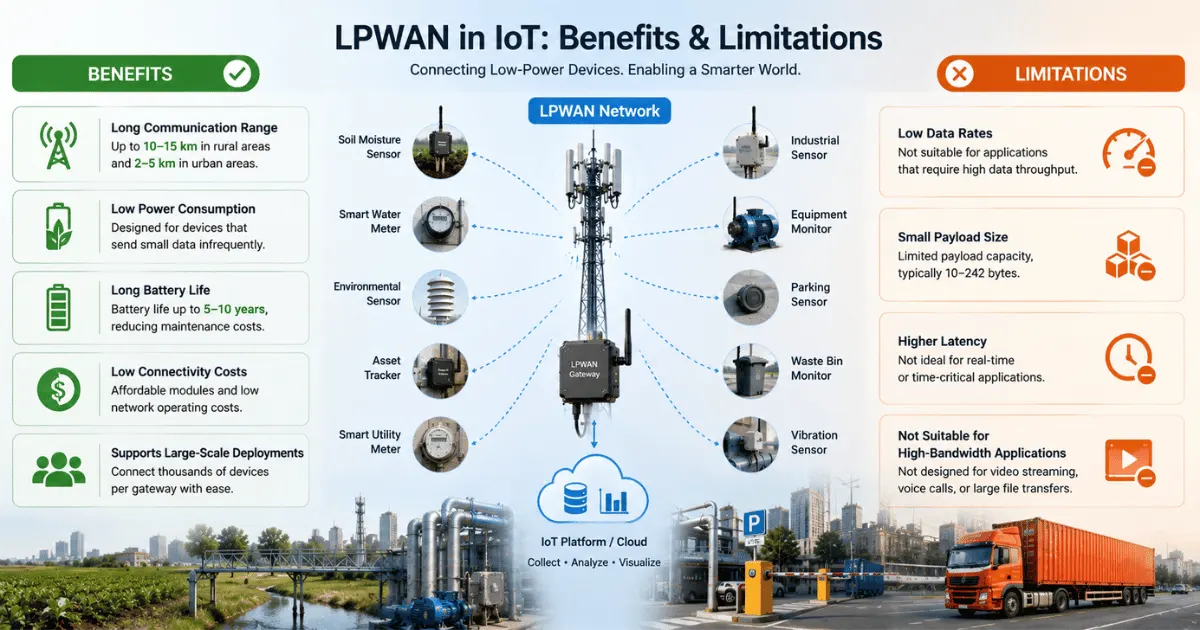
Although LPWAN is well suited for many IoT applications, it is not the right connectivity option for every device or use case. Its focus on long range and low power consumption also creates several limitations.
Limited Data Rates
LPWAN is designed for transmitting small amounts of data. It is not suitable for applications that require continuous high-speed communication, such as video streaming, high-resolution image transmission, or large file transfers.
Higher Transmission Latency
Some LPWAN technologies are optimized for infrequent communication rather than real-time data exchange. As a result, they may not be suitable for IoT applications that require immediate responses or extremely low latency.
Limited Payload Size
LPWAN devices typically send relatively small data packets. This works well for sensor readings, location updates, and device status messages but can limit applications that need to transmit larger amounts of information.
Coverage Depends on the Technology
LPWAN coverage is not the same everywhere. Technologies such as NB-IoT and LTE-M depend on cellular network availability, while LoRaWAN coverage may depend on the availability of gateways or privately deployed network infrastructure.
Not Ideal for High-Bandwidth Applications
LPWAN is built for efficiency rather than bandwidth. Applications that require frequent communication or large amounts of data may be better suited to other wireless technologies.
Technology-Specific Limitations
Each LPWAN technology has its own limitations related to network availability, mobility, data rates, deployment requirements, and communication capabilities. For this reason, selecting an LPWAN technology should depend on the specific requirements of the IoT application.
Overall, LPWAN works best when long range and low power consumption are more important than high data speeds, large payloads, and real-time communication.
LPWAN Applications and Use Cases
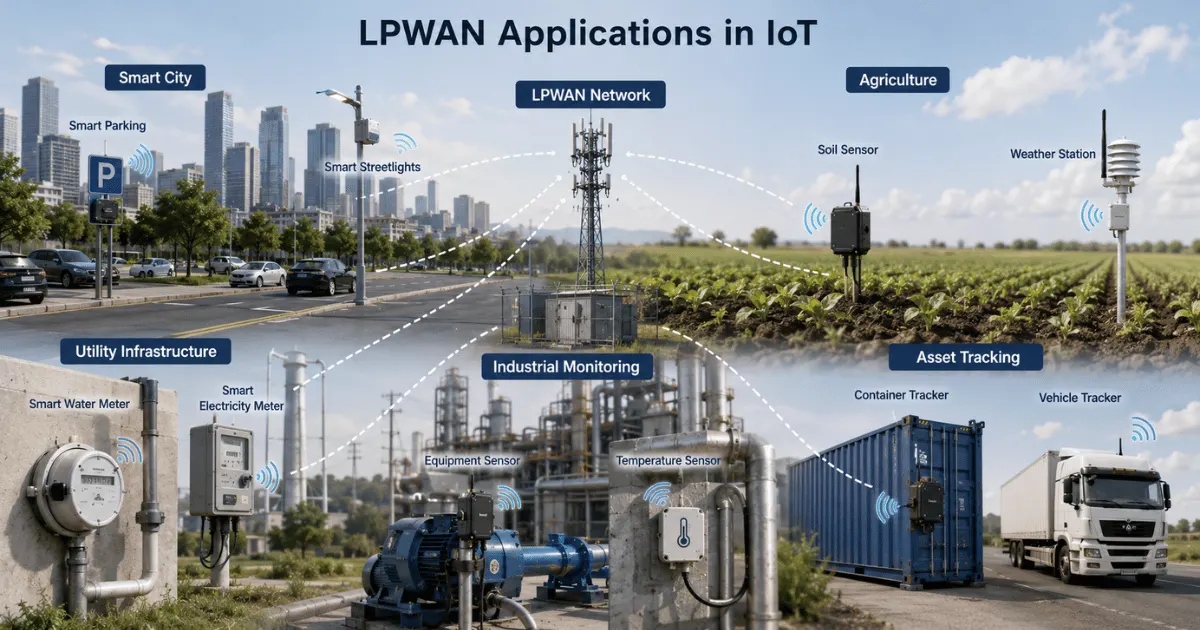
LPWAN is used in IoT environments where devices need to send small amounts of data over long distances while operating with limited power. Its characteristics make it suitable for distributed systems that may contain hundreds or thousands of connected devices.
Smart Cities
LPWAN can connect devices used for smart parking, street lighting, waste monitoring, environmental sensing, and utility management. These devices can transmit information to a central platform, helping city operators monitor infrastructure and improve services.
Smart Agriculture
In agriculture, LPWAN can connect sensors placed across farms and rural areas. These devices may monitor soil conditions, temperature, humidity, water levels, and other environmental factors. Long-range connectivity is particularly useful when Wi-Fi or traditional wired networks are unavailable.
Asset Tracking
LPWAN can support asset tracking systems that monitor the location or status of equipment, containers, vehicles, and other physical assets. Devices can send periodic updates while using minimal battery power.
Smart Metering
Utility companies can use LPWAN-connected meters to collect information about electricity, water, or gas usage. The data can be transmitted automatically to a central system, reducing the need for manual meter readings.
Environmental Monitoring
LPWAN supports environmental monitoring devices deployed across large or remote areas. These sensors can collect data related to air quality, temperature, weather conditions, water levels, and other environmental measurements.
Industrial IoT
Industrial environments can use LPWAN to connect distributed sensors and monitoring devices across factories, warehouses, and large operational sites. The technology can support equipment monitoring, asset tracking, and operational data collection. For a broader look at this area, see our guide on industrial IoT solutions.
Overall, LPWAN is most useful when IoT devices are widely distributed, battery-powered, and only need to transmit relatively small amounts of data.
Comparison of LPWAN Technologies
The major LPWAN technologies share the same general goal of providing long-range, low-power connectivity for IoT devices. However, they differ in network infrastructure, data capabilities, mobility, and typical applications.
| LPWAN Technology | Network Type | Data Capability | Mobility | Common Use Cases |
| LoRaWAN | Non-cellular | Low data rates | Limited to moderate | Smart cities, agriculture, environmental monitoring |
| NB-IoT | Cellular | Low data rates | Mainly stationary devices | Smart meters, utilities, building monitoring |
| LTE-M | Cellular | Higher than most LPWAN options | Supports mobility | Asset tracking, wearables, connected devices |
| Sigfox | Dedicated LPWAN network | Very small data messages | Limited | Asset tracking, monitoring, simple sensor systems |
How to Choose Between LPWAN Technologies
The right LPWAN technology depends on the requirements of the IoT system.
- LoRaWAN can be suitable when organizations need flexible deployment and long-range communication.
- NB-IoT is often suited to stationary devices that need reliable cellular connectivity.
- LTE-M can be a better option for applications requiring mobility and relatively higher data capabilities.
- Sigfox is designed for simple devices that send very small and infrequent messages.
Factors such as coverage availability, battery requirements, data transmission frequency, device mobility, infrastructure, and deployment cost should be considered before selecting an LPWAN technology.
LPWAN vs Other IoT Networks
LPWAN is only one option for connecting IoT devices. Other wireless technologies, such as Wi-Fi, Bluetooth, and cellular networks, serve different communication requirements.
| Technology | Range | Power Consumption | Data Rate | Best Suited For |
| LPWAN | Long | Very low | Low | Remote sensors, smart meters, asset tracking |
| Wi-Fi | Short to medium | High | High | Cameras, smart home devices, high-data applications |
| Bluetooth | Short | Low | Low to moderate | Wearables, nearby devices, personal IoT |
| Traditional Cellular | Wide area | Higher | High | Mobile devices, connected vehicles, high-data applications |
When Should You Use LPWAN?
LPWAN is a suitable option when IoT devices need to communicate over long distances while using minimal power. It is particularly useful for battery-powered devices that send small amounts of data periodically.
However, LPWAN may not be the best choice when an application requires high-speed communication, large data transfers, continuous connectivity, or extremely low latency. In these cases, Wi-Fi or cellular connectivity may be more appropriate.
The choice of network should depend on the specific requirements of the IoT system, including range, battery life, data volume, latency, mobility, and deployment cost.
For example, LPWAN provides the connectivity layer that allows distributed devices to communicate, while the broader IoT ecosystem includes the devices, networks, platforms, applications, and other components that work together in a complete IoT system.
LPWAN Security Challenges
Like other IoT communication technologies, LPWAN networks can face security risks. Because LPWAN devices may operate in remote locations and communicate over wireless networks, protecting devices, data, and network access is an important part of deployment.
Device Authentication
IoT devices should be properly authenticated before they are allowed to connect to the network. Authentication helps prevent unauthorized devices from sending data or gaining access to network resources.
Data Encryption
Sensitive data transmitted between IoT devices and network infrastructure should be protected from unauthorized access. Encryption helps secure data while it moves across the network.
Physical Device Security
Many LPWAN devices are deployed in public, remote, or difficult-to-monitor locations. This can increase the risk of physical tampering, theft, or unauthorized access to the device.
Network and Device Management
Large LPWAN deployments may involve hundreds or thousands of connected devices. Organizations need effective processes for monitoring devices, managing credentials, applying updates, and identifying unusual activity.
Technology-Specific Security Risks
Security capabilities can vary between LPWAN technologies and network implementations. For this reason, organizations should understand the security features and limitations of the specific technology they choose.
For a broader understanding of the risks involved in connected systems, see our guide on [IoT security challenges and solutions].
Overall, securing an LPWAN deployment requires protection across the device, communication, network, and management layers rather than relying on a single security measure.
The Future of LPWAN in IoT
LPWAN is expected to remain an important connectivity option as the number of connected IoT devices continues to grow. Its combination of long-range communication, low power consumption, and support for large-scale deployments makes it suitable for many future IoT systems.
Growth of Massive IoT Deployments
Future IoT deployments will involve increasing numbers of sensors and connected devices. LPWAN can support large-scale systems where devices transmit small amounts of information from widely distributed locations.
Integration With Edge Computing
LPWAN devices can work with edge computing systems to process data closer to where it is generated. This can reduce the amount of data sent to cloud platforms and improve the efficiency of IoT operations.
Smart Cities and Infrastructure
LPWAN is likely to continue supporting connected infrastructure, including smart meters, environmental sensors, parking systems, waste monitoring, and public infrastructure. As cities deploy more connected devices, long-range and low-power connectivity will remain important.
Industrial and Agricultural IoT
Industries and agricultural operations are increasingly using distributed sensors to monitor equipment, environmental conditions, and physical assets. LPWAN can provide connectivity in locations where traditional wired or high-bandwidth networks may be impractical.
Continued Development of LPWAN Technologies
Technologies such as LoRaWAN, NB-IoT, and LTE-M continue to evolve alongside broader IoT infrastructure. Improvements in network coverage, device efficiency, security, and integration with cloud and edge platforms may expand the range of LPWAN applications.
Overall, the future of LPWAN is closely connected to the growth of large-scale, low-power IoT deployments. Rather than replacing high-bandwidth networks, LPWAN will continue to serve applications where devices need reliable long-range communication while transmitting relatively small amounts of data.
Conclusion
LPWAN is a wireless communication technology designed for IoT devices that need to transmit small amounts of data over long distances while using minimal power. Its characteristics make it useful for applications such as smart cities, agriculture, asset tracking, smart metering, environmental monitoring, and industrial IoT.
Technologies such as LoRaWAN, NB-IoT, LTE-M, and Sigfox provide different approaches to low-power, wide-area connectivity. The right option depends on factors such as network coverage, battery life, data requirements, device mobility, and deployment costs.
LPWAN is not designed to replace high-speed technologies such as Wi-Fi or traditional cellular networks. Instead, it fills a specific role in the IoT ecosystem by connecting large numbers of distributed, often battery-powered devices that do not require high-bandwidth communication.
As IoT deployments continue to grow, LPWAN will remain an important connectivity solution for systems that prioritize long range, low power consumption, scalability, and cost-efficient communication.
FAQs About LPWAN
1. What does LPWAN stand for?
LPWAN stands for Low Power Wide Area Network. It describes wireless networking technologies designed to connect IoT devices over long distances while using very little power.
2. Is LoRaWAN the same as LPWAN?
No. LPWAN is a category of wireless networking technologies, while LoRaWAN is a specific LPWAN protocol. Other LPWAN technologies include NB-IoT, LTE-M, and Sigfox.
3. How far can an LPWAN network reach?
The range of an LPWAN network depends on the technology, environment, and network infrastructure. LPWAN can typically cover much larger areas than short-range technologies such as Bluetooth or Wi-Fi, especially in rural or open environments.
4. How long do LPWAN device batteries last?
LPWAN devices can often operate on batteries for several years. Actual battery life depends on factors such as transmission frequency, payload size, device configuration, network conditions, and battery capacity.
5. Does LPWAN require a gateway?
It depends on the technology. LoRaWAN commonly uses gateways to receive data from IoT devices, while cellular technologies such as NB-IoT and LTE-M use cellular network infrastructure.
6. Can LPWAN work in remote areas?
Yes, LPWAN can be useful in remote locations where devices are widely distributed and only need to transmit small amounts of data. However, coverage depends on the available network infrastructure or the ability to deploy private gateways.
7. What factors should you consider when choosing an LPWAN technology?
Important factors include network coverage, communication range, battery life, data requirements, device mobility, deployment cost, and infrastructure availability.
8. Is LPWAN suitable for large IoT deployments?
Yes. LPWAN is designed to support large numbers of connected devices, making it suitable for applications such as smart metering, agriculture, environmental monitoring, asset tracking, and smart city infrastructure.




- Be Respectful
- Stay Relevant
- Stay Positive
- True Feedback
- Encourage Discussion
- Avoid Spamming
- No Fake News
- Don't Copy-Paste
- No Personal Attacks
- Be Respectful
- Stay Relevant
- Stay Positive
- True Feedback
- Encourage Discussion
- Avoid Spamming
- No Fake News
- Don't Copy-Paste
- No Personal Attacks
