What Are Actuators in IoT? Types, Examples & How They Work
Published: 13 Aug 2026
IoT devices do more than collect data. They can also take action based on that data, and this is where actuators in IoT become important. An actuator is a device that receives a signal or command from an IoT system and converts it into a physical action, such as turning on a light, opening a valve, moving a motor, or adjusting a thermostat.
In a typical IoT system, sensors detect changes in the physical environment, while actuators respond to those changes. Together, sensors, controllers, networks, and actuators allow IoT devices to monitor conditions and automatically control physical systems.
In this guide, you’ll learn what an actuator is in IoT, how IoT actuators work, the different types of actuators, real-world examples, and how sensors and actuators work together.
An actuator in IoT is a device that converts a control signal from an IoT system into a physical action. It receives commands from a controller, gateway, or cloud platform and can perform actions such as moving a mechanism, opening a valve, switching a device, or adjusting temperature. Common IoT actuators include motors, relays, valves, pneumatic actuators, hydraulic actuators, and linear actuators.
Table of Contents
What Is an Actuator in IoT?
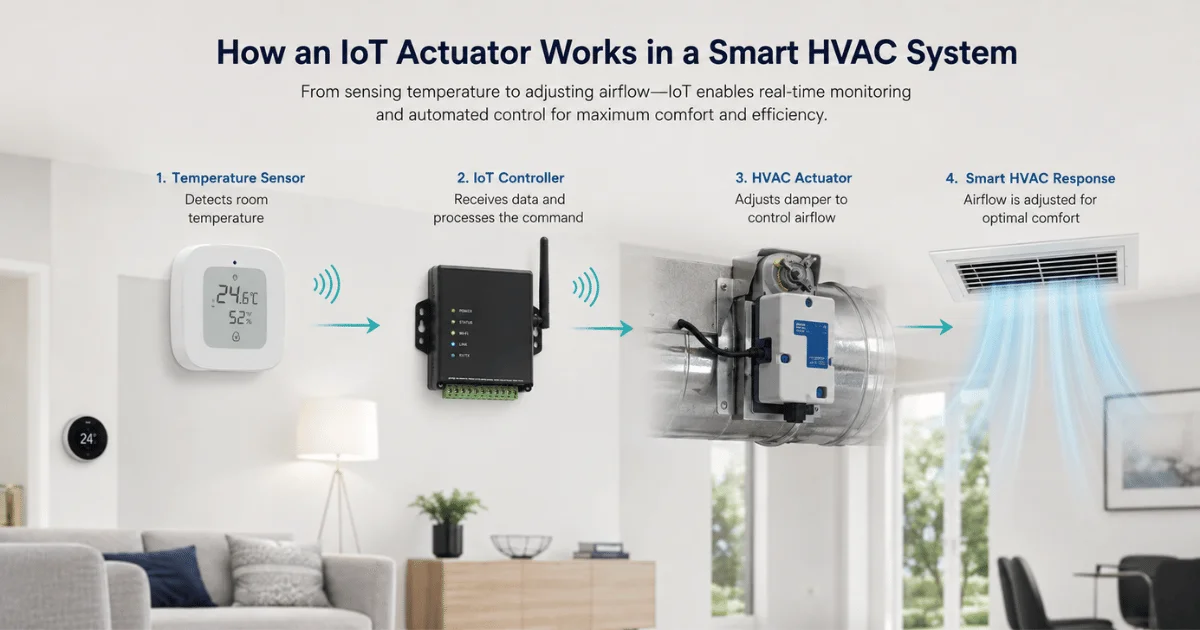
An actuator in IoT is a device that converts a control signal into a physical action. While an IoT sensor collects information from the physical environment, an actuator acts on that environment based on instructions from an IoT system.
For example, a temperature sensor can detect that a room is too hot. The IoT system processes that information and sends a command to an actuator. The actuator can then turn on an air conditioner, open a ventilation valve, or adjust a heating system.
This creates a simple IoT process:
Sensor → Data → Controller → Command → Actuator → Physical Action
Actuators are therefore an important part of IoT automation. They allow connected systems to do more than collect and monitor data. They enable devices and machines to respond automatically to changing conditions.
How Actuators Work in IoT
An IoT actuator typically receives commands from a controller, gateway, cloud platform, or local processing system. The command tells the actuator what action to perform.
For example, consider a smart irrigation system. A soil moisture sensor measures the moisture level in the soil. If the soil becomes too dry, the IoT system can send a command to a water valve actuator. The actuator opens the valve, allowing water to reach the crops.
The basic process looks like this:
- A sensor detects a physical condition.
- The IoT system collects the sensor data.
- A controller or software platform analyzes the data.
- A command is generated based on the programmed condition.
- The actuator receives the command.
- The actuator performs a physical action.
This relationship between sensing and action is what makes IoT systems useful for automation.
For a broader understanding of the devices involved in this process, see our guide to What Are IoT Devices? Types, Examples & How They Work.
Sensors and Actuators: What Is the Difference?
Sensors and actuators perform opposite but connected roles in an IoT system.
A sensor observes the physical world and converts conditions such as temperature, pressure, motion, light, humidity, or gas levels into data. An actuator receives a command and produces a physical response.
| Component | Main Role | Example |
| Sensor | Detects or measures a condition | Temperature sensor |
| Controller | Processes information and makes decisions | Microcontroller |
| Actuator | Performs a physical action | Motor or valve |
For example, a smart thermostat may use a temperature sensor to measure room temperature and an actuator to control the heating or cooling system.
In simple terms:
Sensors tell an IoT system what is happening. Actuators make something happen.
Both are important because an IoT system that only collects information cannot automatically respond to that information. Actuators provide the connection between digital decisions and physical actions.
Types of Actuators in IoT
IoT actuators can be grouped by how they convert electrical control signals into physical movement or action. The most common types include electrical, hydraulic, pneumatic, thermal, and mechanical actuators. The right type depends on the application, required force, movement, speed, and control method.
1. Electrical Actuators
Electrical actuators use electrical energy to create physical movement. They are widely used in IoT devices because they are relatively easy to control with microcontrollers and connected systems.
Examples include:
- DC motors for rotating fans, wheels, and pumps
- Servo motors for precise angular movement
- Stepper motors for controlled incremental movement
- Solenoid actuators for switching or locking mechanisms
For example, a smart ventilation system can use an electrical actuator to open or close an air damper based on temperature or air-quality data.
2. Hydraulic Actuators
Hydraulic actuators use pressurized fluid to produce movement. They are useful when an IoT system needs high force for heavy equipment or industrial machinery.
A connected industrial system can use sensors to monitor pressure, temperature, or machine conditions and then send commands to hydraulic actuators. This allows physical equipment to respond automatically to changing operating conditions.
Hydraulic actuators are commonly associated with industrial IoT, construction equipment, manufacturing machinery, and heavy automated systems.
3. Pneumatic Actuators
Pneumatic actuators use compressed air to create linear or rotary movement. They are common in industrial automation because they can provide fast and reliable movement.
For example, an IoT-enabled production line can use sensors to detect an object on a conveyor. The control system can then activate a pneumatic actuator to push, position, or sort the object.
Their main advantage is fast operation, while their limitations include the need for compressed-air infrastructure and appropriate pressure control.
4. Thermal Actuators
Thermal actuators respond to changes in temperature and convert thermal energy into physical movement. They can be useful in systems where temperature itself provides the control mechanism.
A simple example is a temperature-controlled valve. When the temperature reaches a specific level, the actuator can change the valve position to regulate airflow, water, or another fluid.
Thermal actuation can therefore support smart HVAC systems, temperature control, and automated environmental systems.
5. Mechanical Actuators
Mechanical actuators produce movement through mechanical mechanisms such as gears, screws, levers, or linkages. They are often combined with an electrical motor or another power source.
For example, a motor can rotate a screw mechanism that moves an object in a straight line. In an IoT system, a controller can determine when the movement should occur based on data received from sensors.
Mechanical actuators are useful when an IoT device needs controlled linear movement, positioning, opening, closing, or adjustment.
6. Linear and Rotary Actuators
Actuators can also be classified by the type of movement they produce.
Linear actuators move an object along a straight path. They can be used for automated doors, adjustable equipment, valves, and positioning systems.
Rotary actuators produce rotational movement. Motors and rotary mechanisms are commonly used to control fans, wheels, robotic components, and rotating valves.
The choice between linear and rotary actuation depends on the physical action required by the IoT application.
How the Types Differ
The main difference between actuator types is how they generate movement and what kind of application they are designed for. Electrical actuators are common in connected consumer and automation devices, while hydraulic and pneumatic actuators are more suitable for industrial environments where force or rapid movement is important.
In an IoT system, the actuator itself is only one part of the process. Sensors collect information, the controller or IoT platform processes that information, and the actuator performs the resulting physical action. This relationship between sensing and action is what allows IoT systems to interact with the physical world.
How Actuators Work in IoT
An IoT actuator works by turning a digital command into a physical action. The process usually begins when an IoT sensor detects a change in the environment, such as temperature, pressure, motion, light, or humidity. The collected data is then sent to a controller or IoT platform for processing.
If the system determines that an action is required, it sends a control signal to the actuator. The actuator receives this signal and activates a mechanical, electrical, pneumatic, or hydraulic mechanism to produce the required physical response.
For example, consider a smart irrigation system. A soil moisture sensor measures the moisture level in the soil. When the moisture falls below a predefined level, the IoT controller processes the sensor data and sends a command to an actuator connected to a water valve. The actuator opens the valve, allowing water to flow to the crops.
The basic IoT sensing and actuation process can be represented as:
Sensor → Controller/IoT Gateway → IoT Platform → Control Signal → Actuator → Physical Action
This creates a feedback loop between the physical environment and the digital system. Sensors provide information about what is happening, while actuators allow the IoT system to respond to that information.
The same principle is used in many IoT applications. A smart thermostat can activate a heating or cooling system, an industrial system can adjust a machine, and a smart building can control lighting or ventilation based on sensor readings.
The actuator therefore serves as the action layer of an IoT system, connecting digital decisions with changes in the physical world.
Examples of Actuators in IoT
IoT actuators are used whenever a connected system needs to turn a digital decision into a physical action. The actuator can control movement, flow, temperature, lighting, or other equipment based on commands from an IoT controller.
Smart HVAC Systems
In a smart HVAC system, sensors can monitor temperature, humidity, and air quality. When conditions change, actuators can adjust dampers, valves, fans, or other HVAC components.
For example, if a room becomes too warm, the IoT system can send a command to an actuator that adjusts an air damper or activates cooling equipment. This helps maintain the required indoor conditions without constant manual control.
Smart Irrigation
Smart irrigation systems use soil moisture sensors to determine when plants need water. When the moisture level falls below a set threshold, an IoT controller can activate a valve actuator.
The actuator opens the water valve, allowing irrigation to begin. Once enough water has been supplied, the system can send another command to close the valve.
Smart Door Locks
Smart locks use actuators to physically lock or unlock a door. When an authorized user sends a command through an app or access system, the IoT controller communicates with the lock’s actuator.
The actuator then moves the locking mechanism into the required position.
Smart Lighting
Connected lighting systems can use actuators or switching mechanisms to control lights. An IoT system can activate or deactivate lighting based on motion, time, occupancy, or ambient light data.
For example, a motion sensor can detect someone entering a room and trigger the system to switch on the lights.
Industrial Automation
Industrial IoT systems use actuators to control machinery and production processes. Motors, valves, pneumatic cylinders, and other actuators can perform actions based on data collected from industrial sensors.
For example, an automated production line can use sensors to detect the position of a product and then activate an actuator to move, sort, or position it.
Robotic Systems
Robots rely on actuators to create movement. Motors and other actuating mechanisms control robotic arms, wheels, joints, and grippers.
When an IoT or robotic control system sends a command, the actuator converts it into the required movement. This allows connected robots to respond to sensor data and perform tasks automatically.
These examples show that IoT actuators are not limited to one type of device. Their function depends on the physical action required, from opening a valve and moving a mechanism to controlling temperature or operating industrial equipment.
Sensors vs. Actuators in IoT
Sensors and actuators are two important components of an IoT system, but they perform different jobs. A sensor detects or measures a physical condition, while an actuator performs a physical action based on a command from the system.
For example, a temperature sensor can measure the temperature of a room. If the temperature becomes too high, the IoT system can send a command to an actuator that controls the air-conditioning system.
The main difference is:
| Sensors | Actuators |
| Detect physical conditions | Perform physical actions |
| Convert physical conditions into data | Convert control signals into actions |
| Provide input to the IoT system | Receive commands from the IoT system |
| Measure temperature, pressure, motion, etc. | Move, switch, open, close, or adjust equipment |
How They Work Together
Sensors and actuators often work as part of the same automated process. The sensor provides information, the controller processes it, and the actuator responds.
For example, in a smart greenhouse:
Soil moisture sensor → IoT controller → Decision → Water valve actuator → Irrigation
The sensor tells the system that the soil is dry. The controller evaluates the reading and sends a command to the actuator. The actuator opens the water valve, allowing the irrigation system to operate.
This relationship is important because an IoT system needs both sensing and actuation when it must monitor conditions and respond automatically.
A sensor by itself can tell you what is happening. An actuator allows the system to do something about it. Together, they help IoT systems create automated feedback loops across smart homes, agriculture, healthcare, manufacturing, transportation, and other applications.
For example, a smart HVAC system can use temperature and humidity sensors to monitor indoor conditions while actuators control valves, dampers, fans, or other equipment. The system can continuously adjust its operation as conditions change.
What Is the Role of Actuators in IoT?
The main role of an actuator in IoT is to turn digital decisions into physical actions. It allows an IoT system to respond to information collected by sensors instead of only monitoring conditions.
Actuators can perform several important functions:
- Control: Turn equipment, lights, motors, pumps, or other devices on or off.
- Movement: Move mechanical components in a straight or rotating motion.
- Flow control: Open or close valves to control water, air, gas, or other fluids.
- Temperature control: Adjust heating, cooling, or ventilation systems.
- Automation: Perform physical tasks automatically when specific conditions are detected.
- Process adjustment: Change machine settings or operating conditions based on real-time data.
For example, an industrial IoT system can monitor machine temperature with sensors. If the temperature becomes too high, the controller can send a command to an actuator that adjusts a cooling valve or activates a cooling mechanism.
This creates a continuous feedback process:
Monitor → Analyze → Decide → Act → Monitor Again
Actuators are especially important in industrial IoT, where connected systems need to respond to equipment conditions, production requirements, and safety limits. They can help automate machinery, control production processes, and reduce the need for manual intervention.
In smart buildings, actuators can control lighting, HVAC equipment, doors, and ventilation. In agriculture, they can operate irrigation valves and automated equipment. In smart homes, they can control locks, blinds, appliances, and other connected systems.
The actuator’s role therefore goes beyond simply moving a component. It provides the physical response that completes the IoT control loop, allowing connected systems to interact with and change the environment around them.
Benefits of Actuators in IoT
Actuators make IoT systems capable of responding to real-world conditions instead of only collecting and displaying data. When connected to sensors, controllers, and communication systems, they enable automated actions based on predefined rules or real-time information.
1. Automation
Actuators allow IoT systems to perform physical tasks automatically. A system can detect a condition, make a decision, and activate an actuator without requiring manual intervention.
For example, a smart irrigation system can automatically open a water valve when soil moisture becomes too low.
2. Real-Time Control
IoT actuators can respond quickly when a connected system detects a change. This is important in applications where equipment needs to be adjusted immediately.
Industrial machines, HVAC systems, smart lighting, and automated production lines can use actuators to respond to changing conditions in real time.
3. Improved Efficiency
Automated actuation can help equipment operate only when needed. This can reduce unnecessary energy, water, and resource consumption.
For example, smart building systems can adjust ventilation or lighting based on occupancy and environmental conditions.
4. Reduced Manual Work
Actuators can perform repetitive physical operations automatically. This reduces the need for people to continuously operate valves, switches, motors, or other mechanisms.
In industrial environments, automated actuators can handle repetitive tasks while operators focus on monitoring and higher-level decisions.
5. Better Process Control
Actuators allow IoT systems to make precise adjustments to physical processes. A connected system can continuously receive sensor data and modify equipment operation when conditions change.
This is particularly useful in manufacturing, agriculture, energy management, and building automation.
6. Support for Remote Operation
Connected actuators can allow users or systems to control equipment remotely. For example, a user could operate a smart lock, irrigation valve, or connected appliance through an IoT application.
This makes physical equipment accessible through connected digital systems without requiring someone to be physically present.
Overall, actuators provide the action component of IoT automation. They help transform sensor data and digital decisions into useful physical changes, making connected systems more responsive, efficient, and autonomous.
How Are IoT Actuators Controlled?
IoT actuators are controlled through commands generated by an IoT system. The command usually starts with sensor data, which is processed by a controller, gateway, or cloud platform. When a predefined condition is met, the system sends a control signal to the actuator.
A typical process looks like this:
Sensor → IoT Gateway/Controller → Processing → Control Command → Actuator → Physical Action
For example, in a smart irrigation system, a soil moisture sensor detects that the soil is too dry. The controller evaluates the reading against a predefined threshold. If irrigation is required, it sends a command to a valve actuator. The actuator opens the valve and allows water to flow.
Local Control
Some IoT systems control actuators locally through a microcontroller, PLC, or IoT gateway. This approach can provide fast responses because the command does not need to travel to a remote cloud server.
Local control is useful for applications where low latency or continuous operation is important, such as industrial automation and safety systems.
Cloud-Based Control
In cloud-based IoT systems, sensor data can be sent to a cloud platform for processing. The platform can apply rules or software logic and then send a command back to the connected device or actuator.
This approach can support remote monitoring and control across large deployments.
Rule-Based Control
Many IoT actuators operate according to predefined rules.
For example:
If temperature > set limit → Activate cooling actuator
If soil moisture < set level → Open irrigation valve
If motion is detected → Turn on connected light
These rules allow the system to respond automatically without requiring a person to issue every command.
Remote Control
Users can also control IoT actuators through mobile applications, dashboards, or other connected interfaces. A user might remotely unlock a smart door, operate an irrigation system, or adjust a connected HVAC system.
The exact control method depends on the IoT architecture, communication technology, actuator type, and application requirements.
What Are the Applications of IoT Actuators?
IoT actuators are used across many industries where connected systems need to respond to sensor data or remote commands. Their application depends on the type of physical action required, such as movement, switching, opening, closing, or adjusting a process.
Smart Homes
In smart homes, actuators control devices and systems such as smart locks, motorized blinds, lighting, heating, and ventilation. For example, a connected thermostat can trigger an actuator to adjust a heating or cooling system when the room temperature changes.
Smart Agriculture
Agricultural IoT systems use actuators to control irrigation valves, pumps, ventilation systems, and automated farming equipment. Soil moisture and environmental sensors provide the data needed to determine when an actuator should operate.
This allows irrigation and other processes to respond automatically to changing field conditions.
Industrial IoT
Industrial IoT uses actuators extensively for machinery and process automation. Motors, valves, pneumatic cylinders, and other actuating devices can adjust production equipment based on sensor measurements and control commands.
This can help manufacturers automate repetitive operations and maintain more consistent production processes.
Smart Cities
Smart city systems can use actuators to control connected infrastructure. Examples include traffic-control equipment, street lighting, water systems, parking infrastructure, and environmental control systems.
For example, connected traffic infrastructure can adjust signals based on real-time traffic conditions.
Healthcare
IoT-enabled healthcare equipment can use actuators to perform controlled physical operations. Connected medical devices may adjust settings or mechanisms based on measurements and commands from monitoring systems.
Because healthcare applications can be safety-critical, actuator control must be designed with appropriate reliability and safeguards.
Smart Buildings
Buildings use actuators to control HVAC valves, air dampers, ventilation systems, lighting, doors, and other infrastructure. Sensors can monitor occupancy, temperature, humidity, and air quality, while actuators adjust building systems in response.
Energy and Utilities
IoT actuators can also control equipment in energy and utility systems. They may operate valves, switches, pumps, and other components based on system conditions or remote commands.
Across these applications, the basic purpose remains the same: sensors provide information, the IoT system makes a decision, and actuators carry out the physical response.
What Is the Difference Between IoT Actuators and Traditional Actuators?
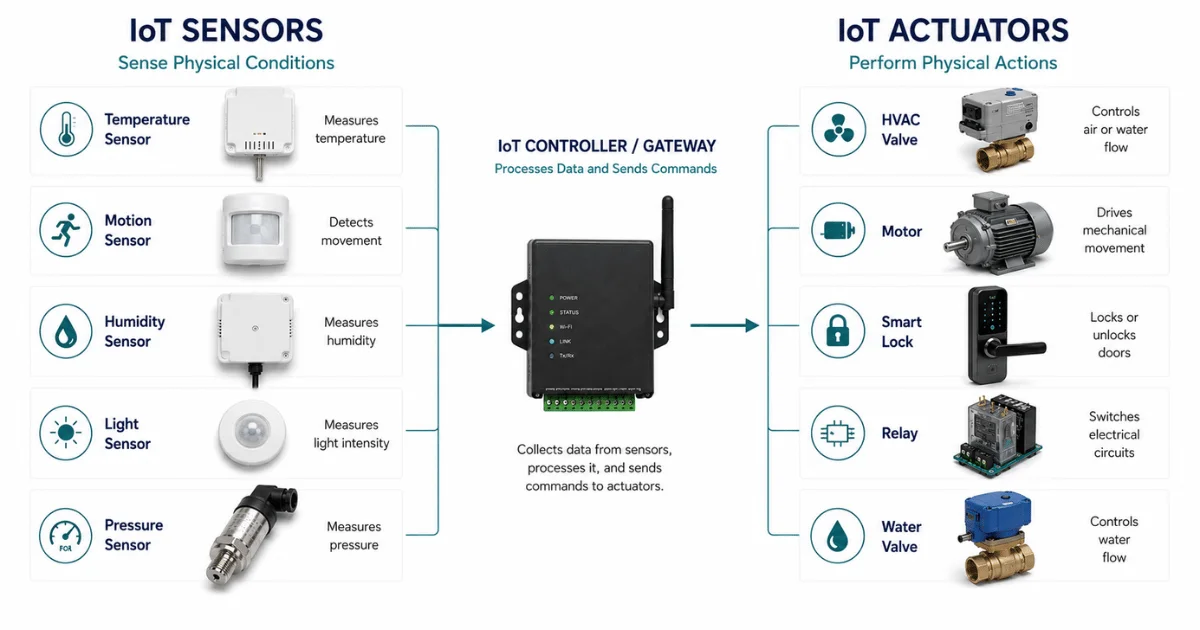
The main difference is connectivity and control. A traditional actuator performs a physical action when it receives a local control signal, while an IoT actuator can be connected to a network and controlled as part of a larger digital system.
A traditional valve actuator, for example, may be controlled directly by a local switch or industrial controller. An IoT-connected valve actuator can receive commands through an IoT gateway or network while also working with sensor data and automation rules.
| IoT Actuators | Traditional Actuators |
| Connected to an IoT network | Usually controlled locally |
| Can receive remote commands | Often requires local control |
| Can work with sensor data | May operate independently |
| Supports automated rules | Usually depends on a dedicated control system |
| Can provide or work with operational data | Data collection may be limited |
| Suitable for connected and distributed systems | Common in conventional automation |
However, an IoT actuator is not necessarily a completely different type of physical actuator. A motor, valve, relay, or pneumatic mechanism can become part of an IoT system when it is connected to suitable control electronics and communication infrastructure.
This means the key distinction is not simply the mechanical device itself. It is the way the actuator is integrated, controlled, monitored, and connected within the overall system.
How to Choose the Right Actuator for an IoT System?
Choosing an actuator for an IoT system depends on the physical action required, operating conditions, control method, and overall system requirements. The actuator should match both the equipment being controlled and the IoT architecture.
1. Required Type of Motion
First, determine whether the application needs rotary motion, linear motion, switching, or flow control.
For example, motors can provide rotary movement, while linear actuators can move a component along a straight path. Valves are suitable when the system needs to control the flow of water, air, or gas.
2. Load and Force Requirements
The actuator must provide enough force or torque to perform the required task. An actuator that is too weak may fail to move the equipment properly, while an oversized actuator can increase cost and energy consumption.
3. Power Requirements
Consider the available power supply and the actuator’s energy consumption. Battery-powered IoT devices may require low-power actuators, while industrial systems can support larger electrically powered or pneumatic actuators.
4. Response Speed
Some applications require an actuator to respond quickly to commands. Industrial automation, safety systems, and real-time control applications may need faster response times than simple home automation systems.
5. Control Interface
The actuator must be compatible with the controller or IoT gateway. Depending on the system, control may use electrical signals, relays, motor drivers, digital interfaces, or other control methods.
6. Operating Environment
Temperature, moisture, dust, vibration, chemicals, and other environmental conditions can affect actuator performance. Outdoor and industrial IoT deployments may require actuators designed for harsh environments.
7. Reliability and Maintenance
IoT actuators may operate thousands of times over their service life. Select an actuator with suitable durability, maintenance requirements, and expected operating life for the application.
8. Connectivity and Integration
The actuator does not always need built-in internet connectivity. In many IoT systems, a controller or gateway provides the network connection and sends commands to the actuator.
The best choice therefore depends on the physical task, force or torque, power source, response time, environment, control interface, and reliability requirements of the IoT application.
What Are the Limitations of IoT Actuators?
Although actuators make IoT systems capable of physical action, they also introduce several limitations that need to be considered during system design.
1. Power Consumption
Some actuators require significantly more power than sensors. Motors, pumps, and other mechanical devices can quickly drain batteries in systems that depend on portable or remote power sources.
2. Mechanical Wear
Actuators contain moving or switching components that can wear out over time. Frequent operation can increase maintenance requirements and eventually reduce reliability.
3. Response and Control Delays
An IoT actuator may depend on a controller, gateway, network, or cloud platform before receiving a command. Network delays can become a problem when an application requires immediate physical responses.
4. Integration Complexity
Connecting an actuator to an IoT system may require additional hardware such as motor drivers, relays, controllers, or gateways. Compatibility between the actuator and the control system must also be considered.
5. Security Risks
Connected actuators can create physical consequences if unauthorized users gain control. A compromised actuator could potentially open a valve, unlock a door, change equipment settings, or disrupt an industrial process.
Strong authentication, access control, encryption, and secure device management are therefore important for connected actuator systems.
6. Environmental Conditions
Actuators operating outdoors or in industrial environments may be exposed to heat, moisture, dust, vibration, or chemicals. These conditions can affect performance and shorten the device’s operating life.
7. Cost
More advanced actuator systems may require additional controllers, communication hardware, power supplies, and maintenance. This can increase the overall cost of an IoT deployment.
For these reasons, actuator selection should consider not only the physical action required but also power, reliability, security, connectivity, environmental conditions, and maintenance.
IoT Actuators: Key Takeaways
IoT actuators provide the action layer of an IoT system. While sensors collect information from the physical environment, actuators use commands from the IoT system to create a physical response.
The key points are:
- Actuators convert control signals into physical actions.
- Common actuator types include electrical, hydraulic, pneumatic, thermal, and mechanical actuators.
- They can control motors, valves, pumps, switches, locks, lighting, HVAC equipment, and other devices.
- Actuators work with sensors and controllers to create automated feedback loops.
- They are widely used in smart homes, agriculture, manufacturing, healthcare, smart buildings, and smart cities.
- Selection depends on factors such as motion, force, power consumption, response time, environment, control interface, and reliability.
- Security is important because unauthorized actuator control can have real-world consequences.
In simple terms, sensors tell an IoT system what is happening, while actuators allow it to do something about it. This combination is what enables IoT systems to move beyond monitoring and perform automated actions in the physical world.
Conclusion
IoT actuators are the components that turn digital decisions into physical actions. They work alongside sensors, controllers, gateways, and software to create automated systems that can monitor conditions and respond to them.
From opening a smart irrigation valve to controlling industrial machinery, HVAC systems, smart locks, and connected infrastructure, actuators are essential to the practical side of IoT.
The right actuator depends on the required movement, force or torque, power consumption, response time, operating environment, control method, and reliability. When properly selected and secured, actuators help IoT systems become more automated, responsive, efficient, and capable of interacting with the physical world.




- Be Respectful
- Stay Relevant
- Stay Positive
- True Feedback
- Encourage Discussion
- Avoid Spamming
- No Fake News
- Don't Copy-Paste
- No Personal Attacks
- Be Respectful
- Stay Relevant
- Stay Positive
- True Feedback
- Encourage Discussion
- Avoid Spamming
- No Fake News
- Don't Copy-Paste
- No Personal Attacks
