What Are IoT Communication Protocols? Types, Layers, Examples & Comparison Guide
Published: 30 Jul 2026
Every connected IoT device, from a smart thermostat and fitness tracker to an industrial sensor on a factory floor, relies on one essential technology to share data: IoT communication protocols. These protocols define how devices discover each other, exchange information, confirm successful delivery, and protect data while it travels across local networks, gateways, edge systems, and cloud platforms. Without standardized communication rules, connected devices from different manufacturers would struggle to work together reliably.
As the Internet of Things (IoT) continues to expand across homes, healthcare, manufacturing, agriculture, transportation, and smart cities, choosing the right communication protocol has become one of the most important design decisions. A battery-powered environmental sensor has very different communication requirements than a security camera streaming high-definition video or a robotic arm operating in a factory. Factors such as communication range, power consumption, bandwidth, latency, security, and interoperability all influence which protocol is the best fit.
IoT communication does not rely on a single protocol. Instead, devices use a layered protocol stack, where different protocols handle specific tasks. Some provide wireless connectivity, such as Bluetooth® Low Energy (BLE), Zigbee, Wi-Fi, and LoRaWAN. Others manage network routing with IPv6 and 6LoWPAN, while transport protocols like TCP and UDP move data between devices. At the application layer, protocols such as MQTT, CoAP, HTTP, and AMQP define how IoT applications exchange messages with gateways, edge devices, and cloud servers.
If you’re new to connected systems, it’s helpful to first understand how IoT devices, sensors, gateways, and cloud services work together before exploring the protocols that connect them. You can learn more in our guide on How Does an IoT System Work?, which explains the complete IoT communication workflow from data collection to cloud processing.
In this guide, you’ll learn what IoT communication protocols are, why they matter, how the IoT protocol stack works, the major protocols used at each communication layer, how they compare, and how to choose the right protocol for different IoT applications. Whether you’re building a smart home solution, deploying industrial IoT systems, or simply learning how connected devices communicate, this article will give you a practical understanding of the technologies that power modern IoT networks.
IoT communication protocols are standardized rules that enable IoT devices, sensors, gateways, edge systems, and cloud platforms to exchange data securely and efficiently. They operate across different layers of the IoT protocol stack, including connectivity, network, transport, and application layers. Common IoT communication protocols include Bluetooth LE, Zigbee, Wi-Fi, LoRaWAN, NB-IoT, MQTT, CoAP, HTTP, and AMQP, each designed for different requirements such as range, power efficiency, bandwidth, latency, and security.
Table of Contents
What Are IoT Communication Protocols?
IoT communication protocols are standardized rules that define how IoT devices, sensors, gateways, edge systems, and cloud platforms exchange data. They ensure that devices from different manufacturers can communicate using a common language, making connected systems reliable, secure, and interoperable.
Think of a communication protocol as a set of agreed rules for a conversation. Just as people follow a language and grammar to understand each other, IoT devices follow communication protocols to determine when to send data, how to format it, where to deliver it, and how to verify that it arrived correctly. These rules also specify how devices establish connections, recover from transmission errors, and protect information during data transmission.
Unlike traditional internet communication, IoT environments often involve battery-powered sensors, constrained devices, wireless sensor networks, and low-bandwidth connections. Because of these limitations, IoT protocols are designed to minimize power consumption, reduce network traffic, and maintain reliable communication even over unstable or long-distance networks. For example, a soil moisture sensor in a remote agricultural field has very different communication needs than a surveillance camera streaming live video over Wi-Fi.
IoT communication is not handled by a single protocol. Instead, devices use multiple protocols working together in a layered IoT protocol stack. Each layer performs a specific function:
- Connectivity protocols establish wired or wireless communication between devices.
- Network protocols provide addressing and route data across networks.
- Transport protocols ensure data reaches its destination reliably or with minimal delay.
- Application protocols define how IoT applications exchange messages and commands.
Together, these layers create an efficient communication framework that supports everything from simple smart home devices to large-scale industrial IoT deployments.
Why Standardized Communication Protocols Matter
Without standardized communication protocols, every IoT manufacturer would use its own communication method. A smart thermostat might not communicate with a home automation hub, or an industrial sensor could fail to send data to a cloud analytics platform because each system speaks a different “language.”
Standardized protocols solve this problem by providing:
- Interoperability between devices from different vendors.
- Reliable data exchange across local networks, gateways, and cloud servers.
- Scalable communication for networks containing thousands or even millions of connected devices.
- Built-in security features, including authentication, encryption, and secure message delivery.
- Efficient resource usage for battery-powered and low-power IoT devices.
These standards are one of the main reasons modern IoT ecosystems can support applications ranging from smart homes and hospitals to factories, transportation systems, and smart cities.
Related: If you’re new to connected systems, start with our guide on Internet of Things (IoT): Meaning, Technology, Applications, and Future Trends to understand how communication protocols fit into the broader IoT ecosystem before exploring the protocol stack in detail.
Why IoT Communication Protocols Matter
Choosing the right IoT communication protocol is more than a technical decision—it directly affects how efficiently, securely, and reliably an IoT system operates. A protocol determines how devices exchange information, how much power they consume, how quickly data reaches its destination, and whether the system can scale as more devices are added.
For example, a smart parking sensor may only need to send a small data packet every few minutes, while a security camera continuously streams video that requires much higher bandwidth. Using the same communication protocol for both devices would reduce efficiency, increase costs, and may even shorten battery life. This is why different IoT applications rely on different communication protocols.
Reliable Data Exchange
The primary purpose of an IoT communication protocol is to ensure reliable data exchange between connected devices. Every time a sensor records temperature, humidity, pressure, or motion, the data must reach its destination accurately.
Many protocols include mechanisms such as:
- Error detection
- Packet acknowledgment
- Retransmission of lost packets
- Message sequencing
These features reduce communication errors and improve reliability, especially in industrial environments where inaccurate data can lead to poor decisions or equipment failures.
Interoperability and Compatibility
A modern IoT ecosystem often includes devices from multiple manufacturers. For example, a smart building may combine occupancy sensors, lighting systems, HVAC controllers, surveillance cameras, and cloud-based management software from different vendors.
Standardized communication protocols make these devices compatible and interoperable, allowing them to exchange data without requiring proprietary communication methods. This interoperability also simplifies system expansion because new devices can join the network without redesigning the entire infrastructure.
Power Consumption
Many IoT devices operate on batteries for months or even years without maintenance. In these cases, power consumption becomes one of the most important factors when selecting a communication protocol.
Low-power protocols such as Bluetooth Low Energy (BLE), Zigbee, Thread, LoRaWAN, and NB-IoT reduce unnecessary transmissions and keep devices in sleep mode whenever possible. This approach significantly extends battery life, making these protocols ideal for environmental sensors, wearable devices, and smart agriculture deployments.
Network Range and Coverage
Communication requirements vary depending on where IoT devices are deployed.
- Bluetooth LE works well for short-range communication between nearby devices.
- Wi-Fi provides high-speed connectivity inside homes, offices, and factories.
- LoRaWAN enables sensors to transmit data over several kilometers while using very little power.
- NB-IoT and LTE-M use existing cellular networks to support remote IoT deployments without requiring local gateways.
Selecting a protocol with the appropriate communication range helps improve network performance while avoiding unnecessary infrastructure costs.
Security and Data Integrity
IoT devices often transmit sensitive information, including operational data, healthcare records, environmental measurements, and industrial telemetry. Protecting this information is essential.
Many IoT communication protocols support security features such as:
- Device authentication
- Data encryption
- Secure key exchange
- Transport Layer Security (TLS)
- Datagram Transport Layer Security (DTLS)
These mechanisms help protect IoT systems against unauthorized access, data tampering, and cyberattacks while preserving data integrity throughout transmission. Security becomes even more important as IoT deployments grow and connect critical infrastructure to cloud platforms.
If you’d like to explore common vulnerabilities and practical defenses, see our guide on IoT Security Challenges and Solutions, which explains how protocol security fits into a broader IoT cybersecurity strategy.
Scalability for Growing IoT Networks
An IoT network may begin with a few connected devices but eventually grow to thousands or even millions of sensors. Communication protocols must support this growth without reducing performance or overwhelming the network.
Scalable protocols efficiently manage device addressing, message routing, and network traffic so that adding more devices does not significantly increase latency or congestion. This capability is especially important in industrial IoT, smart cities, and large-scale environmental monitoring, where thousands of connected devices operate simultaneously.
Key Takeaway: IoT communication protocols are the foundation of every connected system. They determine how devices communicate, how efficiently they use power, how securely they transmit data, and how well an IoT network performs as it grows. Choosing the right protocol ensures reliable communication today while supporting future expansion.
How IoT Devices Communicate
Every IoT system follows the same basic communication process, regardless of whether it is a smart thermostat, wearable fitness tracker, industrial sensor, or connected vehicle. An IoT device first collects data from its environment, then sends that data through one or more communication protocols until it reaches an application where it can be analyzed or acted upon.
Although the technologies involved may differ, the communication workflow remains largely the same across most IoT deployments.
A Typical IoT Communication Flow
A simple IoT communication process looks like this:
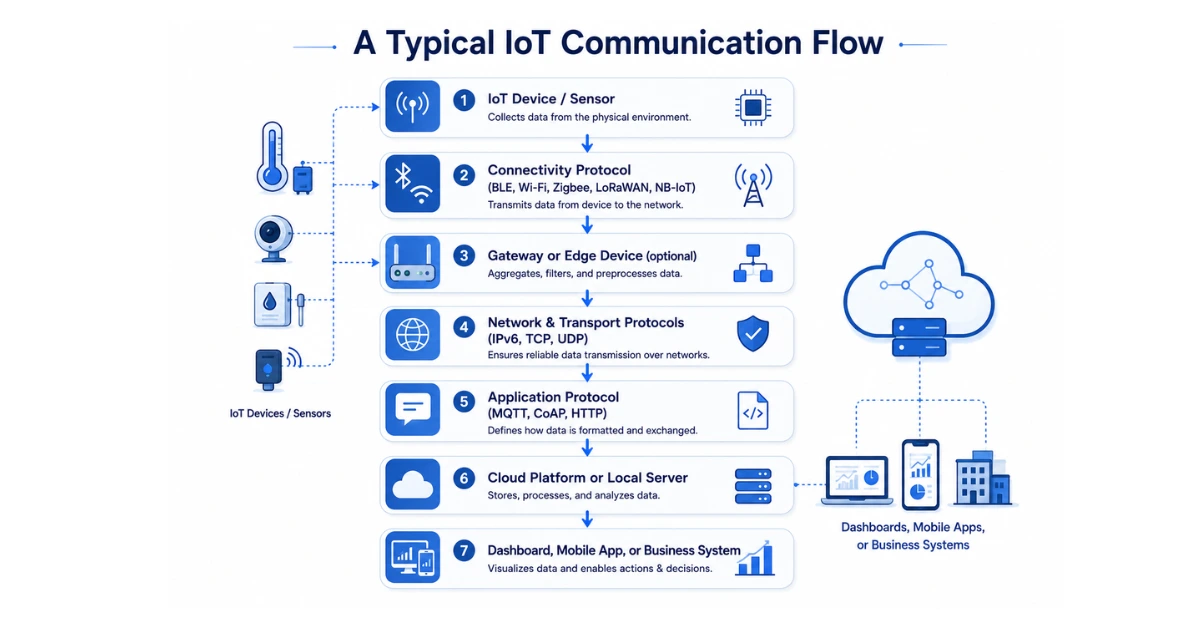
Each stage has a specific role. Connectivity protocols establish the initial connection, network and transport protocols move data between systems, and application protocols define how information is exchanged between software platforms.
If you’d like a deeper explanation of this architecture, see our guide on How Does an IoT System Work?, which covers sensors, gateways, cloud platforms, and data processing in more detail.
Step 1: Sensors Collect Data
Communication begins when an IoT device gathers information from its surroundings using one or more sensors.
Depending on the application, a device may measure:
- Temperature
- Humidity
- Air quality
- Motion
- Pressure
- Light levels
- Equipment vibration
- GPS location
These measurements are converted into digital data that can be transmitted across a network.
Step 2: The Device Connects to a Network
Once data is collected, the device must connect to another device or network. The communication protocol used depends on factors such as range, bandwidth, and power requirements.
For example:
- A Bluetooth LE fitness tracker sends data to a nearby smartphone.
- A Wi-Fi security camera streams video to a home network.
- A LoRaWAN environmental sensor transmits small data packets over several kilometers.
- An NB-IoT smart utility meter communicates through a cellular network.
Each protocol is optimized for different communication needs rather than trying to solve every problem.
Step 3: Gateways or Edge Devices Process the Data
Not every IoT deployment sends data directly to the cloud. In many systems, a gateway or edge device acts as an intermediary.
An IoT gateway can:
- Receive data from multiple devices.
- Translate between different communication protocols.
- Filter unnecessary information.
- Aggregate data from multiple sensors.
- Forward processed data to cloud servers.
Edge computing takes this one step further by analyzing data close to where it is generated. Processing information locally reduces bandwidth usage, lowers latency, and allows faster responses for time-sensitive applications.
For a detailed explanation, read our guides on What Is an IoT Gateway? and Edge Computing in IoT.
Step 4: Data Travels Across the Network
After leaving the gateway or device, data moves through the network using internet protocols such as IPv6, while transport protocols like TCP or UDP determine how messages are delivered.
At this stage, protocols help:
- Route data to the correct destination.
- Detect transmission errors.
- Confirm successful delivery when required.
- Reduce packet loss.
- Maintain reliable communication between devices and servers.
The choice between TCP and UDP depends on whether reliability or speed is the higher priority, a topic we’ll explore later in this guide.
Step 5: Application Protocols Deliver the Information
The final communication step uses an application layer protocol such as MQTT, CoAP, or HTTP.
These protocols define:
- How devices publish data.
- How applications request information.
- How commands are sent back to devices.
- How messages are formatted and exchanged.
For example, an industrial vibration sensor might publish machine health data using MQTT, while a smart irrigation controller could use CoAP to receive watering commands from a cloud application.
Step 6: Applications Turn Data into Action
Once the information reaches a cloud platform, edge application, or local server, software analyzes the incoming data and decides what happens next.
Examples include:
- Displaying sensor readings on a dashboard.
- Sending alerts when equipment overheats.
- Adjusting a building’s HVAC system automatically.
- Turning lights on when motion is detected.
- Predicting machine failures using AI models.
This is where raw sensor data becomes useful business intelligence or automated actions.
Why Multiple Protocols Work Together
A common misconception is that IoT devices use only one communication protocol. In reality, multiple protocols work together within the IoT protocol stack, with each layer handling a different part of the communication process.
For example, a smart factory sensor might use:
- Bluetooth LE to communicate with a nearby gateway.
- IPv6 to address devices across the network.
- TCP to ensure reliable data delivery.
- MQTT to publish sensor readings to a cloud platform.
Each protocol performs a specialized task, creating a communication system that is efficient, scalable, and reliable. Understanding this layered approach makes it much easier to compare protocols and choose the right one for a specific IoT application.
Understanding the IoT Protocol Stack
IoT communication relies on a layered protocol stack, where each layer performs a specific task in moving data from an IoT device to its final destination. Instead of using a single protocol for every communication function, IoT systems combine multiple protocols that work together to provide connectivity, routing, reliable data delivery, and application-level messaging.
This layered design makes IoT networks more flexible, scalable, and interoperable. It also allows developers to replace one protocol without redesigning the entire communication system. For example, an IoT solution can switch from Wi-Fi to LoRaWAN for connectivity while continuing to use MQTT for messaging.
Although the IoT protocol stack is inspired by the OSI (Open Systems Interconnection) model, it is simplified for connected devices and focuses on the communication needs of the Internet of Things.
The Four Main Layers of the IoT Protocol Stack
| Layer | Purpose | Common Protocols |
| Connectivity Layer | Connects IoT devices to nearby networks or gateways | Bluetooth LE, Zigbee, Thread, Wi-Fi, LoRaWAN, NB-IoT, LTE-M, Ethernet |
| Network Layer | Identifies devices and routes data across networks | IPv6, 6LoWPAN, RPL |
| Transport Layer | Delivers data between devices and applications reliably or with low latency | TCP, UDP, DTLS |
| Application Layer | Defines how applications exchange data and commands | MQTT, CoAP, HTTP, AMQP, DDS, WebSocket, LwM2M |
Each layer builds on the one below it. Together, they create a complete communication path from an IoT sensor to a cloud platform or local application.
1. Connectivity Layer
The Connectivity Layer is responsible for establishing the physical or wireless connection between IoT devices and the network. It determines how devices transmit signals, the communication range they can achieve, the amount of power they consume, and the maximum data rate they support.
Different protocols are designed for different scenarios:
- Bluetooth Low Energy (BLE) connects nearby wearable devices and sensors while using very little power.
- Zigbee and Thread create mesh networks that improve coverage for smart home and building automation.
- Wi-Fi provides high-speed communication for devices that require greater bandwidth, such as security cameras.
- LoRaWAN supports long-range communication for battery-powered sensors in agriculture and environmental monitoring.
- NB-IoT and LTE-M use existing cellular infrastructure to connect remote IoT devices over wide geographic areas.
- Ethernet delivers stable, wired communication for industrial equipment where reliability is more important than mobility.
Choosing the right connectivity protocol depends on factors such as communication distance, battery life, bandwidth requirements, and deployment environment.
2. Network Layer
Once devices are connected, the Network Layer determines where data should be sent. It assigns addresses to devices and routes information between networks so that messages reach the correct destination.
Three important protocols commonly used in IoT are:
- IPv6 provides a virtually unlimited address space, allowing billions of IoT devices to connect to the internet.
- 6LoWPAN enables low-power wireless devices to use IPv6 efficiently by compressing packet headers and reducing communication overhead.
- RPL (Routing Protocol for Low-Power and Lossy Networks) finds efficient communication paths in networks where devices have limited processing power, battery life, or unstable connections.
Without the Network Layer, IoT devices could communicate locally but would struggle to exchange information across larger networks or cloud platforms.
3. Transport Layer
The Transport Layer ensures that data moves between devices, gateways, and applications in the appropriate way. Depending on the application, the priority may be reliability, speed, or a balance of both.
The most common transport protocols include:
- TCP (Transmission Control Protocol) guarantees reliable communication by checking for errors, acknowledging received packets, and retransmitting lost data when necessary. It is ideal for applications where data accuracy is critical.
- UDP (User Datagram Protocol) sends data with minimal overhead and does not wait for acknowledgments. This makes it suitable for applications that require fast communication and can tolerate occasional packet loss.
- DTLS (Datagram Transport Layer Security) adds encryption and authentication to UDP-based communication, helping protect sensitive IoT data during transmission.
Selecting the appropriate transport protocol depends on the application’s latency requirements, network conditions, and security needs.
4. Application Layer
The Application Layer defines how IoT applications exchange information after devices have established a network connection. These protocols determine message formats, communication models, and how software systems interact with connected devices.
Some of the most widely used application protocols include:
- MQTT uses a lightweight publish/subscribe model that works well for low-bandwidth and high-latency networks.
- CoAP follows a request/response model similar to HTTP but is optimized for constrained IoT devices.
- HTTP enables web-based communication and integrates easily with cloud services and REST APIs.
- AMQP is commonly used for enterprise messaging systems that require reliable message delivery.
- DDS supports real-time communication in applications such as robotics and industrial automation.
- WebSocket enables continuous two-way communication between devices and web applications.
- LwM2M (Lightweight Machine-to-Machine) simplifies remote device management, configuration, and firmware updates for large IoT deployments.
You’ll learn more about each of these protocols in the following sections of this guide.
Why the Layered Approach Is Important
Separating communication into layers gives IoT systems greater flexibility and interoperability. Instead of depending on a single protocol, developers can combine technologies that best match their application’s requirements.
For example, an environmental monitoring system might use:
- LoRaWAN for long-range wireless connectivity.
- IPv6 and 6LoWPAN for network addressing.
- UDP to minimize communication overhead.
- CoAP for lightweight application messaging.
Meanwhile, a factory monitoring system could combine:
- Ethernet for stable connectivity.
- TCP for reliable data delivery.
- MQTT for publishing machine telemetry to cloud dashboards.
This modular design is one of the biggest strengths of the IoT protocol stack. It allows organizations to build communication systems that balance range, power consumption, reliability, scalability, and security based on the needs of each IoT application.
Connectivity Layer Protocols
The Connectivity Layer is the foundation of IoT communication. It defines how an IoT device physically or wirelessly connects to another device, gateway, or network. The protocol you choose at this layer directly affects communication range, battery life, data rate, network topology, and deployment cost.
There is no single protocol that fits every IoT application. Instead, each protocol is designed to solve a specific communication challenge. A wearable fitness tracker needs a short-range, low-power connection, while a smart agriculture sensor may need to transmit data several kilometers without frequent battery replacement.
The table below compares the most widely used connectivity protocols in IoT.
| Protocol | Range | Power Usage | Typical Applications |
| Bluetooth LE (BLE) | Short | Very Low | Wearables, health devices, asset tracking |
| Zigbee | Short | Low | Smart homes, lighting, automation |
| Thread | Short | Low | Smart homes, Matter-enabled devices |
| Wi-Fi | Medium | High | Cameras, smart appliances, video streaming |
| LoRaWAN | Long | Very Low | Agriculture, environmental monitoring, smart cities |
| NB-IoT | Wide Area | Low | Smart meters, remote monitoring |
| LTE-M | Wide Area | Medium | Fleet tracking, mobile IoT |
| Ethernet | Wired | Continuous Power | Industrial automation, manufacturing |
Bluetooth Low Energy (BLE)
Bluetooth Low Energy (BLE) is a wireless communication protocol designed for battery-powered IoT devices. It consumes significantly less power than traditional Bluetooth while maintaining reliable short-range communication.
BLE is commonly used in:
- Fitness trackers
- Smartwatches
- Medical wearables
- Beacons
- Smart locks
Because BLE supports fast pairing and low energy consumption, it is ideal for devices that exchange small amounts of data at regular intervals.
Zigbee and Thread
Zigbee and Thread are low-power mesh networking protocols widely used in smart home automation and commercial building systems.
Unlike a star network, a mesh topology allows connected devices to relay messages for one another. If one communication path becomes unavailable, data can travel through another device, improving network reliability and coverage.
These protocols are commonly used for:
- Smart lighting
- Motion sensors
- Thermostats
- Door and window sensors
- Building automation
Thread has gained popularity because it forms the networking foundation for the Matter smart home standard.
Wi-Fi
Wi-Fi (IEEE 802.11) provides high-speed wireless communication and is one of the most familiar networking technologies.
Unlike low-power protocols, Wi-Fi offers higher bandwidth, making it suitable for devices that transmit large amounts of data, including:
- Security cameras
- Smart TVs
- Home assistants
- Industrial control panels
The trade-off is higher power consumption, which makes Wi-Fi less suitable for battery-powered sensors that must operate for months or years.
LoRaWAN
LoRaWAN is a Low-Power Wide-Area Network (LPWAN) protocol designed for long-range communication with minimal power consumption.
A single LoRaWAN gateway can communicate with sensors located several kilometers away, making it ideal for deployments where Wi-Fi or Bluetooth cannot provide sufficient coverage.
Typical applications include:
- Smart agriculture
- Environmental monitoring
- Water management
- Smart city infrastructure
- Utility metering
If you’d like to learn more, read our complete guide on What Is LoRaWAN, How It Works, and Why It Matters for IoT, where we explain its architecture, device classes, and real-world use cases.
NB-IoT and LTE-M
Both NB-IoT (Narrowband IoT) and LTE-M (Long-Term Evolution for Machines) use existing cellular networks to connect IoT devices without requiring a local gateway.
Although they share the same cellular infrastructure, they are designed for different needs.
- NB-IoT prioritizes battery life and reliable communication for stationary devices that send small amounts of data.
- LTE-M supports higher bandwidth and device mobility, making it suitable for moving assets such as connected vehicles and logistics equipment.
These protocols are commonly deployed in:
- Smart utility meters
- Asset tracking
- Fleet management
- Remote industrial monitoring
Ethernet
While most IoT discussions focus on wireless connectivity, Ethernet remains an important communication option, especially in Industrial IoT (IIoT).
A wired Ethernet connection provides:
- High reliability
- Low latency
- Stable communication
- Minimal interference
- High bandwidth
For factories, production lines, and critical infrastructure where continuous communication is essential, Ethernet often remains the preferred choice despite the growth of wireless IoT technologies.
Choosing the Right Connectivity Protocol
Selecting a connectivity protocol depends on balancing several factors rather than choosing the newest technology. Before making a decision, consider:
- Communication range
- Battery life requirements
- Data transmission rate
- Network topology (star or mesh)
- Deployment environment
- Infrastructure availability
- Device mobility
- Cost and scalability
The right connectivity protocol creates a reliable foundation for the rest of the IoT communication stack. Once devices are connected, network protocols determine how data is addressed and routed across the IoT ecosystem.
You have not enough Humanizer words left. Upgrade your Surfer plan.
Network Layer Protocols
After a device establishes a connection, the Network Layer determines where the data should go. It provides device addressing and routing, allowing information to travel across local networks, gateways, and the internet until it reaches its destination.
Unlike the Connectivity Layer, which focuses on the communication medium, the Network Layer ensures that every connected device can be uniquely identified and that data follows the most efficient route. This becomes especially important in large IoT deployments with thousands of sensors spread across factories, smart cities, or agricultural fields.
The three most common network protocols in IoT are IPv6, 6LoWPAN, and RPL.
| Protocol | Primary Purpose | Best Used For |
| IPv6 | Device addressing | Large-scale IoT networks |
| 6LoWPAN | IPv6 over low-power wireless networks | Battery-powered IoT devices |
| RPL | Routing in low-power and lossy networks | Wireless sensor networks |
IPv6
IPv6 (Internet Protocol Version 6) is the addressing protocol that enables billions of IoT devices to connect to the internet. Unlike IPv4, which has a limited number of addresses, IPv6 provides an enormous address space capable of supporting the continued growth of the Internet of Things.
With IPv6, every IoT device can have a unique network address, making communication between devices, gateways, edge systems, and cloud platforms more efficient.
6LoWPAN
Many IoT sensors have limited memory, processing power, and battery capacity. Standard IPv6 packets are often too large for these constrained devices.
6LoWPAN (IPv6 over Low-Power Wireless Personal Area Networks) solves this problem by compressing IPv6 headers and optimizing data transmission for low-power wireless networks. This reduces communication overhead while allowing small IoT devices to remain compatible with IPv6-based networks.
Because of its efficiency, 6LoWPAN is widely used in wireless sensor networks and smart building deployments.
RPL
RPL (Routing Protocol for Low-Power and Lossy Networks) is designed for IoT environments where wireless connections may be unstable or devices operate on limited battery power.
Instead of using a fixed communication path, RPL continuously identifies efficient routes for data transmission. If a connection fails, it can automatically select an alternative path, improving network reliability without requiring manual intervention.
This makes RPL particularly useful in applications such as:
- Smart cities
- Environmental monitoring
- Industrial sensor networks
- Smart utility grids
Together, IPv6, 6LoWPAN, and RPL provide the addressing and routing foundation that allows IoT devices to communicate across local and global networks.
Transport Layer Protocols
Once data has been addressed and routed, the Transport Layer determines how it is delivered between devices, gateways, and applications. Its primary responsibility is to balance reliability, speed, and communication efficiency.
The most widely used transport protocols in IoT are TCP, UDP, and DTLS.
| Protocol | Strength | Common Use Cases |
| TCP | Reliable data delivery | Industrial systems, cloud communication |
| UDP | Fast, lightweight communication | Real-time monitoring, sensor data |
| DTLS | Secure UDP communication | Low-latency IoT applications |
TCP (Transmission Control Protocol)
TCP is a connection-oriented protocol that prioritizes reliability. Before transmitting data, it establishes a connection between two devices and verifies that each data packet reaches its destination correctly.
TCP provides:
- Error detection
- Packet acknowledgment
- Retransmission of lost packets
- Ordered data delivery
These features make TCP an excellent choice for applications where accuracy is more important than speed, such as industrial monitoring, financial systems, and cloud-based IoT platforms.
UDP (User Datagram Protocol)
Unlike TCP, UDP sends data without establishing a connection or waiting for acknowledgments. This reduces communication overhead and lowers latency.
UDP is well suited for applications that send frequent, small messages and can tolerate occasional packet loss, including:
- Environmental sensors
- Smart lighting
- Traffic monitoring
- Real-time telemetry
Its lightweight design also helps conserve bandwidth and processing resources on constrained IoT devices.
DTLS (Datagram Transport Layer Security)
While UDP is fast, it does not provide built-in security. DTLS (Datagram Transport Layer Security) adds encryption, authentication, and data integrity to UDP-based communication.
By combining the speed of UDP with essential security features, DTLS helps protect sensitive IoT data without introducing the higher overhead associated with connection-oriented protocols.
With reliable data transport in place, the final step is determining how applications exchange messages and commands, which is handled by the Application Layer protocols such as MQTT, CoAP, HTTP, and AMQP.
How to Choose the Right IoT Communication Protocol
There is no universal “best” IoT communication protocol. The right choice depends on your application’s communication requirements, deployment environment, power constraints, and scalability goals.
Before selecting a protocol, answer these questions:
1. How far do devices need to communicate?
Communication range is often the first deciding factor.
- Bluetooth LE works best within a few meters.
- Zigbee and Thread cover homes and buildings through mesh networking.
- Wi-Fi is ideal for local high-speed communication.
- LoRaWAN supports communication over several kilometers.
- NB-IoT and LTE-M provide nationwide coverage through cellular networks.
2. How much power is available?
Battery-powered sensors require protocols designed for low energy consumption.
Choose BLE, Zigbee, Thread, LoRaWAN, or NB-IoT for devices expected to operate for months or even years without battery replacement.
If devices have a continuous power source, protocols like Wi-Fi or Ethernet can provide higher bandwidth without worrying about energy usage.
3. How much data needs to be transmitted?
Different protocols are optimized for different workloads.
| Data Type | Recommended Protocols |
| Small sensor readings | MQTT, CoAP, LoRaWAN |
| Device telemetry | MQTT, NB-IoT |
| Large files or firmware updates | HTTP/HTTPS |
| Video or multimedia | Wi-Fi, Ethernet |
4. Is low latency important?
Applications such as industrial automation, robotics, or connected vehicles often require near real-time communication.
In these scenarios:
- UDP minimizes transmission delay.
- DDS supports deterministic real-time messaging.
- WebSocket enables continuous two-way communication between applications and devices.
5. How secure is the communication?
Security should be considered from the beginning—not added later.
Look for protocols that support:
- Device authentication
- End-to-end encryption
- TLS or DTLS
- Secure firmware updates
- Data integrity verification
These features help protect IoT devices against unauthorized access, data interception, and tampering.
If you’re building a secure deployment, our guide on IoT Security Challenges and Solutions explains common threats and practical defenses in greater detail.
6. Will the network grow over time?
Many IoT projects begin with a small pilot but eventually expand to thousands of connected devices.
Choose protocols that can scale efficiently without creating excessive network traffic or management complexity. Protocols such as MQTT, LoRaWAN, IPv6, and NB-IoT are widely used because they support large-scale deployments while maintaining reliable communication.
Quick Protocol Selection Guide
| If your priority is… | Choose… |
| Lowest power consumption | BLE, Zigbee, LoRaWAN |
| Long-distance communication | LoRaWAN, NB-IoT, LTE-M |
| High-speed local networking | Wi-Fi, Ethernet |
| Reliable messaging | MQTT, TCP |
| Lightweight communication | CoAP, UDP |
| Enterprise integration | HTTP, AMQP |
| Real-time industrial systems | DDS |
The best IoT solution rarely relies on a single protocol. Most modern deployments combine multiple protocols across different layers of the IoT protocol stack. For example, a smart agriculture system might use LoRaWAN for connectivity, IPv6 for addressing, UDP for transport, and MQTT to send sensor data to a cloud platform.
Choosing the right combination ensures your IoT network remains efficient, secure, and ready to scale as your deployment grows.
Conclusion
IoT communication protocols are the backbone of every connected system. From short-range technologies like Bluetooth LE to long-range solutions such as LoRaWAN, and from reliable messaging with MQTT to lightweight communication using CoAP, each protocol plays a specific role in the IoT ecosystem.
Rather than relying on a single technology, modern IoT deployments combine multiple protocols across the connectivity, network, transport, and application layers. Selecting the right combination improves performance, extends battery life, strengthens security, and ensures devices can scale as networks grow.
Understanding how these protocols work together helps developers, engineers, and businesses design IoT solutions that are reliable, interoperable, and ready for real-world deployment. Whether you’re building a smart home, an industrial monitoring system, or a city-wide sensor network, choosing the appropriate communication protocols is one of the most important decisions you’ll make.
FAQs
What are IoT communication protocols?
IoT communication protocols are standardized rules that allow IoT devices, gateways, cloud platforms, and applications to exchange data reliably and securely. Different protocols are designed for different purposes, such as wireless connectivity, device addressing, data transport, or application messaging. Together, they form the IoT protocol stack that enables connected devices to communicate across networks.
What are the main types of IoT communication protocols?
IoT communication protocols are commonly grouped into four categories:
- Connectivity protocols: Bluetooth LE, Zigbee, Thread, Wi-Fi, LoRaWAN, NB-IoT, LTE-M
- Network protocols: IPv6, 6LoWPAN, RPL
- Transport protocols: TCP, UDP, DTLS
- Application protocols: MQTT, CoAP, HTTP, AMQP, DDS, WebSocket, LwM2M
Each protocol serves a specific role in moving data from IoT devices to cloud platforms or local applications.
Which IoT communication protocol is the best?
There is no single best protocol for every IoT application.
The right choice depends on factors such as:
- Communication range
- Battery life
- Data rate
- Network reliability
- Security requirements
- Deployment cost
- Scalability
For example, LoRaWAN is well suited for long-range sensor networks, while Bluetooth LE is ideal for wearable devices. MQTT is one of the most widely used application protocols because it provides lightweight and reliable messaging for constrained IoT devices.
How do IoT devices communicate with each other?
IoT devices communicate by using multiple protocols that work together across different layers.
A typical communication process includes:
- Sensors collect data.
- A connectivity protocol transmits the data.
- Network protocols route the information.
- Transport protocols deliver the data.
- Application protocols exchange messages with cloud services or other devices.
This layered approach allows IoT systems to remain reliable, scalable, and interoperable.
What is the difference between MQTT and CoAP?
Both MQTT and CoAP are lightweight application-layer protocols, but they use different communication models.
| MQTT | CoAP |
| Publish/Subscribe model | Request/Response model |
| Excellent for cloud messaging | Ideal for constrained devices |
| Requires a broker | Direct device communication |
| Highly reliable | Lower communication overhead |
MQTT is commonly used for industrial monitoring and cloud-connected IoT platforms, while CoAP is often chosen for low-power sensors and embedded systems.
Why is security important in IoT communication protocols?
IoT devices often transmit sensitive operational or personal data over public and private networks. Without proper security, attackers may intercept communications, impersonate devices, or gain unauthorized access.
Modern IoT protocols improve security by supporting:
- TLS and DTLS encryption
- Device authentication
- Secure key exchange
- Data integrity verification
- Secure firmware updates
Combining secure protocols with strong device management significantly reduces cybersecurity risks.
Which wireless protocol is best for battery-powered IoT devices?
For battery-powered deployments, protocols designed for low energy consumption are generally the best choice.
Common options include:
- Bluetooth Low Energy (BLE) for wearable devices
- Zigbee and Thread for smart homes
- LoRaWAN for long-range sensor networks
- NB-IoT for cellular IoT deployments
The optimal protocol depends on the required communication range, data volume, and expected battery life.
What is the difference between IoT communication protocols and network protocols?
IoT communication protocols is a broad term that includes every protocol used for device communication, from physical connectivity to application messaging.
Network protocols are one layer within that stack. They focus specifically on device addressing and routing. Protocols such as IPv6, 6LoWPAN, and RPL ensure data reaches the correct destination, while application protocols like MQTT and CoAP define how devices exchange messages.






- Be Respectful
- Stay Relevant
- Stay Positive
- True Feedback
- Encourage Discussion
- Avoid Spamming
- No Fake News
- Don't Copy-Paste
- No Personal Attacks
- Be Respectful
- Stay Relevant
- Stay Positive
- True Feedback
- Encourage Discussion
- Avoid Spamming
- No Fake News
- Don't Copy-Paste
- No Personal Attacks
