IoT security challenges and solutions: what actually matters in 2026
Published: 21 May 2026
The number of connected devices crossed 18 billion in early 2026. That’s a lot of attack surface.
IoT security challenges and solutions aren’t a new conversation, but the stakes keep climbing. Your smart thermostat, factory sensor, and hospital IV pump all connect to the internet, and most of them ship with the bare minimum in security features. This post breaks down the real problems, what’s actually working, and where the industry still has a long way to go.
Table of Contents
Why IoT devices stay vulnerable to attacks
The honest answer is economics.
Most IoT manufacturers optimize for cost and time-to-market. Security adds both. So devices ship with default passwords that never get changed, outdated firmware, and no lack of encryption on data in transit. When a researcher at Georgia Tech scanned public IP ranges in 2025, she found over 3 million devices still running default admin credentials.
That’s not a technical failure. That’s a business model failure.
The default password problem
Default passwords are probably the single most exploited entry point in IoT security breaches. Attackers use tools like Shodan to find exposed connected devices, then run a dictionary attack against known manufacturer defaults. Takes about 4 minutes on average.
The Mirai botnet did exactly this in 2016 and knocked major chunks of the internet offline. Variants of Mirai are still active. Still using the same trick.
Lack of encryption across IoT systems
A lot of IoT sensors transmit data in plaintext. Temperature readings, location data, and usage patterns are all flowing across IoT networks with zero protection. This matters more than people think, because even “boring” sensor data can expose sensitive data about behavior patterns, facility layouts, or medical routines.
TLS 1.3 is widely supported and adds minimal overhead even on constrained hardware. The problem is that implementing it costs time, and most IoT manufacturers aren’t paying that cost voluntarily.
Weak access controls at the edge
IoT devices at the edge, manufacturing floors, remote monitoring stations, and agricultural sensors often run with admin-level access by default because restricting access controls was an afterthought. Once an attacker gains access to one device, lateral movement across the IoT network is trivial.
Zero-trust architecture helps here. Every device authenticates, every request gets verified, and nothing is trusted by default. It’s more overhead, but it’s how you stop a compromised parking sensor from becoming a gateway into your corporate network.
The biggest IoT security challenges in 2026
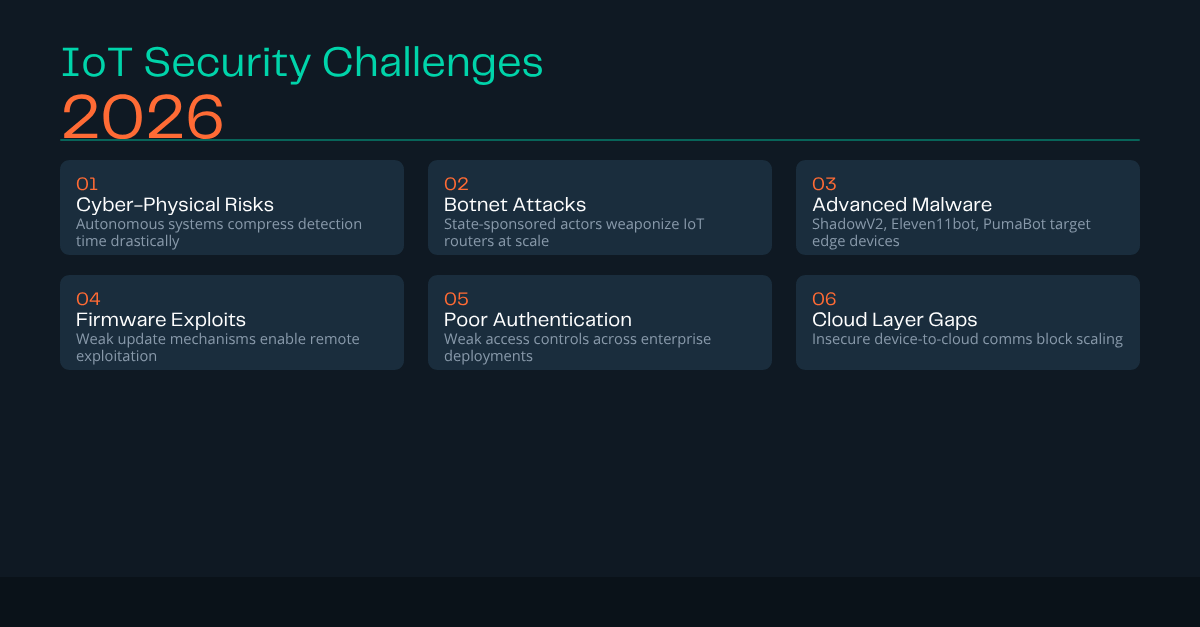
Scale and device diversity
There’s no unified security standard across IoT devices. A Zigbee sensor, an industrial PLC, and a consumer smartwatch all “do IoT” but have completely different security features, update mechanisms, and threat models. Managing access controls across thousands of these devices in an enterprise environment is genuinely hard.
IoT-based smart home security challenges, security requirements, and solutions
Homes are now small enterprise networks. Security requirements that used to apply only to offices now apply to anyone with a smart lock, a connected camera, or a voice assistant. The difference is that homes don’t have IT departments.
Most home IoT security breaches happen through 3 vectors: compromised router credentials, unpatched firmware, and third-party app integrations with excessive permissions. If your smart home hub app requests access to your contacts and location, that’s worth questioning.
The IoT-based smart home security fix starts with basics: change default credentials, segment smart home devices onto their own network, and audit which apps have permission to talk to what. None of this requires a security team.
IoT privacy and security challenges and solutions
IoT privacy and security challenges are tightly linked in ways most people underestimate. A fitness tracker leaking workout location data is a privacy problem. But that same data, in the wrong hands, tells someone exactly when your house is empty. Privacy failures become physical security risks fast.
On the solutions side, data minimization is the most underused tool. Devices should collect only what they need and retain it only as long as necessary. Most IoT systems collect everything by default and let the data pile up indefinitely. That’s unnecessary risk with no corresponding benefit.
IoT device vulnerability at the firmware level
Firmware is where a lot of IoT device vulnerability lives. Manufacturers push a firmware version at launch and then go quiet. No patches, no updates, no response to disclosed vulnerabilities. In 2025, Forescout’s research team found that over 60% of enterprise IoT devices were running firmware more than 2 years out of date.
The EU Cyber Resilience Act, fully in effect as of January 2026, now requires manufacturers to provide firmware updates for a device’s full supported life. Similar legislation has been passed in the UK and is moving through Congress in the US. Regulation is slow and imperfect, but it changes the economics. Security features are no longer optional when the fine for shipping an insecure device is 2.5% of global annual turnover.
IoT security problems, challenges, and solutions: what’s actually working

Network segmentation
Isolating IoT devices from critical business systems is one of the highest-ROI moves in device security. If an attacker compromises a smart coffee machine, network segmentation means they’re stuck in the IoT VLAN. They can’t pivot to the ERP system or the customer database.
Most enterprise routers support this natively. Most don’t have it configured. That gap is where a lot of IoT security problems get exploited.
Machine learning in IoT security: current solutions and future challenges
Machine learning in IoT security has genuinely matured. ML models can establish behavioral baselines for individual devices and flag anomalies in real time. A pressure sensor that suddenly starts making DNS requests to an unfamiliar external IP — that’s detectable. A thermostat scanning ports is detectable. A camera uploading 10x its normal data volume at 3am is detectable.
Darktrace, Claroty, and Microsoft Defender for IoT are doing this at scale today. The current solutions aren’t perfect — false positive rates are still a real operational pain — but they catch threats that signature-based tools miss entirely.
The future challenges are harder. Adversarial attacks on the detection models themselves are an emerging threat. Attackers who understand how the anomaly detection works can craft traffic patterns that stay just inside the “normal” envelope. Solving that is an open research problem.
IoT security review: blockchain solutions and open challenges
IoT security blockchain solutions had a few years of pure hype, but there are genuine use cases emerging. Device identity management is the clearest one. Instead of relying on a central certificate authority — a single point of failure — a distributed ledger provides tamper-evident records of device identities and firmware versions. IBM’s IoT trust framework uses this approach in supply chain monitoring.
The open challenges are real, though. Computational overhead is too high for resource-constrained edge sensors. Scalability degrades when you’re managing millions of devices. And key management on the blockchain introduces its own complexity. It works at the gateway level today. Getting it to the sensor level is still an unsolved problem.
Zero-trust as a foundational security architecture
Zero-trust isn’t new, but its application to IoT systems is still maturing. The core idea: every device, every user, every request gets verified every time. Nothing is trusted because it’s on the right network or using the right IP.
For connected devices spread across multiple physical locations and network environments, this is the right mental model. It’s harder to implement than perimeter security, but perimeter security was always a fiction when devices connected to the internet directly.
IoT security comparison: approaches side by side
| Approach | What it does | Best for | Limitation |
|---|---|---|---|
| Reactive patch management | Fixes known vulnerabilities after disclosure | Mature, well-resourced teams | Always behind the threat curve |
| Network segmentation | Isolates IoT from critical systems | Enterprise and industrial environments | Doesn’t fix device-level weaknesses |
| Zero-trust architecture | Verifies every device, every request | Mixed device type environments | Complex to implement at scale |
| ML-based anomaly detection | Flags unusual behavior in real time | Large fleets with established baselines | Requires data volume to train models |
| Blockchain identity management | Immutable device auth records | Supply chain and firmware integrity | Overhead too high for tiny edge devices |
Conclusion
The IoT security challenges and solutions conversation has been running for over a decade. What’s changed in 2026 is the scale, the regulatory environment, and the maturity of the detection tools available.
The device count is going in one direction. So is the sophistication of attacks targeting them. But the good news is that most successful breaches still exploit basic failures: default passwords left unchanged, no lack of encryption on data in transit, poor access controls, and unpatched firmware. Fix those first. They’re unsexy, and they work.
Then layer in ML-based detection as your environment grows. Evaluate blockchain-based identity solutions if you’re managing a supply chain or firmware distribution at scale. And if you’re a manufacturer, the window for shipping insecure devices with no consequences is closing fast.
The connected world isn’t optional anymore. Securing it is.
Frequently asked questions
What are the most common IoT security problems right now?
Unchanged default passwords, lack of encryption on data transmission, infrequent firmware updates, and overly permissive access controls are still the top 4. They’ve been the top 4 for years. The difference now is that 18 billion connected devices means each failure has a much larger blast radius.
How do IoT security challenges differ for smart homes versus enterprises?
Enterprises have IT teams, network monitoring tools, and defined security policies. Homes have none of that. IoT-based smart home security relies almost entirely on the user doing the right thing — changing default credentials, updating firmware, segmenting networks — with zero institutional support. That’s why home devices are disproportionately represented in botnet infrastructure.
How does machine learning improve IoT security?
By learning what “normal” looks like for a specific IoT device and flagging deviations. A pressure sensor making external DNS queries isn’t behaving like a pressure sensor. ML catches that. Signature-based tools, which only flag known bad patterns, don’t.
Is blockchain a real solution for IoT security, or mostly hype?
Both, depending on the use case. For device identity and firmware integrity verification at the gateway level, it has real operational value. For securing individual constrained IoT sensors directly, the computational overhead makes it impractical today. The open challenges around scalability are real and unsolved.
What should a small business do first to improve IoT security?
Three key steps: change every default password on every device immediately, isolate all IoT devices on a separate network segment, and enable automatic firmware updates where possible. Those 3 moves eliminate the majority of security risks without requiring a dedicated security team or significant budget.
What’s driving better IoT security in 2026?
Regulation, mostly. The EU Cyber Resilience Act made security features mandatory at the manufacturing level. When non-compliance costs 2.5% of global revenue, the business model calculus changes. Voluntary standards weren’t moving the needle. Legal liability is.






- Be Respectful
- Stay Relevant
- Stay Positive
- True Feedback
- Encourage Discussion
- Avoid Spamming
- No Fake News
- Don't Copy-Paste
- No Personal Attacks
- Be Respectful
- Stay Relevant
- Stay Positive
- True Feedback
- Encourage Discussion
- Avoid Spamming
- No Fake News
- Don't Copy-Paste
- No Personal Attacks
