What is Agentic AI? Definition, How It Works, and Use Cases
Published: 7 Mar 2026
Agentic AI (agentic artificial intelligence) is an autonomous AI system that perceives its environment, reasons through goals, takes independent action, and learns from outcomes, all without requiring constant human direction. Unlike traditional software that follows fixed rules or generative AI that responds to prompts, agentic AI operates with genuine agency. It sets its own sub-goals, executes multi-step tasks, and adjusts its behavior based on new information. The word “agentic” comes from “agency,” meaning the capacity to act independently in pursuit of an objective.
Agentic AI systems are built on four core components: a perception module that gathers data, a reasoning engine powered by large language models (LLMs), an action module that interacts with external software and tools, and a learning loop that improves performance over time. These components allow agentic AI to handle complex, open-ended workflows that traditional automation cannot manage.
The main benefits of agentic AI include increased operational efficiency, reduced reliance on human intervention for repetitive tasks, continuous self-improvement, and the ability to collaborate with both humans and other AI agents. Businesses use agentic AI across customer service, healthcare, supply chain management, software development, cybersecurity, IT support, HR operations, and financial services.
This guide covers how agentic AI works, what makes it different from generative AI and standard AI agents, its real-world applications, the types of agentic AI systems, and the challenges organizations face when deploying it.
Table of Contents
The Evolution of Agentic AI
Agentic AI did not emerge fully formed. It developed through a progression of AI architectures, each more capable than the last.
The earliest AI systems were rule-based. They followed predefined logic trees and could only handle situations their designers had anticipated. These systems were rigid. They could not adapt when conditions changed or when they encountered a scenario outside their programmed instructions.
Reinforcement learning (RL) introduced a major shift. Instead of following hard-coded rules, RL systems learned through trial and error, receiving rewards for successful actions and penalties for failures. This gave AI systems a mechanism for improving their own behavior, but they still required enormous amounts of training data and were limited to narrow, well-defined environments.
The introduction of large language models changed the landscape entirely. LLMs like those developed by OpenAI, Anthropic, Google, and Microsoft demonstrated that AI could reason through complex language-based problems with a flexibility that earlier systems could not match. Projects like AutoGPT and BabyAGI were early experiments in connecting LLMs to real-world tools and letting them pursue goals across multiple steps.
Modern agentic AI combines the reasoning ability of LLMs with external tool access, memory systems, and multi-agent coordination. The result is a class of AI systems that can operate across digital environments, including desktop and mobile operating systems, APIs, web applications, and enterprise software, with a degree of autonomy that earlier AI systems never achieved.
The next phase of agentic AI development involves physical environments. As sensory integration and robotics improve, agentic AI systems will move beyond digital tasks and begin operating in the physical world.
Key Concepts of Agentic AI
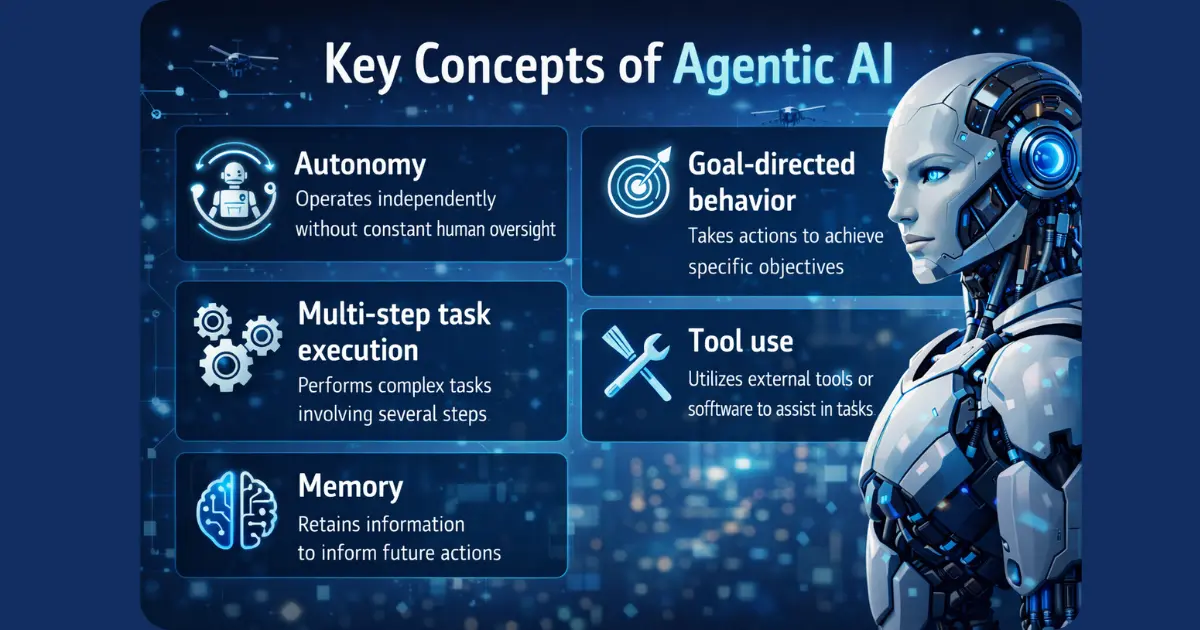
Agentic AI is built on five foundational concepts that distinguish it from other AI architectures.
Autonomy is the defining characteristic. Agentic AI does not wait for a user to provide step-by-step instructions. It receives a high-level goal and determines on its own how to achieve it.
Goal-directed behavior means the system organizes all of its actions around an objective. Every decision the system makes is evaluated against whether it moves the goal forward.
Multi-step task execution refers to the ability to break a complex objective into smaller sub-tasks, complete them in sequence or in parallel, and adapt the sequence if something changes mid-execution.
Tool use allows agentic AI to interact with external systems. Through APIs and integrations, an agentic AI system can search the web, write and run code, query databases, send messages, and perform actions inside third-party applications.
Memory enables agentic AI to maintain context across a long task. Short-term memory keeps track of the current session, while long-term memory stores information across sessions so the system does not need to relearn what it already knows.
Together, these concepts define what makes an AI system “agentic” rather than simply automated.
What are the Characteristics of Agentic AI Systems?
Agentic AI systems share four defining characteristics: proactive behavior, adaptability, collaborative capacity, and specialization.
Proactive
Agentic AI acts without waiting to be asked. Traditional systems are reactive. They respond when triggered and follow preset workflows. Agentic systems identify emerging patterns, anticipate potential problems, and take initiative before issues escalate.
In a supply chain setting, a traditional logistics platform updates delivery statuses when a user checks in or through periodic notifications. An agentic AI system monitors inventory levels continuously, tracks weather conditions, and anticipates shipping delays. It raises alerts proactively and reroutes shipments to reduce downtime, all without a human prompting it to do so.
Adaptable
Agentic AI adapts to changing environments and domain-specific conditions. Standard SaaS solutions are built for broad applicability and handle repetitive tasks well, but they often lack depth when unique domain situations arise. Agentic systems use context awareness and domain knowledge to respond intelligently to conditions that generic tools cannot handle.
A generic customer service platform responds with predefined answers. An agentic AI system supporting a healthcare provider understands medical terminology, follows healthcare regulations, adapts to evolving patient concerns, and delivers context-sensitive support in real time.
Collaborative
Agentic AI works alongside humans and alongside other agentic AI systems. AI agents understand shared goals, interpret human intent, and coordinate actions across a broader team. They perform well in settings that require human oversight or that involve decision-making from multiple stakeholders.
A treatment planning agent in a hospital can coordinate with several medical teams to prepare an integrated treatment and follow-up plan for a cancer patient, pulling inputs from oncology, radiology, and pharmacy before producing a unified recommendation.
Specialized
Agentic AI systems are typically composed of multiple hyperspecialized agents, each focused on a narrow area of expertise. These AI-powered agents coordinate with each other, sharing insights and transferring tasks as needed.
In financial services, one agent handles regulatory compliance, another handles fraud detection, and a third handles portfolio optimization. Working together, they monitor transactions in real time, flag anomalies, recommend investment adjustments, and maintain regulatory compliance simultaneously.
How Does Agentic AI Work?
Agentic AI operates through four structured stages: perceive, reason, act, and learn. Each stage integrates specific AI technologies and methods.
Perceive
At the perception stage, AI agents collect real-time data from a range of sources. They ingest structured data from databases, semi-structured data from APIs, and unstructured data from documents, images, and user interfaces. Agents interact directly with RESTful APIs, gRPC services, and GraphQL endpoints to pull data from cloud platforms, enterprise systems, and SaaS applications.
In environments with legacy systems or heavy document use, optical character recognition (OCR) and natural language processing (NLP) help extract relevant information from scanned documents. At this stage, agents also filter the incoming data, determining what is relevant based on the task context.
Reason
The reasoning stage is powered by LLMs that interpret the context of the goal, develop an action plan, and adapt in real time using new information from the perception stage. LLMs apply semantic reasoning, handle ambiguous inputs, and manage error correction.
Some LLMs use retrieval-augmented generation (RAG) to improve accuracy by pulling from proprietary data sources rather than relying solely on their training knowledge. Others use predictive machine learning (ML) models to forecast future conditions. For example, a predictive ML model embedded in a supply chain system can forecast demand surges and prepare the system to respond before the surge arrives.
Long-term memory systems operate at this stage as well, ensuring that context-dependent tasks remain consistent throughout the full execution of a complex workflow.
Act
At the action stage, the agentic AI executes the plan developed during reasoning. Through administrator-installed plugins and API integrations, it interacts directly with third-party applications, compiles and runs code, migrates data, processes documents, and runs simulations.
The act stage involves orchestrating multiple subtasks. Some agentic AI systems include human-in-the-loop (HITL) checkpoints, where a developer or operator must approve a specific action before the system proceeds. All actions are logged, giving organizations a clear audit trail for governance and compliance.
Learn
The learning stage enables agentic AI to improve its performance over time. Agents use reinforcement learning (RL) techniques, including proximal policy optimization (PPO) and Q-learning, to refine their actions based on outcomes. The system measures its performance using metrics such as latency, confidence score, and success rate.
In multi-agent architectures, learning is distributed across agents. Information is shared through communal memory layers, improving the performance of the entire system, not just the individual agent that handled a specific task. Over time, this recursive improvement loop produces measurable gains in speed, accuracy, and efficiency.
Tips from the Expert
Steve Moore, Vice President and Chief Security Strategist at Exabeam, offers five practical recommendations for teams deploying agentic AI.
First, implement interpretability frameworks to make the system’s reasoning transparent. Tools like SHAP (Shapley Additive Explanations) or LIME (Local Interpretable Model-agnostic Explanations) show why the system made a specific decision, which builds organizational trust in the output.
Second, combine agentic AI with reinforcement learning. Most deployments rely on supervised learning, but RL improves adaptability in dynamic environments where conditions change frequently.
Third, run adversarial testing against the system before production deployment. Exposing the AI to simulated attacks and adversarial inputs reveals decision-making vulnerabilities that standard testing misses.
Fourth, embed domain-specific ontologies into the system. General AI models lack deep expertise in specialized fields. Structured knowledge bases, such as SNOMED for healthcare or FIBO for finance, improve contextual reasoning in those domains significantly.
Fifth, maintain human-in-the-loop oversight even in highly autonomous systems. Configure thresholds at which the AI pauses and requests human validation before proceeding with high-risk decisions.
Agentic AI vs. Generative AI
Agentic AI and generative AI are related but serve different functions.
| Aspect | Agentic AI | Generative AI |
|---|---|---|
| Primary Purpose | Executes tasks and achieves goals autonomously. | Creates content such as text, images, code, or audio. |
| Operation Style | Proactive and goal-driven; plans and performs multiple actions. | Reactive; produces output in response to a prompt. |
| Decision Making | Can reason through complex scenarios and choose actions. | Generates responses based on patterns learned during training. |
| Task Execution | Handles multi-step workflows and adapts as conditions change. | Produces a single output for a given prompt. |
| Interaction with Systems | Integrates with tools, APIs, and external systems to perform actions. | Typically does not act in external systems by itself. |
| Learning & Adaptation | Uses memory and feedback to improve decisions over time. | Does not maintain long-term task memory by default. |
| Role in AI Systems | Acts as an autonomous system that manages processes and objectives. | Often serves as a component used by other systems, including agentic AI. |
| Example Use Case | Automatically running marketing campaigns, monitoring results, and adjusting strategies. | Writing blog posts, generating images, or producing code from prompts. |
Generative AI focuses on content creation. Given an input prompt, it produces text, images, code, or audio based on patterns learned during training. It operates reactively. A user provides a prompt, and the system generates output. Generative AI does not pursue goals independently or take actions in external systems on its own. Models like OpenAI GPT-4o and Anthropic Claude are generative AI systems.
Agentic AI extends beyond content generation to autonomous decision-making and real-world execution. It perceives its environment, reasons through complex scenarios, takes action through tool integrations, and learns from outcomes. Where generative AI produces a static response to a user input, agentic AI pursues an objective across multiple steps and adapts its behavior as conditions change.
The two are not mutually exclusive. Generative AI serves as a core component within modern agentic AI systems, providing the language-based reasoning that drives the agent’s planning and decision-making. Agentic AI uses generative AI as one of its tools rather than as its end product.
A useful example: generative AI could create a set of marketing materials. Agentic AI could then deploy those materials across channels, monitor performance metrics, identify which versions are underperforming, and revise the strategy automatically, using generative AI again at each creative step.
Agentic AI vs. AI Agents
| Feature | Agentic AI | AI Agents |
|---|---|---|
| Definition | A broader concept of AI systems that can act autonomously to achieve goals. | Individual software programs designed to perform specific tasks autonomously. |
| Scope | Represents a paradigm or capability in AI systems. | Represents specific implementations or applications. |
| Goal Handling | Can set, plan, and pursue goals dynamically. | Usually follows predefined goals or instructions. |
| Decision Making | Makes complex decisions based on context, memory, and reasoning. | Makes limited decisions within a defined task scope. |
| Task Execution | Handles multi-step and long-term tasks independently. | Typically performs single or narrow tasks. |
| Use of Tools | Integrates multiple tools, APIs, and resources dynamically. | May use tools but often in a more controlled or scripted way. |
| Memory & Learning | Often includes long-term memory and adaptive learning. | Usually has minimal or task-specific memory. |
| Example | May use tools, but often in a more controlled or scripted way. | Individual software programs are designed to perform specific tasks autonomously. |
The terms “agentic AI” and “AI agents” are often used interchangeably, but there is a meaningful distinction between the two.
AI agents are software programs designed to perform specific tasks autonomously, often following predefined rules. Chatbots, recommendation engines, and robotic process automation (RPA) bots are all AI agents. They execute tasks based on input conditions but lack advanced reasoning, adaptability, or the ability to pursue complex multi-step goals. An AI agent in a cybersecurity system might flag suspicious login attempts based on static rules but require human analysts to investigate and respond.
Agentic AI is a newer and more capable concept. It represents systems that exhibit a higher degree of autonomy and problem-solving ability. Agentic AI does not follow fixed rules. It adjusts its behavior dynamically based on contextual understanding, navigates complex environments, makes independent decisions, and learns from each interaction. All agentic AI systems are AI agents, but not all AI agents qualify as agentic AI.
An agentic AI system in a security operations center (SOC) does not simply flag an alert. It investigates the alert, correlates threat signals across multiple systems, determines the likelihood of an active attack, and executes mitigation actions without waiting for human direction.
Examples of Agentic AI Automation
Agentic AI is being deployed across industries to automate tasks and improve operational outcomes.
Customer Service
Agentic AI manages customer inquiries, resolves issues, and delivers personalized support, allowing human agents to focus on problems that require judgment and empathy.
Supply Chain Management
By analyzing data from sales systems, inventory platforms, and shipping networks, agentic AI optimizes supply chains, predicts demand fluctuations, and automates logistics decisions.
Healthcare
Medical teams use agentic AI to assist with diagnosis, treatment planning, and drug discovery. The system analyzes patient records, research papers, and clinical trial data to surface relevant insights.
Software Development
Agentic AI automates code generation, debugging, and testing, reducing the time required to move from development to deployment while improving code quality.
What are the Use Cases of Agentic AI?
Agentic AI has three primary use cases that represent early and high-impact areas of adoption.
Code Transformation
Agentic AI uses specialized AI-powered agents to remove the complexity from modernization and migration tasks. Agentic AI models built for .NET can modernize Windows-based .NET applications to Linux environments significantly faster by applying machine learning, graph neural networks, LLMs, and automated reasoning together.
Agentic AI can also decompose monolithic z/OS COBOL applications into individual components, reducing a process that once took months to one that takes minutes. The speed, scale, and automation that agentic AI brings to application migration have no equivalent in traditional tooling.
Incident Response Automation
When an incident occurs, whether from a vulnerability or a manual error, agentic AI accelerates the entire response process. It automates the incident response pathway from detection through resolution: rolling back problems, generating incident reports, and notifying the appropriate team members without waiting for a human to orchestrate the steps.
Agentic AI also produces more specific post-incident analysis than traditional methods, identifying root causes in greater depth to prevent the same errors from recurring.
Customer Service Automation
In most customer service scenarios, the answer a customer needs already exists somewhere in the company’s documentation. Agentic AI processes the inquiry, searches available company documents, and returns a relevant answer. If that is not sufficient, the system gathers more information from the customer and works through available solutions. AI-powered agents learn from each interaction, adapting their strategies to improve resolution rates over time. When the system cannot resolve an issue after several attempts, it escalates to a human support agent. This model keeps most customer-oriented services running around the clock without requiring full human staffing.
Real-World Applications of Agentic AI
1. Automating IT Support and Service Management
Agentic AI is changing IT support by identifying and resolving issues before they escalate. Traditional AI follows predefined troubleshooting scripts. Agentic AI analyzes data from IT management systems, learns from past incidents, and adjusts its approach dynamically as new problems arise.
Employees receive immediate assistance for routine IT tasks, including password resets, software installations, and access provisioning, without waiting for human IT staff. For more complex issues, the system integrates with enterprise tools to diagnose and resolve problems that standard automation cannot handle. By automating both routine and advanced IT tasks, organizations reduce downtime and free up IT teams for higher-value work.
2. Enhancing HR Operations and Employee Support
Agentic AI automates routine administrative HR processes while providing real-time, personalized support to employees. In recruitment, it screens resumes, identifies strong candidates, and schedules interviews automatically. For existing employees, it answers HR-related questions, assists with benefits inquiries, and supports onboarding without HR staff involvement for each interaction.
AI-powered HR assistants integrate with internal communication tools, making support available within the workflows employees already use. HR teams redirect time saved from administrative tasks toward workforce planning and talent development.
3. Streamlining Financial Processes and Decision-Making
In financial services, agentic AI analyzes large volumes of data in real time to handle expense reporting, compliance checks, fraud detection, and financial forecasting with high accuracy. It examines a customer’s financial history, detects spending patterns, and recommends specific actions to improve financial outcomes. This includes automating routine money management tasks such as preventing overdraft fees and optimizing savings allocations based on current interest rates.
Financial institutions that deploy agentic AI reduce their dependence on manual processes, lower operational costs, and deliver better financial insights to both businesses and individuals.
Agentic AI Use Cases in Cybersecurity
4. Real-Time Threat Detection and Response
Agentic AI monitors network traffic continuously, analyzes user behavior, and identifies anomalies that indicate malicious activity. When a threat is detected, the system initiates an automated response: isolating compromised endpoints, blocking malicious IP addresses, and notifying security teams. Unlike rule-based security tools, agentic AI refines its threat detection models based on evolving attack patterns rather than waiting for a human to update its rule set.
5. Adaptive Threat Hunting
Agentic AI improves proactive cybersecurity by searching autonomously for threats inside an organization’s systems. Rather than relying on signature-based detection, these systems analyze security data in bulk, looking for hidden patterns and indicators of compromise. By learning continuously from new attack techniques, agentic AI uncovers emerging threats that conventional defenses miss, correlating data from logs, endpoint activity, and network traffic to surface potential attack vectors.
6. Offensive Security Testing
Agentic AI simulates cyberattacks autonomously to test an organization’s defenses. These AI-driven penetration testing systems work through real-world attack scenarios, identifying vulnerabilities in networks, applications, and cloud environments. They adapt their attack strategies based on what the security environment presents rather than running through a fixed checklist. After each round, the system generates detailed reports on security gaps, recommends remediation steps, and validates the effectiveness of fixes once implemented.
7. Case Management
Agentic AI simplifies security case management by automating the classification, tracking, and resolution of incidents. When a threat is detected, the system logs relevant details, categorizes the incident by severity, and assigns it to the appropriate security team. By drawing on past cases, it recommends optimal response strategies. Integration with SIEM platforms and other security tools keeps all stakeholders updated on incident progress, automates reporting, and maintains compliance documentation.
What are the Benefits of Agentic AI?
There are four primary business benefits of deploying agentic AI.
Increased Efficiency
Agentic AI automates complex and repetitive tasks, removing the need for human-driven manual processes across a wide range of operations. Employees whose time was previously consumed by administrative work gain capacity for strategic planning, problem-solving, and other higher-value activities.
Increased User Trust
Agentic AI delivers a higher degree of personalization when interacting with customers. It uses existing customer data to produce tailored messaging, engage in the customer’s preferred tone, and recommend relevant products or services. Over time, consistent and accurate interactions build trust between customers and the business. Agentic AI can also analyze customer feedback, identify the most common issues, and route that information directly to product teams, while responding to individual reviewers to demonstrate that feedback is received and acted upon.
Continuous Improvement
Agentic AI learns and improves continuously. It interacts with users, collects feedback, and refines its decision-making through each iteration. For businesses, this means performance levels increase over time without requiring the organization to retrain or reconfigure the system manually. The gains compound as the system accumulates more experience.
Human Augmentation
Agentic AI works alongside human agents rather than replacing them. Automating difficult decision-making pathways and reducing the volume of manual tasks, it enhances human productivity and allows people to focus on the work that requires their judgment. Human and AI agents working together produce better outcomes than either could achieve independently.
What are the Types of Agentic AI Systems?
Agentic AI can be configured as a single-agent system or a multi-agent system. Single-agent systems have one AI agent handling all tasks sequentially. These work well for well-defined problems where speed matters and the workflow does not require specialized expertise across multiple domains.
Multi-agent systems involve multiple AI agents collaborating to break complex workflows into smaller segments. This approach is more scalable and more flexible for complex scenarios. The majority of production agentic AI deployments use multi-agent architectures.
There are two main structures for multi-agent systems.
Horizontal Multi-Agent
In a horizontal multi-agent system, every agent operates at the same level of technical complexity. Each agent specializes in a narrow skill and contributes its findings to a shared pool that the system uses to solve a broader problem. This structure relies on lateral collaboration between specialized agents rather than a central coordinator directing traffic.
Vertical Multi-Agent
In a vertical multi-agent system, there is a hierarchical structure. Lower-level agents handle simpler tasks such as data collection, formatting, and basic processing. Higher-level agents handle tasks that require more processing power and LLM reasoning, including critical thinking, strategic planning, and final decision-making. Lower-level outputs are passed upward through the hierarchy to inform the decisions made at the top.
What are the Challenges with Agentic AI Systems?
Three specific challenges make agentic AI more difficult to build and operate than conventional software.
System Design
Building a multi-agent architecture that coordinates effectively across models, applies domain-specific knowledge accurately, and performs high-level reasoning is a technically demanding task. Agentic AI sits at the frontier of what current AI technology can achieve. Many organizations will find it difficult to design a system that meets their requirements without significant engineering investment or external expertise.
Testing and Debugging
Agentic AI operates with minimal human intervention, which is one of its primary advantages. That same independence makes testing, debugging, and error diagnosis harder. When a system goes wrong, finding the specific point of failure requires traceability and reproducibility mechanisms built into the architecture from the start. Developers must invest in logging, replay systems, and structured error tracing to maintain visibility into what the system did and why.
Trust and Transparency
AI hallucinations remain a real concern even in advanced systems. When an agent generates false information and passes it to other agents in the network, incorrect data can propagate rapidly, compounding errors in the final output. In industries like finance and healthcare, where errors carry severe real-world consequences, organizations need a high level of verified trust in the system before using it at scale. Achieving that trust requires explainability tools, audit trails, and in many cases, human review checkpoints at key decision points.
Challenges and Risks in Agentic AI Implementation
Agentic AI raises four broader challenges that require governance frameworks to manage effectively.
Accountability in autonomous decision-making is complicated because agentic AI makes decisions dynamically. When something goes wrong, determining whether responsibility falls on the AI developer, the deploying organization, or another party is not straightforward. Clear policies and documentation must be in place before deployment, not after.
Data privacy and security risks arise because agentic AI systems depend on large datasets that often include sensitive information. Without strong data governance, there is a risk of unauthorized access, data misuse, and opaque decision-making. Compliance with regulations such as GDPR and CCPA is a baseline requirement, not an optional consideration.
Over-reliance on autonomous systems is a risk when organizations reduce human oversight to the point where no one is reviewing what the AI is doing. Agentic AI processes data efficiently and optimizes workflows well, but it lacks the nuanced judgment needed for complex, high-stakes decisions. Healthcare, finance, and legal services all involve ethical dimensions that require human accountability.
Ethical governance and transparency require organizations to establish clear frameworks that define what the AI is permitted to do, how it documents its decisions, and how affected parties can contest AI-driven outcomes.
Agentic AI Considerations and Best Practices
Organizations that deploy agentic AI successfully address seven considerations before going live.
Clear objectives come first. The specific problems the AI agents will solve must be defined and aligned with broader business goals before any technical work begins.
Data quality and preparation matter because agentic AI makes decisions based on the data it receives. Inaccurate, incomplete, or improperly formatted data produce unreliable outputs regardless of how capable the model is.
Ethical implications require attention because agentic AI makes decisions that affect people’s lives. Potential biases in training data or algorithms must be identified and addressed. A loan approval system that produces biased outcomes across demographic groups creates legal and reputational exposure in addition to ethical harm.
Security is non-negotiable. Agentic AI systems interact with sensitive enterprise data and can execute actions in external systems. Robust security measures protect against data breaches, unauthorized access, and adversarial manipulation.
Explainability enables trust and effective debugging. Organizations should invest in systems that can articulate why a decision was made, not only what the decision was.
Integration with existing business systems requires planning. Compatibility with current IT infrastructure, data formats, and workflows must be verified before deployment, and data migration challenges should be anticipated.
Monitoring and evaluation must be ongoing. AI agent performance should be tracked continuously, and algorithms should be refined as issues emerge.
Customizing and Integrating Agentic AI Solutions
Successful deployment of agentic AI requires customization to match the specific needs of the organization and careful integration with existing infrastructure.
Key Customization Considerations
AI systems should be trained on domain-specific expertise and the organization’s own business processes. General-purpose models produce general-purpose results. Domain-specific training produces outputs aligned with industry requirements and organizational strategy.
Infrastructure must be optimized so that the AI integrates cleanly with enterprise databases, APIs, and digital workflows. A well-structured data architecture minimizes integration friction and ensures smooth operations from day one.
Human-AI collaboration requires clear role definition. Agentic AI operates autonomously, but human supervision remains necessary to validate decisions at key checkpoints and maintain accountability for outcomes.
Best Practices for Implementation
Start with pilot projects. Testing AI capabilities in controlled environments before scaling limits the risk of large-scale failures.
Monitor AI decisions continuously. Real-time tracking ensures transparency and catches errors before they propagate.
Deploy layered security frameworks to protect the system from threats and data breaches.
Work with AI and cybersecurity specialists during integration. External expertise reduces the risk of implementation errors and ensures the system follows established best practices.
Define clear boundaries between human and AI responsibilities. Both sides of the collaboration need to know where their authority begins and ends.
How Can AWS Support Your Agentic AI Requirements?
Amazon Web Services (AWS) offers a suite of tools designed to support agentic AI development and deployment at enterprise scale.
Amazon Bedrock is a fully managed service that provides access to industry-leading foundation models (FMs) along with the infrastructure needed to build generative AI applications. Amazon Bedrock Agents use the reasoning capabilities of FMs, APIs, and enterprise data to break down user requests, gather relevant information, and complete tasks efficiently. Setup is straightforward, and agents are operational within a few steps.
Amazon Bedrock supports memory retention for seamless task continuity across sessions, multi-agent collaboration with supervisor coordination, and built-in security through Amazon Bedrock Guardrails.
AWS Transform is the first agentic AI service purpose-built for transforming .NET, mainframe, and VMware workloads. Built on 19 years of migration experience, it deploys specialized AI agents to automate assessments, code analysis, refactoring, decomposition, dependency mapping, validation, and transformation planning. Organizations use it to modernize hundreds of applications simultaneously while maintaining quality and control.
Amazon Q Business is a generative AI-powered assistant designed for enterprise use. It enables any employee to create lightweight agentic AI applications that interact with common enterprise software and automate repetitive tasks, putting agentic AI creation in the hands of the broader workforce rather than just technical teams.
Agentic AI for Security with Exabeam
Agentic AI is changing security operations by shifting from passive detection to proactive defense. Instead of flagging alerts for human analysts to investigate, agentic AI systems investigate threats, correlate data across sources, and execute response actions without waiting for direction.
Exabeam Nova is built specifically for this model. It acts as a force multiplier inside a security operations center (SOC) by automating investigations, reducing alert fatigue, and accelerating response times. Exabeam Nova integrates directly into the New-Scale Security Operations Platform, embedding AI-driven insights into existing security workflows without requiring separate tools.
Exabeam Nova adjusts its investigative approach based on the severity and context of each threat. It produces case summary notes within Threat Center that compile key threat indicators, related detections, and recommended actions, reducing the time analysts spend assembling fragmented data. Built on the Exabeam Threat Classification Framework and trained on a significantly larger data set than its predecessor, it delivers deeper investigative accuracy and more reliable threat prioritization.
Customer data processed by Exabeam Nova remains private and secure within the Exabeam environment. No investigation details are used for model training, and all processing stays within a trusted infrastructure that meets industry compliance requirements.
Beyond active investigations, Exabeam Nova supports security posture evaluation through Outcomes Navigator, helping teams assess use case coverage, identify gaps, and receive targeted recommendations for strengthening defenses.
Google Cloud and Agentic AI
Google Cloud provides a range of products and services for organizations building agentic AI systems.
Why Google
Google’s infrastructure supports the scale, reliability, and security that enterprise agentic AI deployments require. Google’s research in large language models, including the Gemini model family, provides the underlying reasoning capability that powers many agentic AI applications.
Products and Pricing
Vertex AI Agent Builder allows teams to create AI agents and applications using natural language or a code-first approach. It provides a range of options for grounding agents in enterprise data.
Agent Development Kit (ADK) is a flexible and modular framework for developing and deploying AI agents. It gives engineering teams control over how agents are built and how they interact with external systems.
Gemini Enterprise is a secure platform for discovering, creating, running, and governing AI agents across an organization.
Solutions
Google Cloud’s Vertex AI provides tools for training, building, and deploying AI models. It includes pre-trained APIs for common tasks and custom training options for specialized use cases. Vertex AI also includes MLOps tools that manage the full machine learning lifecycle, from data preparation through model monitoring, which supports the ongoing development of agentic AI systems over time.
Resources
Google Cloud publishes documentation, tutorials, and technical guides covering agentic AI architecture, agent development, and integration patterns. These resources support both teams new to agentic AI and those scaling existing deployments.
Engage
Organizations can begin working with Google Cloud’s agentic AI tools through a free trial, access technical support through Google’s developer programs, and engage Google Cloud’s professional services team for enterprise implementation assistance.
Conclusion
Agentic AI is an autonomous AI system that perceives its environment, reasons toward a goal, takes independent action, and improves through continuous learning. It differs from generative AI in that it pursues objectives across multi-step workflows rather than generating responses to prompts. It differs from standard AI agents in that it applies dynamic reasoning and contextual judgment rather than following fixed rules.
The four core stages of agentic AI, which are perceiving data, reasoning through a plan, acting on that plan, and learning from outcomes, allow it to handle complex tasks in customer service, supply chain management, healthcare, software development, cybersecurity, IT support, HR operations, and financial services.
The key benefits include increased operational efficiency, continuous performance improvement, stronger user trust through personalization, and better outcomes when AI works alongside human agents rather than in isolation.
The main challenges involve system design complexity, testing and debugging difficulty, and the governance requirements around transparency and accountability. Organizations that address these challenges through clear objectives, quality data, strong security, explainability frameworks, and ongoing monitoring are positioned to deploy agentic AI successfully.
Cloud platforms from AWS and Google Cloud, along with specialized solutions like Exabeam Nova, give organizations practical starting points for building and scaling agentic AI in their own environments.
FAQs
What is the simplest definition of agentic AI?
Agentic AI is an AI system that pursues goals independently, taking multi-step actions and adapting its behavior based on what it learns from its environment, without requiring a human to direct each step.
How is agentic AI different from generative AI?
Generative AI creates content in response to prompts. Agentic AI takes autonomous action in pursuit of goals. Agentic AI often uses generative AI as a component of its reasoning process, but its purpose extends well beyond content generation.
What is the difference between an AI agent and agentic AI?
AI agents are software programs that perform specific tasks based on predefined rules and algorithms. Agentic AI is a more advanced system that applies dynamic reasoning, adapts to changing conditions, and pursues complex multi-step objectives. All agentic AI systems are AI agents, but not all AI agents are agentic AI.
What are the main use cases of agentic AI?
Agentic AI is utilized across various domains, including customer service automation, IT support, HR operations, financial process management, supply chain optimization, healthcare support, software development, code transformation, incident response, and cybersecurity.
What are the biggest risks of agentic AI?
The four main risks are accountability gaps in autonomous decision-making, data privacy and security vulnerabilities, over-reliance on AI without sufficient human oversight, and insufficient transparency in how decisions are made.
How does agentic AI learn?
Agentic AI learns through reinforcement learning techniques, including proximal policy optimization (PPO) and Q-learning. It measures its performance using metrics such as latency, confidence score, and success rate, and refines its behavior based on feedback from both automated systems and human reviewers.
What is a multi-agent system in agentic AI?
A multi-agent system involves multiple AI agents working together to complete complex workflows. In a horizontal multi-agent system, agents operate at the same level and collaborate laterally. In a vertical multi-agent system, agents are organized hierarchically, with lower-level agents processing data and passing it to higher-level agents for reasoning and decision-making.
Which platforms support agentic AI development?
AWS supports agentic AI through Amazon Bedrock, Amazon Bedrock Agents, AWS Transform, and Amazon Q Business. Google Cloud supports it through Vertex AI Agent Builder, the Agent Development Kit, and Gemini Enterprise. OpenAI and Microsoft also offer tools and infrastructure for building agentic AI systems.






- Be Respectful
- Stay Relevant
- Stay Positive
- True Feedback
- Encourage Discussion
- Avoid Spamming
- No Fake News
- Don't Copy-Paste
- No Personal Attacks
- Be Respectful
- Stay Relevant
- Stay Positive
- True Feedback
- Encourage Discussion
- Avoid Spamming
- No Fake News
- Don't Copy-Paste
- No Personal Attacks
