AI Inference vs Training: Key Differences Explained
Published: 4 Mar 2026
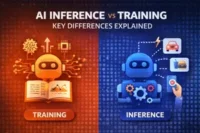
Artificial intelligence (AI) training and artificial intelligence (AI) inference are the 2 core phases of the machine learning (ML) lifecycle. Training is the process of teaching a model to recognize patterns from data. Inference is what the model does after processing new, real-world inputs to generate predictions and decisions.
The 2 phases share the same underlying model but serve entirely different purposes. Training is compute-heavy, episodic, and focused on building model accuracy. Inference is continuous, latency-sensitive, and focused on delivering results in production. Understanding the difference between AI inference and training helps ML engineers select the right hardware, control costs, and optimize the overall workflow.
This article covers 8 key differences between AI inference vs training, the processes that work best in each phase, real-world use cases, hardware selection guidance, and emerging trends shaping both stages of the ML lifecycle.
Table of Contents
What is AI Inference?

AI inference is the process where a trained model receives new, unseen data and produces an output, a prediction, classification, recommendation, or generated response. Inference is what runs every time a user interacts with an AI-powered product. It is the operational phase of the ML lifecycle, and it accounts for the majority of compute costs over a model’s lifetime.
Unlike training, inference does not update the model’s weights. The model’s parameters are fixed. Each input triggers a forward pass through the network, and the result is returned as output. The inference environment is typically a cloud server or edge device equipped with CPUs or GPUs and connected to data sources through extract, transform, and load (ETL) pipelines.
Common examples of AI inference systems include voice assistants, facial recognition systems, recommendation engines, and fraud detection tools.
Batch vs Real-Time Inference
There are 2 primary inference modes: batch inference and real-time inference.
Real-time inference processes inputs immediately as they arrive. A user sends a message to a support chatbot, and the model returns a response within milliseconds. Real-time inference is used for any user-facing application where latency matters.
Batch inference accumulates inputs over a period and processes them together in bulk. Running 10,000 customer support tickets through a classification model overnight is a batch inference job. Batch inference prioritizes throughput and cost efficiency over speed.
Most production systems use both. Real-time inference handles live traffic; batch inference handles heavier, time-insensitive workloads like analytics scoring or content tagging.
How Does AI Inference Work?
AI inference follows a 5-step pipeline from raw input to final output. Using a product recommendation engine as an example:
- Input preprocessing. Raw user data browsing history, purchase records, and time spent on product pages are cleaned, structured, and formatted into a feature vector that the model can process.
- Tokenization or encoding. The preprocessed features are converted into numerical representations. In a recommendation engine, each product, category, and user behavior maps to an embedding: a dense numerical vector that captures relationships between items in the catalog.
- The forward pass. The encoded input moves through the model’s layers. The model compares the user’s behavior patterns against what it learned during training and generates a probability score for each candidate product. No weight updates occur during inference; the model runs forward only and returns a result.
- Decoding or ranking. The model outputs a scored list of candidates. A ranking layer sorts the scores and applies business rules: filtering out-of-stock items, boosting items on sale, and removing products already purchased.
- Post-processing. Product IDs are mapped back to actual listings with names, images, and prices, then formatted for display. The final recommendation carousel the user sees is the result of this entire pipeline.
All 5 steps complete in milliseconds to seconds, depending on model size and hardware. At scale, this pipeline runs millions of times per day, which is why inference cost and optimization are central concerns for AI teams.
What is AI Training?
AI training is the process of teaching a model to recognize patterns by exposing it to large volumes of labeled data and iteratively adjusting its internal parameters until it produces accurate outputs. Training is the most resource-intensive phase of the machine learning lifecycle.
Training requires large datasets, significant GPU compute, and substantial processing time. The quality of training directly determines how well a model performs during inference. A model trained on low-quality or biased data will produce unreliable predictions no matter how well the inference infrastructure is optimized.
Once training is complete, the model’s weights are saved, and the model is packaged for deployment. At that point, the model is frozen; it will not learn anything new until it is retrained.
How Does AI Training Work?
Training a weather forecasting model provides a clear illustration of how the process works in practice:
- Data collection. Training begins with assembling a representative dataset. For a weather model, this includes historical atmospheric data, satellite imagery, ground sensor readings, and recorded outcomes. The breadth and quality of this data determine the upper bound of what the model can learn.
- Data preprocessing and labeling. Raw data requires cleaning: missing sensor values are filled, satellite images are normalized, and time-series data are aligned across sources. Each data point receives a label reflecting what actually happened: clear skies, thunderstorm, tornado warning, so the model has a target to learn against.
- Feature engineering and selection. The team decides which inputs the model should learn from. Engineered features such as the rate of atmospheric pressure change over 6 hours often capture patterns that raw data alone cannot. Feature selection then removes redundant or noisy variables, reducing training time and improving accuracy.
- Model architecture selection. The team selects a model architecture suited to the problem. A weather forecasting model combining spatial satellite data with time-series sensor readings might use convolutional layers for image processing alongside transformer-based layers for temporal patterns.
- The training loop. The model processes batches of training data, generates predictions, and compares those predictions against actual labels using a loss function. Backpropagation adjusts the model’s weights to reduce the error. This cycle repeats across the full dataset for multiple iterations, called epochs, until the model’s accuracy reaches an acceptable level.
- Validation and evaluation. Throughout training, the model is tested on a separate holdout dataset to confirm it is learning generalizable patterns rather than memorizing training data. If the model performs well on training data but poorly on the validation set, it is overfitting. ML engineers adjust hyperparameters, add data, or simplify the architecture as needed.
- Export and deployment. Once the model meets performance benchmarks, the trained parameters are saved, and the model is packaged for inference.
The full process can take days or weeks, depending on dataset size, model complexity, and available hardware. Modern large language model (LLM) training — such as GPT-4 — has taken between 90 and 100 days.
AI Inference vs Training
| Post-deployment, uses fixed weights to generate predictions | AI Inference | AI Training |
|---|---|---|
| Stage of ML lifecycle | Pre-deployment: adjusts weights iteratively on training datasets | Pre-deployment; adjusts weights iteratively on training datasets |
| Frequency | Continuous or on-demand | Episodic; once per model version or fine-tuning cycle |
| Cost and pricing | Ongoing, usage-driven operational cost | Upfront or periodic compute cost |
| Infrastructure and hardware | GPUs or accelerators optimized for concurrency and low latency | Multi-node GPU clusters optimized for parallelism and throughput |
| Latency and throughput | Latency-sensitive; tight response time targets | Throughput-sensitive; per-batch latency is secondary |
| Computational resource needs | Lower; forward pass only, no backpropagation | Higher; full forward and backward passes across millions of data points |
| Timeframe | Milliseconds to seconds per request | Days to weeks per training run |
| Energy and cost implications | Ongoing costs that compound at scale | High upfront energy and monetary cost |
Stage of the ML Lifecycle
- AI inference occurs after model deployment as part of production systems. The model’s weights are fixed, and each input triggers a forward pass to generate output classifications, embeddings, probability scores, or generated tokens. Inference runs continuously in production, often integrated into user-facing applications or APIs.
- AI training occurs before deployment. The training phase uses training datasets to adjust model weights via backpropagation and improve accuracy through iteration. Training is compute-intensive, typically runs on multi-node GPU clusters optimized for parallelism, and is episodic rather than continuous.
Frequency
- AI inference runs continuously or on demand. Real-time inference serves user-facing requests immediately; batch inference handles accumulated inputs on a schedule. High-volume systems, recommendation engines, and AI agents require sustained throughput with predictable latency.
- AI training is performed episodically, typically once per model version or during fine-tuning cycles. Training workloads may repeat over multiple epochs, but they do not run continuously in production. Teams can optimize for GPU utilization and throughput without real-time latency pressure.
Cost and Pricing
- AI inference costs are ongoing and usage-driven. They scale with request volume, GPU and accelerator usage, memory allocation, and autoscaling behavior. Because inference runs continuously, costs compound quickly. Nearly 44% of organizations now allocate 76–100% of their AI budget to inference, and 49% identify high inference cost as the single largest blocker to scaling AI products.
- AI training costs are upfront or periodic, driven by dataset size, model complexity, number of epochs, and distributed GPU usage. Training costs are episodic and more predictable than inference costs at scale.
Infrastructure and Hardware Requirements
- AI inference workloads run on GPUs or specialized accelerators tuned for memory bandwidth, concurrency, and predictable performance under variable traffic. CPUs handle inference for smaller models or low-throughput use cases, but GPUs are standard for production workloads serving real-time traffic.
- AI training relies on GPUs or multi-node clusters capable of distributed gradient computation. The priority is parallelism, high memory throughput, and fast inter-node communication. CPUs play a supporting role in data preprocessing and small-scale experimentation, but the training loop itself runs on GPUs.
Latency and Throughput
- AI inference is latency-sensitive. Teams optimize for low, predictable response times under both bursty and sustained load using dynamic batching, request coalescing, and concurrency-aware scheduling.
- AI training is throughput-sensitive. Per-batch latency matters less because training happens offline. The focus is on moving through as much data as possible per training run by maximizing GPU utilization across epochs.
Computational Resource Needs
AI training is an iterative, experimental phase that involves complex neural network architectures like Convolutional Neural Networks (CNNs), Transformers, and vision transformers. The model processes an extensive dataset multiple times, requiring large video RAM (VRAM) and parallel processing capacity. ML engineers often pair 10 to 20 GPUs for standard training runs; modern LLM training has used several thousand.
AI inference processes significantly fewer calculations. A deployed model may handle hundreds or thousands of concurrent requests, compared to the millions of data points processed during training. Because inference only involves a forward pass, no backpropagation, the computational complexity is substantially lower. Many edge-deployed solutions perform AI inference on mobile-grade CPUs.
Timeframe
Training an AI model takes days to weeks, depending on model complexity, dataset size, and available compute. GPT-4 training took between 90 and 100 days.
Inference times are milliseconds to seconds per request. Autonomous vehicles analyze multiple objects simultaneously in real time, where even slight delays in inference can have critical consequences.
Energy and Cost Implications
AI training requires 10 to thousands of GPUs running for weeks or months, resulting in high energy and monetary costs. GPT-3 training consumed approximately 1,287 megawatt-hours (MWh) of electricity, equivalent to the annual power consumption of roughly 130 US homes. The development cost for GPT-4 is estimated at around 70 million USD; Gemini 1 exceeded 150 million USD.
AI inference costs are lower per request but accumulate continuously at scale. For large consumer AI products, ongoing inference spend routinely exceeds the original training investment.
Processes in Training and Inference
Processes That Are More Effective in Training
- Learning complex data patterns. The training phase is where the model builds its understanding of real-world patterns. Exposure to millions of data points across diverse scenarios allows the model to learn from errors through iterative weight adjustments.
- Scalable training environments. AI training runs in scalable environments that automatically expand resources as the dataset size grows, ensuring efficient use of compute across large runs.
Processes That Are Less Effective in Training
- Data collection and cleaning. Building a high-quality training dataset requires significant time, effort, and domain expertise. Poor data quality directly limits model performance and can cause the entire project to fail.
- High training costs. Training requires expensive GPUs, long runtimes, and large storage resources. The financial barrier is high, particularly for LLM-scale training.
- Optimization complexity. The training process requires iterative optimization across feature selection, hyperparameter tuning, and architecture design. The process is largely trial and error and can require many training runs before acceptable performance is reached.
Processes That Are More Effective in Inference
- Real-time decision making. Inference enables applications to return decisions within milliseconds based on live input data. This capability drives use cases like autonomous vehicles, facial recognition systems, and real-time fraud detection.
- Scalable inference environments. Inference environments scale as user demand grows. Cloud-hosted inference can automatically provision additional GPU resources during traffic spikes.
Processes That Are Less Effective in Inference
- High latency. Unoptimized model architectures or underpowered hardware increase inference time. Cloud-deployed solutions can also experience network latency. In healthcare or autonomous driving applications, excessive inference latency has direct consequences.
- Performance depends on training quality. If training was inadequate, poor model performance is reflected during inference. Inference-side optimizations cannot compensate for a poorly trained model; developers must return to the training phase.
- Ongoing retraining requirements. Model performance degrades over time due to model drift as real-world data patterns shift. AI models require continuous retraining cycles to maintain inference accuracy.
Use Cases for AI Inference
Inference is where AI operates in the real world. There are 5 primary inference use cases across industries:
- Intelligent video surveillance. Smart surveillance cameras run inference locally on edge devices to detect suspicious behavior or security anomalies in real time. Edge-deployed models eliminate the latency of round-trip network calls to cloud servers.
- Inventory and demand forecasting. Retailers use machine learning inference for real-time inventory monitoring and demand prediction. Models process live sales data to trigger restocking and optimize supply chain decisions.
- Industrial quality control. Manufacturers deploy computer vision systems that run inference on production line data to detect defects, irregular shapes, or anomalies in real time as items move through the production process.
- AI-powered customer interaction. LLM-based AI agents use real-time inference to respond to customer queries, route support tickets, and generate personalized responses at scale.
- Medical diagnosis support. AI inference systems assist clinicians by processing medical imaging data, such as X-rays, MRIs, and CT scans, to flag potential abnormalities for review.
Use Cases for AI Training
There are 4 primary training use cases where the AI training phase drives significant value:
- Medical imaging model development. Training self-supervised learning models on large medical image datasets spanning radiography, CT, MRI, and ultrasound builds rich feature representations without requiring expensive expert annotations. Models trained at this scale achieve measurably higher accuracy on diagnostic tasks like detecting chest abnormalities and brain hemorrhages.
- Speech recognition model training. Training automatic speech recognition (ASR) systems on hundreds of thousands of hours of multilingual audio data produces models capable of handling accents, background noise, and technical terminology across diverse real-world conditions.
- Fraud detection model retraining. Financial institutions continuously retrain fraud detection models against live production traffic as fraud patterns evolve. Platforms that support rapid retraining and deployment significantly reduce the window during which new fraud vectors go undetected.
- Large language model development. Training LLMs like GPT-4 on trillion-token datasets using thousands of GPUs produces general-purpose language capabilities that power downstream inference applications, including coding assistants, content generation tools, and AI agents.
Choosing the Right Hardware for Training and Inference
Hardware selection depends on the specific use case. There is no universal answer; the right hardware for a sales forecasting engine differs significantly from what is required for an LLM-based customer interaction agent.
The 3 hardware scenarios below illustrate typical requirements:
Scenario 1: Sales forecasting with 5 years of daily transaction data. Training hardware: CPU. The dataset contains a few thousand data points, and standard ML algorithms are sufficient. Inference hardware: CPU. If the CPU is adequate for training, it handles inference without difficulty.
Scenario 2: Image classification for e-commerce product categorization. Training hardware: GPU. Images are processed by deep neural networks that benefit from GPU parallel processing. Inference hardware: CPU for standard catalog sizes; GPU if the product catalog is very large or a real-time response is required.
Scenario 3: LLM-based AI agent for customer interaction. Training hardware: Multiple GPUs. LLMs have complex architectures and require large datasets. Inference hardware: Multiple GPUs, depending on expected concurrent user volume. GPU-accelerated inference is required for near-real-time response in customer-facing applications.
Budget and project duration also shape hardware decisions. Cloud-based solutions from AWS, Azure, and Google Cloud offer lower upfront costs and pay-as-you-go pricing. Long-term projects with sustained compute needs may benefit from in-house NVIDIA GPU infrastructure, where the higher upfront cost pays off over time compared to ongoing cloud fees.
Future Trends in AI Training and Inference
There are 4 major trends shaping the future of both AI training and inference:
- Energy efficiency. As AI applications scale, demand for greener training infrastructure is growing. Renewable energy-powered data centers, hardware with improved power efficiency, and AI architectures that learn from fewer data passes will reduce the carbon footprint of training workloads.
- Distributed computing. Distributed training and inference use hardware clusters to spread computation across multiple machines for faster processing. This approach is already standard for large model training and is expanding to inference workloads.
- Edge AI expansion. AI models are increasingly deployed directly on user devices rather than on cloud servers. Smartphone manufacturers, including Samsung, have introduced on-device AI capabilities. As hardware costs decline and models become more efficient, edge inference will become more prevalent across consumer and industrial applications.
- Inference-first architectures. As organizations shift AI budgets toward inference, model architectures and training procedures are being optimized with inference efficiency as a primary objective, not an afterthought. Techniques like quantization, distillation, and FlashAttention are becoming standard parts of the training-to-deployment pipeline.
Conclusion
AI training and AI inference are the 2 core phases of every machine learning application. Training builds the model’s knowledge by processing large datasets through iterative optimization. Inference applies that knowledge to new data in production to generate real-world predictions and decisions.
The 8 key differences between AI inference vs training span stage of the ML lifecycle, frequency, cost, infrastructure, latency, computational resource needs, timeframe, and energy implications. Training is resource-intensive, episodic, and focused on model accuracy. Inference is continuous, latency-sensitive, and optimized for production performance.
Artificial intelligence training uses expensive GPUs, can take weeks to complete, and can cost tens of millions of USD for large-scale LLM development. AI inference runs continuously in production, scales with user demand, and now accounts for the majority of most organizations’ ongoing AI spend. Understanding both phases’ distinct objectives, resource requirements, and performance considerations allows ML engineers to make better architecture decisions, select the right hardware, and optimize costs across the entire AI development lifecycle.
AI Inference vs Training FAQ
What is the difference between AI inference and training?
AI training is the phase where a model learns patterns from large datasets, adjusting its internal weights through iterative optimization. AI inference occurs after deployment, applying the trained model to new data to generate predictions, classifications, or generated outputs. Training produces the model’s knowledge; inference uses that knowledge in production.
Which is more expensive: training or inference?
Training requires intensive computing over a finite period, often multiple GPU clusters running for days or weeks. Inference costs are ongoing and scale continuously with production usage. While a single training run can cost tens of millions of USD for large models, inference costs compound across every user request over the model’s operational lifetime. For most organizations running AI products at scale, total inference spend exceeds training spend over time.
Can inference run without training?
No. Inference depends entirely on a trained model. Without prior training, a model has no learned weights or patterns to apply and cannot generate accurate predictions. Even small-scale inference requires a trained model.
Does inference always require a GPU?
No, but GPUs are standard for most production workloads. CPUs handle inference for small models or low-throughput batch jobs where GPU costs are not justified. For large models, real-time traffic, or LLM-based applications, GPUs or specialized accelerators are required to meet latency and throughput targets.
How often is training performed compared to inference?
Training is episodic, typically performed once per model version or during periodic fine-tuning cycles. Inference is continuous or on-demand, running in real time for user requests or on a scheduled basis for batch jobs. A model trained once may serve billions of inference requests before the next retraining cycle.
What hardware is used for AI training vs inference?
AI training typically uses multi-node GPU clusters from NVIDIA, often with frameworks like TensorFlow or PyTorch running on cloud infrastructure from AWS, Azure, or Google Cloud. AI inference can run on GPUs, CPUs, or specialized edge hardware, depending on the model size and latency requirements. Edge-deployed solutions use mobile-grade CPUs; LLM inference at scale requires multiple GPUs.
What is the difference between batch and real-time inference?
Real-time inference processes each input immediately as it arrives and returns a result within milliseconds to seconds. Batch inference accumulates inputs over a period and processes them together in bulk, optimizing for throughput and cost per prediction rather than response speed. Real-time inference is used for user-facing applications; batch inference is used for background analytics, scoring, and bulk processing tasks.





- Be Respectful
- Stay Relevant
- Stay Positive
- True Feedback
- Encourage Discussion
- Avoid Spamming
- No Fake News
- Don't Copy-Paste
- No Personal Attacks
- Be Respectful
- Stay Relevant
- Stay Positive
- True Feedback
- Encourage Discussion
- Avoid Spamming
- No Fake News
- Don't Copy-Paste
- No Personal Attacks
