Supervised vs Unsupervised vs Reinforcement Learning: Which Is Which?
Published: 18 Mar 2026
Machine learning (ML) has 3 primary learning paradigms: supervised learning, unsupervised learning, and reinforcement learning. Each paradigm defines how an algorithm receives information, processes patterns, and produces outcomes. Supervised learning trains on a labelled dataset and predicts mapped outputs. Unsupervised learning finds hidden structure in unlabeled data without any predefined output. Reinforcement learning trains an intelligent agent to make sequential decisions by interacting with an environment and collecting rewards.
Understanding the difference between supervised vs unsupervised vs reinforcement learning helps data scientists, developers, and engineers pick the right tool for the right task. Supervised learning fits prediction tasks like email spam detection and disease diagnosis. Unsupervised learning fits exploration tasks like customer segmentation and anomaly detection. Reinforcement learning fits sequential decision-making tasks like robotics control and game playing.
The 3 paradigms differ in 4 fundamental ways: the type of training data they need, the level of human supervision involved, the kind of problem they address, and the feedback mechanism the learning model relies on. This article explains each paradigm in full, compares supervised vs unsupervised learning, supervised vs reinforcement learning, and provides a comprehensive three-way comparison with examples, techniques, and a definition recap.
Table of Contents
Understanding Supervised Learning
Supervised learning is a machine learning (ML) approach where an algorithm trains on a labelled dataset, meaning every input data point comes paired with a correct output label. The algorithm learns a mapping function from inputs to outputs by minimizing the error between its predictions and the known labels. Once trained, the model applies that mapping to new, unseen data to generate predictions.
The word supervised refers to the human effort involved in preparing labelled data. A programmer or data scientist curates the training data, assigns correct labels, and feeds the labelled dataset to the model. The supervision comes at the data preparation stage, not during training itself.
Supervised learning is the most widely used of the 3 machine learning paradigms. It powers applications ranging from medical image classification and credit risk scoring to natural language text classification and sales forecasting.
Supervised Learning Examples
There are 6 common real-world supervised learning examples across industries:
- Email spam detection. A classifier learns from thousands of labelled emails tagged as spam or not spam, then applies that learning to flag new incoming messages.
- Cancer detection from medical scans. A model trained on labelled radiology images learns to distinguish malignant from benign tissue.
- House price prediction. A regression model trained on historical sales data predicts the market value of a new property based on area, location, and number of rooms.
- Loan default prediction. Banks train classification models on historical borrower records labelled as defaulted or repaid to score new applicants.
- Sentiment analysis. A text classifier trained on labelled product reviews predicts whether a new review expresses positive, negative, or neutral sentiment.
- Fraud detection in financial transactions. A model learns patterns in labelled transactional data to flag suspicious activity in real time.
Supervised Learning Techniques
Supervised learning techniques fall into 2 categories based on the output type: classification and regression.
Classification problems ask the model to assign an input to one of a finite set of categories. The output is a discrete class label. For example, a fruit image dataset where each photo is labelled as mango, apple, or orange trains a classifier to identify the class of a new fruit photo. There are 3 widely used classification algorithms:
- Naive Bayes Classifier. Applies Bayes’ theorem with an assumption of feature independence to assign class probabilities.
- Support Vector Machines (SVM). Finds the optimal hyperplane that separates classes in high-dimensional feature space.
- Logistic Regression. Models the probability of a binary outcome using a logistic sigmoid function applied to a linear combination of features.
Regression problems ask the model to predict a continuous numerical value. For example, predicting the price of land in a city given its area, location, and number of rooms is a regression task. There are 3 core regression techniques:
- Linear Regression. Models the relationship between input features and a continuous output as a straight line.
- Nonlinear Regression. Fits curves to data where the relationship between inputs and output is not linear.
- Bayesian Linear Regression. Extends linear regression by treating model parameters as probability distributions rather than fixed values, which produces uncertainty estimates alongside predictions.
Exploring Unsupervised Learning
Unsupervised learning is a machine learning approach where an algorithm trains on unlabeled data with no predefined output to guide it. The algorithm explores the raw data, identifies hidden patterns, and organizes the data into meaningful structures entirely on its own. There is no human-assigned label telling the model what is correct or incorrect.
Unsupervised learning is self-organized. The algorithm does not receive feedback in the form of labeled output. Instead, the learning model discovers structure based on statistical properties of the input data itself, including distances between data points, feature correlations, and frequency patterns.
This approach is valuable in 3 broad situations: when labeling data is too expensive or time-consuming, when the number of possible output categories is unknown, and when the goal is exploration rather than prediction.
Unsupervised Learning Examples
There are 5 common real-world unsupervised learning examples:
- Customer segmentation. A retailer groups customers by purchasing behavior, geography, and engagement level without predefined customer categories.
- Anomaly detection in cybersecurity. A model learns normal network traffic patterns and flags behavior that deviates significantly from those patterns as a potential intrusion.
- Gene expression analysis in biology. Researchers cluster genes with similar expression profiles across experimental conditions to discover functional relationships.
- Topic modeling in text. An algorithm scans a collection of documents and identifies recurring themes without being told what topics to look for.
- Market basket analysis in e-commerce. The algorithm identifies products that customers frequently purchase together, producing association rules used for product recommendations.
Unsupervised Learning
Unsupervised learning solves 2 main types of problems: clustering and dimensionality reduction.
Clustering groups data points into clusters based on similarity. Data points within the same cluster share more in common than with points in other clusters. K-Means clustering is the most widely used clustering algorithm. It partitions data into K groups by iteratively minimizing the distance between each point and its assigned cluster centroid.
Dimensionality reduction compresses high-dimensional data into a lower-dimensional representation while preserving as much meaningful structure as possible. Principal Component Analysis (PCA) is the standard technique. It transforms correlated features into a smaller set of uncorrelated principal components ordered by the variance they explain.
Association rule mining is a third unsupervised task. It identifies co-occurrence rules in transactional datasets. The Apriori algorithm scans transaction records and extracts rules of the form: customers who buy product A frequently also buy product B.
Unsupervised Learning Techniques
There are 3 primary unsupervised learning techniques:
- K-Means Clustering. Partitions data into K clusters by minimizing intra-cluster variance through iterative centroid updates.
- Neural Networks for representation learning. Autoencoders are a class of neural network trained to compress input data into a compact latent representation and then reconstruct the original data, learning efficient feature representations in the process.
- Principal Component Analysis (PCA). Reduces dimensionality by projecting data onto the directions of maximum variance, retaining the most informative structure while discarding noise.
Diving into Reinforcement Learning
Reinforcement learning (RL) is a machine learning paradigm where an intelligent agent learns to make decisions by interacting with an environment and receiving rewards or penalties based on the outcomes of its actions. The agent is not given labelled data. The agent is not told which action is correct. The agent discovers which actions maximize cumulative reward through trial and error over many interactions.
The core structure of reinforcement learning involves 4 components: the agent, the environment, the state, and the reward signal. At each time step, the agent observes the current state of the environment, selects an action based on its policy, receives a reward signal, and transitions to a new state. The agent repeats this cycle until it reaches a terminal state or completes an episode.
Reinforcement learning differs from supervised learning and unsupervised learning in a fundamental way. The feedback is delayed. The agent may not know which earlier action caused a later reward or penalty. This is called the credit assignment problem, and solving it is one of the central challenges in RL research.
Reinforcement learning is growing rapidly and producing a broad variety of learning algorithms used in robotics, gaming, autonomous driving, and healthcare treatment optimization.
Reinforcement Learning Examples
There are 5 major real-world reinforcement learning examples:
- Self-driving cars. The vehicle agent learns to navigate roads, obey traffic signals, and avoid obstacles by receiving rewards for safe progress and penalties for collisions.
- Game playing AI. Systems like AlphaGo learn to play board games at superhuman levels by playing millions of games against themselves and reinforcing winning move sequences.
- Robotic manipulation. Industrial robots learn precise assembly tasks by receiving positive rewards for correct part placement and negative feedback for misalignment.
- Personalized healthcare. RL agents learn optimal treatment policies for chronic disease management by receiving rewards tied to patient health outcomes.
- Recommendation systems. Streaming platforms use RL to learn content recommendation policies that maximize long-term user engagement rather than just immediate click-through rates.
Reinforcement Learning Techniques
There are 3 core reinforcement learning techniques:
- Q-Learning. A model-free algorithm that learns the value of taking a specific action in a specific state without requiring a model of the environment. The agent updates a Q-table iteratively using the Bellman equation.
- SARSA (State-Action-Reward-State-Action). An on-policy RL algorithm that updates the Q-value based on the action the agent actually took in the next state, making it more conservative than Q-learning.
- Deep Q-Networks (DQN). Combines Q-learning with deep neural networks to handle environments with large or continuous state spaces. DQN enabled the first superhuman performance on Atari video games.
Markov’s decision processes (MDPs) provide the mathematical foundation for most reinforcement learning techniques. An MDP formally defines the environment as a set of states, a set of actions, a transition function, and a reward function. Policy learning is the process of finding the optimal mapping from states to actions that maximizes expected cumulative reward.
Supervised vs Unsupervised Learning: Key Differences
Supervised learning and unsupervised learning differ in 3 foundational ways: how they use data, what human effort they require, and what kind of problem they address. Choosing between them depends on whether labeled training data is available and whether the goal is prediction or discovery.
Data and Labeling: Supervised vs Unsupervised Learning
Supervised learning requires a labelled dataset. Every training example must carry a correct output label assigned by a human expert. Preparing this labelled data is often the most expensive and time-consuming part of a supervised learning project. The quality of the labels directly determines the quality of the trained model.
Unsupervised learning requires no labels. The algorithm receives raw input data and must find structure in it without any human-assigned output. This makes unsupervised learning faster to prepare data for, but it also means the algorithm cannot be corrected toward a known correct answer. The output of unsupervised learning, such as cluster assignments or latent representations, must be interpreted and validated by a domain expert.
Labelled data dependency is the single most practical constraint separating the 2 approaches. Organizations with large volumes of labeled historical records lean toward supervised learning. Organizations exploring new data without established categories lean toward unsupervised learning.
Goals and Applications: Supervised vs Unsupervised Learning
The goal of supervised learning is to predict. Given a new input, the model produces a predicted output label or numerical value based on patterns learned from labelled training data. Supervised learning fits 3 main application domains: medical diagnosis, financial risk assessment, and natural language processing (NLP).
The goal of unsupervised learning is to discover. Given raw data, the model identifies hidden groupings, relationships, or compressed representations that were not explicitly specified. Unsupervised learning fits 3 main application domains: customer analytics, cybersecurity anomaly detection, and biological data exploration.
Supervised vs Unsupervised Learning Examples (Comparative)
There are 3 direct comparative examples that illustrate how the 2 approaches tackle similar data with different goals:
Customer data. A supervised model trained on labelled churn records predicts which customers will cancel their subscription next month. An unsupervised model applied to the same customer data discovers natural behavioral segments without a predefined churn label.
Medical images. A supervised model trained on labeled X-rays classified as normal or abnormal predicts the diagnosis for a new scan. An unsupervised model clusters unlabeled scans by visual similarity, potentially revealing previously unknown disease subtypes.
Text data. A supervised sentiment classifier trained on labeled reviews predicts the sentiment of new text. An unsupervised topic model applied to unlabeled documents discovers the thematic structure of the corpus without any predefined category list.
Supervised vs Reinforcement Learning: Key Differences
Supervised learning and reinforcement learning both use feedback to improve a model, but the nature of that feedback is fundamentally different. Supervised learning receives immediate, explicit, labeled feedback at every training step. Reinforcement learning receives delayed, implicit reward signals that emerge from interactions with an environment over many time steps.
Feedback Mechanisms: Supervised vs Reinforcement Learning
Supervised learning feedback is direct and immediate. At each training step, the model produces a prediction, the training label provides the ground truth, and the loss function measures the error. The model updates its parameters to reduce that error. The programmer controls every labeled example the model sees.
Reinforcement learning feedback is indirect and delayed. The agent takes an action, the environment responds with a state transition and a reward signal, and the agent must figure out which sequence of past actions produced that reward. The agent interacts with the environment in discrete steps following Markov’s decision processes, where the next state depends only on the current state and action.
The exploration-exploitation tradeoff is unique to reinforcement learning. The agent must balance exploiting actions it knows produce rewards against exploring new actions that might produce higher rewards. Supervised learning has no equivalent tradeoff because the training data is fixed in advance.
Goals and Applications: Supervised vs Reinforcement Learning
Supervised learning is the right choice when a large labelled dataset exists and the task requires accurate prediction of a fixed output. Supervised learning works well for static prediction problems where the correct output for each input can be determined and labeled in advance.
Reinforcement learning is the right choice when the task requires sequential decision-making in a dynamic environment where the optimal action depends on the current state and future consequences. Reinforcement learning works well for 3 categories of applications: autonomous control systems like self-driving cars, strategic game-playing agents, and personalized recommendation systems that optimize long-term engagement.
The 2 approaches are not mutually exclusive. In practice, supervised learning frequently initializes RL agents through a technique called imitation learning, where the agent pre-trains on labelled human demonstrations before switching to reward-based policy learning.
Supervised vs Unsupervised vs Reinforcement Learning: A Comprehensive Comparison
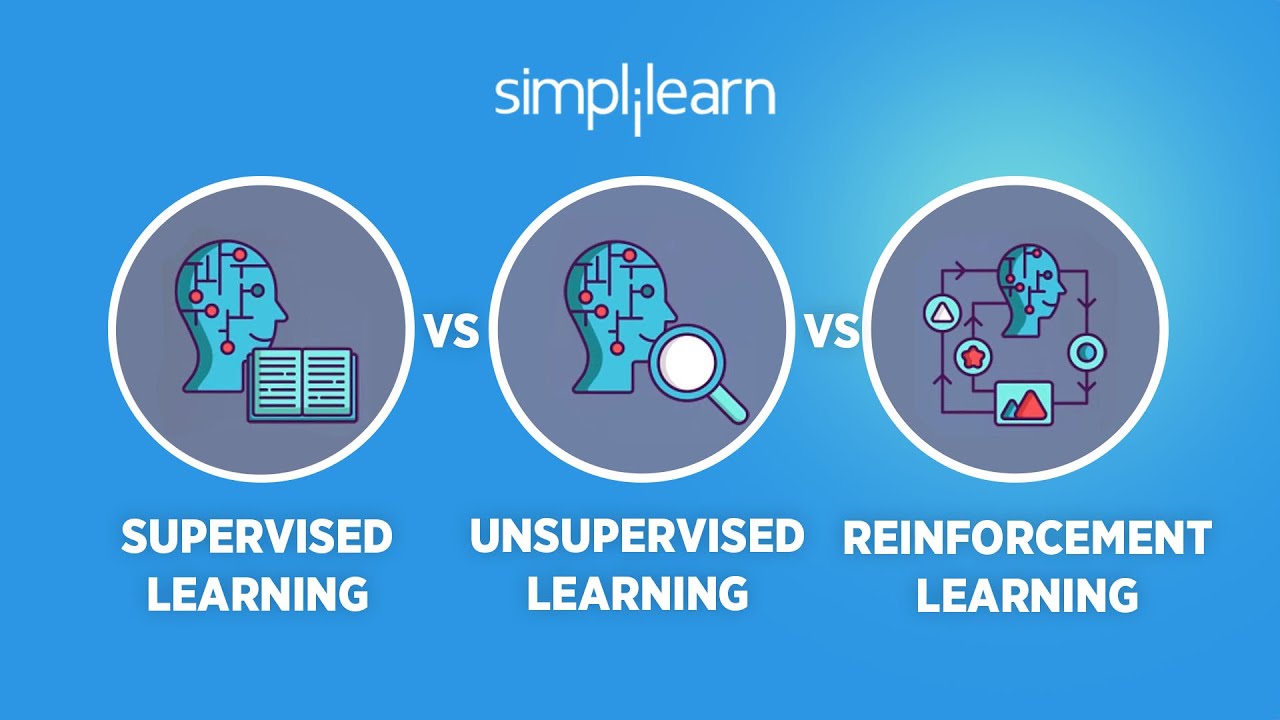
The 3 machine learning paradigms share the goal of building systems that improve from data, but they operate on different data types, use different feedback mechanisms, and solve different categories of problems. The table below provides a structured comparison across 7 criteria.
Supervised vs Unsupervised vs Reinforcement Learning Diagram
| Criteria | Supervised Learning | Unsupervised Learning | Reinforcement Learning |
| Definition | Trains on labelled data to predict mapped outputs | Finds hidden structure in unlabeled data | Agent learns by interacting with environment for rewards |
| Type of Data | Labelled data | Unlabeled data | No predefined data; generated by environment interaction |
| Type of Problems | Classification and Regression | Clustering and Association | Sequential decision-making |
| Supervision Level | High: requires labeled training data | None: no labels required | Partial: reward signal guides learning |
| Core Algorithms | SVM, Logistic Regression, Decision Trees | K-Means, PCA, Autoencoders | Q-Learning, SARSA, Deep Q-Network (DQN) |
| Goal | Predict accurate output for new inputs | Discover hidden patterns in data | Optimize long-term reward through action selection |
| Applications | Medical diagnosis, fraud detection, NLP | Customer segmentation, anomaly detection | Self-driving cars, robotics, gaming |
Supervised vs Unsupervised vs Reinforcement Learning Examples (Comparative)
The clearest way to see how the 3 paradigms differ is to apply all 3 to a similar real-world scenario:
Scenario: E-commerce platform with customer data.
Supervised learning application: A model trained on labelled purchase records predicts whether a specific customer will buy a product in the next 7 days. The output is a binary classification: buy or no buy.
Unsupervised learning application: A clustering algorithm groups all customers into segments based on browsing behavior, average order value, and purchase frequency without any predefined segment labels. The output is a set of natural customer clusters.
Reinforcement learning application: A recommendation agent learns which product to surface to each customer at each session by receiving a reward when a customer completes a purchase and no reward when the customer leaves. The agent learns a policy that maximizes purchase completions over the long term.
Supervised Unsupervised and Reinforcement Learning Definition (Recap)
Supervised learning definition: Supervised learning is a machine learning approach where an algorithm trains on a labelled dataset to learn a mapping from inputs to outputs, then applies that mapping to predict outputs for new inputs.
Unsupervised learning definition: Unsupervised learning is a machine learning approach where an algorithm trains on unlabeled data to discover hidden patterns, groupings, or representations without any predefined output.
Reinforcement learning definition: Reinforcement learning is a machine learning approach where an intelligent agent learns to take actions in an environment by receiving reward signals, with the goal of maximizing cumulative reward over time through a reward and action system.
Supervised Unsupervised and Reinforcement Learning Techniques (Recap)
The 3 paradigms each have a distinct set of core techniques:
Supervised learning techniques: Naive Bayes Classifier, Support Vector Machines (SVM), Logistic Regression, Linear Regression, Nonlinear Regression, Bayesian Linear Regression, Decision Trees, and Neural Networks.
Unsupervised learning techniques: K-Means Clustering, Principal Component Analysis (PCA), Hierarchical Clustering, Autoencoders, and Apriori association rule mining.
Reinforcement learning techniques: Q-Learning, SARSA, Deep Q-Networks (DQN), Policy Gradient methods, and Actor-Critic algorithms built on Markov’s decision processes.
The Relationship to Deep Learning: Supervised vs Unsupervised vs Reinforcement vs Deep Learning
Deep learning (DL) is a subset of machine learning that uses multi-layer neural networks to learn representations directly from raw data. Deep learning is not a fourth independent paradigm sitting alongside supervised, unsupervised, and reinforcement learning. Deep learning is a set of architectural tools that each of the 3 paradigms can use. A deep learning model can be trained in a supervised, unsupervised, or reinforcement learning setting depending on the nature of the training data and feedback.
The distinction that matters is this: supervised vs unsupervised vs reinforcement learning describes how the model receives information and feedback. Deep learning describes the internal architecture of the model that processes that information.
Deep Learning in Supervised Learning
Deep learning powers the most accurate supervised learning models in computer vision, speech recognition, and NLP. Convolutional Neural Networks (CNNs) are deep learning architectures trained with supervised learning on large labelled image datasets to achieve state-of-the-art classification accuracy. Transformer architectures trained with supervised learning on labelled text data produce the language models behind search engines and translation services.
The supervised deep learning workflow follows the same principles as traditional supervised learning: labelled training data, a loss function measuring prediction error, and gradient-based parameter updates. The difference is scale: deep networks have millions or billions of parameters and require far more labelled data and compute to train well.
Deep Learning in Unsupervised Learning
Deep learning has significantly expanded the power of unsupervised learning. Autoencoders are neural networks trained without labels to compress input data into a compact latent representation and then reconstruct the original data. The reconstruction error drives learning, requiring no human-labeled output.
Generative Adversarial Networks (GANs) are a class of deep unsupervised learning models where 2 networks, a generator and a discriminator, compete against each other to produce realistic synthetic data samples. Variational Autoencoders (VAEs) extend the autoencoder concept with probabilistic latent representations, enabling controlled data generation.
Deep Learning in Reinforcement Learning
Deep reinforcement learning combines the decision-making structure of reinforcement learning with the representational power of deep neural networks. The Deep Q-Network (DQN) replaced the traditional Q-table with a deep neural network that approximates the Q-value function, allowing agents to operate in high-dimensional state spaces like raw game screen pixels.
Policy gradient methods such as Proximal Policy Optimization (PPO) train deep neural networks to output probability distributions over actions directly, bypassing the need for a Q-table entirely. AlphaGo and its successors used deep reinforcement learning to achieve superhuman performance in the game of Go, a problem that was previously considered beyond the reach of machine learning.
Beyond the Basics: Semi-Supervised Learning and Other Approaches
The 3 primary machine learning paradigms cover most practical use cases, but 2 additional approaches extend and bridge them: semi-supervised learning and self-supervised learning.
Supervised vs Unsupervised vs Semi Supervised vs Reinforcement Learning
Semi-supervised learning uses a small amount of labelled data combined with a large amount of unlabeled data. This approach addresses one of the most common real-world constraints: labeling data is expensive, but unlabeled data is abundant. The labeled examples guide the model toward the correct output space while the unlabeled examples improve the model’s understanding of the underlying data distribution.
Semi-supervised learning is common in 3 domains where labeling is costly: medical imaging, where expert annotation takes significant time; speech recognition, where transcription is labor-intensive; and web content classification, where the volume of data makes full labeling impractical.
The 4 approaches compared across 5 criteria:
| Criteria | Supervised | Unsupervised | Semi-Supervised | Reinforcement |
| Labels needed | All data | No data | Some data | None (reward-based) |
| Data type | Labelled | Unlabeled | Mixed | Environment-generated |
| Primary goal | Predict | Discover | Predict with less labeling | Optimize actions |
| Feedback type | Immediate label | None | Partial label | Delayed reward |
| Example use | Spam filter | Customer clusters | Image classification | Self-driving car |
Self-supervised learning is a third emerging approach where the model generates its own labels from the structure of the input data. For example, a language model learns to predict the next word in a sentence using the preceding words as supervision. No human labeling is required, yet the model learns rich representations. Self-supervised learning has produced breakthroughs in NLP through models like BERT and GPT.
Conclusion: Choosing the Right Learning Paradigm
Choosing between supervised learning, unsupervised learning, and reinforcement learning comes down to 3 questions: what data is available, what the goal of the model is, and what kind of feedback the learning system will receive.
Use supervised learning when a labelled dataset is available and the goal is accurate prediction of a known output. Supervised learning covers classification problems like spam detection and disease diagnosis, and regression problems like price prediction and demand forecasting.
Use unsupervised learning when the data carries no labels and the goal is discovery rather than prediction. Unsupervised learning covers clustering tasks like customer segmentation and anomaly detection, and dimensionality reduction tasks like feature compression and data visualization.
Use reinforcement learning when the task requires an agent to make sequential decisions in a dynamic environment where the correct action is not known in advance and reward comes after a sequence of interactions. Reinforcement learning fits robotics, autonomous vehicles, game-playing agents, and adaptive recommendation systems.
Deep learning extends the capability of all 3 paradigms by providing powerful neural network architectures that learn representations directly from raw data. Semi-supervised learning bridges supervised and unsupervised learning when labeled data is scarce. The 3 paradigms are not competing alternatives. They are complementary tools, and the best machine learning systems often combine elements of more than one.
The right learning paradigm is not the one with the best benchmark scores. It is the one that matches the data you have, the problem you need to solve, and the feedback available in your environment.
FAQs
What is the main difference between supervised and unsupervised learning?
The main difference between supervised and unsupervised learning is the presence of labeled data. Supervised learning trains on a labelled dataset where every input has a corresponding correct output. Unsupervised learning trains on unlabeled data and discovers hidden patterns without any predefined output.
When should reinforcement learning be used instead of supervised learning?
Reinforcement learning should be used instead of supervised learning when the task requires sequential decision-making in a dynamic environment and no labelled dataset of correct actions exists. Reinforcement learning fits problems like robot navigation, game-playing agents, and autonomous driving, where the agent must learn through interaction with an environment rather than from pre-labeled examples.
Can supervised learning and unsupervised learning be combined?
Yes, supervised learning and unsupervised learning can be combined through semi-supervised learning, which trains on a small pool of labelled data alongside a larger pool of unlabeled data. This approach reduces the cost of data labeling while maintaining reasonable prediction accuracy.
What role do neural networks play across the 3 learning types?
Neural networks serve as the core function approximator across all 3 learning types. In supervised learning, neural networks map labeled inputs to outputs. In unsupervised learning, autoencoders and GANs are neural network architectures that learn from unlabeled data. In reinforcement learning, deep neural networks replace tabular Q-functions to handle large state and action spaces.
What is the exploration-exploitation tradeoff in reinforcement learning?
The exploration-exploitation tradeoff in reinforcement learning is the balance between choosing actions with known high rewards (exploitation) and trying new actions that might lead to even higher rewards (exploration). An agent that only exploits may miss better strategies. An agent that only explores may never converge to an optimal policy. Most RL algorithms use a schedule that starts with high exploration and shifts toward exploitation as the agent accumulates experience.
Is deep learning a separate category from supervised, unsupervised, and reinforcement learning?
No, deep learning is not a separate paradigm. Deep learning is a set of multi-layer neural network architectures that can be applied within any of the 3 learning paradigms. A deep learning model trained on labelled data is a supervised learning model. A deep learning model that learns without labels is unsupervised. A deep learning model that learns from environmental rewards is a reinforcement learning model.

Mistral Forge Enters the Arena: Europe's AI Champion Takes the Fight to OpenAI and Anthropic




- Be Respectful
- Stay Relevant
- Stay Positive
- True Feedback
- Encourage Discussion
- Avoid Spamming
- No Fake News
- Don't Copy-Paste
- No Personal Attacks
- Be Respectful
- Stay Relevant
- Stay Positive
- True Feedback
- Encourage Discussion
- Avoid Spamming
- No Fake News
- Don't Copy-Paste
- No Personal Attacks
