IoT Architecture Layers: A Visual Explanation for Beginners
Published: 16 Mar 2026
IoT architecture layers describe the path that data travels from the moment a sensor captures it to the moment a person or system acts on it. Picture a smart thermostat at home. A temperature sensor reads the room. That reading travels over Wi-Fi to a cloud server. The server runs an algorithm, decides the room is too cold, and sends a command back to the heating system. The homeowner sees the update on a mobile app. Every step in that chain belongs to a specific layer in the IoT architecture.
The layers are not just a diagram on paper. They represent real hardware, real protocols, and real software decisions that engineers make when designing an IoT system. Understanding each layer helps teams avoid common pitfalls such as sending too much raw data to the cloud, choosing the wrong communication protocol, or leaving security gaps at the device level.
The five layers most widely referenced in IoT architecture are the Perception layer, Transport layer, Processing layer, Application layer, and Business layer. Some models expand this to six layers by separating device management and security into their own layer. Others compress the model into four deployment stages: Devices, Internet Gateways, Edge Computing, and Cloud or Data Centers. Each model has its use, and the right choice depends on the complexity and goals of the IoT system being built.
Table of Contents
Decoding the Core: Understanding IoT Architecture Fundamentals
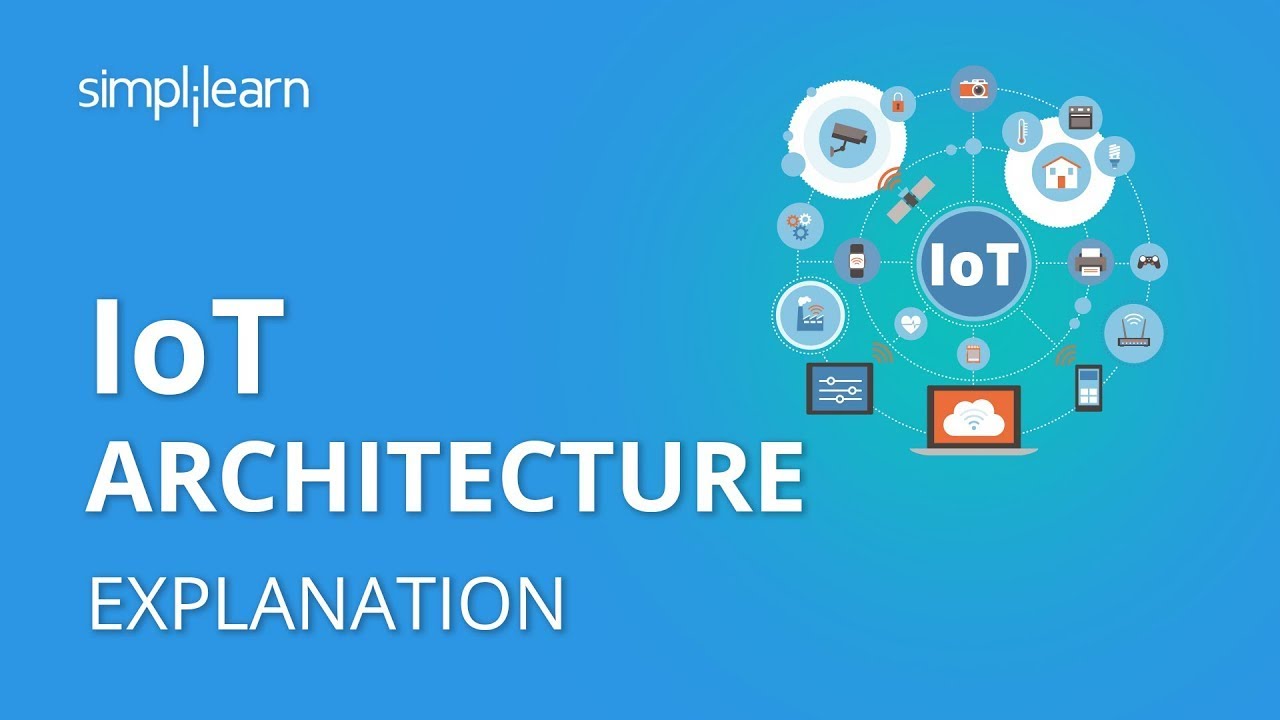
IoT architecture refers to the structural framework that defines how IoT devices, networks, platforms, and applications interact with each other. It is not simply a list of components. It is the logic that governs how those components connect, communicate, and exchange data. A temperature sensor placed in a warehouse is just a piece of hardware until it is connected to a gateway, assigned a communication protocol, and integrated with a data processing platform. At that point, it becomes part of an architecture.
Good IoT architecture solves three fundamental problems. First, it ensures that devices from different manufacturers can work together through common protocols and data formats. Second, it ensures that data moves efficiently from where it is generated to where it is needed. Third, it ensures that the system can grow without requiring a complete rebuild when new devices or applications are added.
Companies like Amazon, Google, Microsoft, Cisco, Oracle, and SAP have each built IoT platforms that reflect their own architectural philosophies, but all of them address these three core problems. Understanding IoT architecture fundamentals allows organizations to evaluate these platforms on their merits and select the right structure for their specific use case.
What is IoT?
The Internet of Things (IoT) is a network of physical devices and objects that are embedded with sensors, software, and connectivity hardware, allowing them to collect and exchange data over the internet. IoT devices encompass a wide range of products, including fitness trackers, smart meters, industrial sensors, connected cameras, medical wearables, and vehicles. Some devices only measure and report data, such as a humidity sensor in a greenhouse. Others also take action, such as a valve actuator that opens or closes based on sensor readings.
The data collected by IoT devices ranges from simple numeric values like temperature, pressure, and motion readings to complex streams like audio, video, and GPS coordinates. Once captured, this data moves to software systems that store it, analyze it, and present it to users or other automated systems. The value of IoT is not the individual device. The value is the closed loop of sensing, deciding, and acting, repeated continuously across thousands or millions of devices simultaneously.
IoT deployments exist across every continent, including Europe, Asia, Africa, North America, South America, and Australia, covering industries from agriculture and logistics to healthcare and smart city management.
What is IoT Architecture?
IoT architecture is the structural blueprint that defines how all components of an IoT system interact, including IoT devices, IoT networks, cloud platforms, and application services. IoT architecture refers to the rules that govern how data flows from the physical world, travels across networks, gets processed at the edge or in the cloud, and is finally turned into insights that users or machines can act on.
A well-designed IoT architecture is scalable, meaning it handles growth from a handful of devices to hundreds of thousands without requiring a system redesign. It is secure, with protections built into every layer from the device firmware to the cloud dashboard. It is also interoperable, supporting multiple device types, communication protocols, and integration points so that the system works regardless of which vendors or platforms are involved.
IoT architecture is the difference between an IoT deployment that delivers consistent, reliable results and one that breaks under load, gets compromised by attackers, or fails to integrate with existing business systems.
What Are the Components of IoT Architecture?
There are 4 major components present in most enterprise IoT deployments.
Security and Management Component
Security and management cover the full lifecycle of every device in the IoT system. Devices require protected firmware and strong identity management. Networks require encryption and access control. Cloud platforms require role-based permissions, audit logs, and continuous monitoring. Management operations include provisioning new devices, pushing configuration updates, applying firmware patches, and retiring devices at end of life. Without this component, IoT systems become unmanageable at scale and vulnerable to attack.
Applications and Analytics Component
The applications and analytics component is where IoT data turns into business value. Applications collect, process, and visualize data from connected devices. Analytics functions range from basic threshold alerts, for example triggering a notification when temperature exceeds 80 degrees Fahrenheit (26.7 degrees Celsius), to advanced machine learning models that detect anomalies, forecast trends, or generate predictive maintenance scores. Outputs from this component flow to dashboards, automated alerts, and integrated business systems.
Infrastructure Component
The infrastructure component is the physical and virtual layer that generates and moves data. It includes sensors, tags, actuators, gateways, and the networks that connect them. Short-range connectivity technologies like Wi-Fi and Bluetooth suit indoor environments and floor-level deployments. Long-range options like LTE-M, NB-IoT, and LoRaWAN suit campuses, cities, and remote deployments. The right choice depends on the required range, power budget, available bandwidth, and cost constraints.
Integration Component
The integration component connects IoT outcomes to business systems. IoT data may flow to enterprise resource planning (ERP) systems, customer relationship management (CRM) platforms, maintenance tracking tools, or custom applications. Middleware technologies including message brokers and application programming interfaces (APIs) keep data exchange organized and reliable. Without integration, insights remain confined to the IoT platform and never influence the business processes they are meant to improve.
Layers of IoT Architecture
The Building Blocks of IoT Architecture
The building blocks of IoT architecture are the specific hardware and software elements that make devices capable of sensing, communicating, and interacting with users and other systems.
Sensors and Actuators are the foundational elements that interface with the physical world. Sensors collect data from the environment by measuring variables such as temperature, humidity, motion, and light. Actuators execute physical actions based on received commands, including opening valves, switching relays, or adjusting motor speed. Together, sensors and actuators form the bridge between the physical and digital dimensions of an IoT system.
Mobile Apps and Dashboards provide the user interfaces that allow people to monitor and control IoT devices in real time. These interfaces range from a simple smartphone app that adjusts a smart thermostat setting to a comprehensive operations dashboard that manages an entire industrial facility. They present data visually and give users direct control over connected devices.
Wireless Technologies including Wi-Fi, Bluetooth, and cellular networks provide the communication pathways that connect IoT devices to local networks and the internet. Wi-Fi delivers the bandwidth and range needed for high-data devices. Bluetooth provides energy-efficient short-range communication suitable for wearables and proximity-based applications. Cellular networks extend connectivity to remote or mobile deployments.
Internet Gateways serve as the bridge between local device networks and the wider internet or cloud platforms. Gateways aggregate data from multiple devices, perform initial filtering, handle protocol translation, and route data to the appropriate cloud services or local servers for further processing.
APIs allow different IoT components to communicate and integrate with each other. APIs define how software systems exchange data, enabling devices from different manufacturers, applications built on different platforms, and services running in different cloud environments to work together as a coherent system.
Key Technologies under the IoT Umbrella
Cloud computing provides the scalable infrastructure needed for large-scale IoT data storage, analytics, and automation. Cloud platforms adjust computing resources dynamically to handle fluctuating data loads from IoT networks, making it practical to manage devices across organizations of any size. Platforms built by Amazon, Google, and Microsoft each offer cloud IoT services that cover device registration, data ingestion pipelines, and analytics tooling.
Edge computing complements cloud computing by handling data processing closer to where data is generated. This minimizes latency and conserves bandwidth, which matters greatly in use cases that require fast responses. In a manufacturing facility, edge computing allows a fault detection system to identify equipment anomalies in milliseconds without waiting for a round trip to a remote cloud server. In a smart city, edge-enabled traffic management systems process input from roadside sensors and cameras locally to optimize signal timing in real time.
The combination of cloud and edge computing produces a balanced architecture. Edge computing handles time-sensitive local decisions, while cloud computing handles deeper analysis, model training, and cross-device management. This hybrid approach is now standard in serious IoT deployments.
Communication protocol choices also shape the architecture significantly. MQTT is widely used for IoT because of its low bandwidth consumption and efficient handling of unreliable networks. AMQP suits enterprise messaging environments that require reliable, ordered delivery. HTTP/2 improves server communication efficiency for web-connected IoT applications. Selecting the right protocol for each part of the system is a core architectural decision.
6 Layers of IoT Architecture
| Layer | Primary Function | Key Components | Scope |
|---|---|---|---|
| Device Layer | Captures data from the physical environment through sensors, trackers, and actuators | Sensors, actuators, smart tags, embedded processors | Physical edge of the IoT system |
| Network Layer | Moves data from devices to the rest of the system and returns commands back to the field | Routers, gateways, Wi-Fi, Bluetooth, cellular networks, LPWAN | Personal, local, and wide area networks |
| Data Layer | Stores transmitted IoT data in structured formats ready for analysis and retrieval | Databases, cloud storage platforms, data lakes | Cloud and on-premise storage infrastructure |
| Analytics Layer | Transforms raw IoT data into actionable insights through algorithms and models | Machine learning models, anomaly detection engines, Edge AI | Cloud, edge, or hybrid processing environments |
| Application and Integration Layer | Delivers processed data to users and connects the IoT system with external business platforms | Mobile apps, dashboards, APIs, middleware, ERP and CRM integrations | User-facing interfaces and business system integrations |
| Security and Management Layer | Protects every other layer and manages the full device lifecycle from provisioning to retirement | Encryption, authentication, secure boot, access control, firmware update tools, audit logs | Spans all layers across the entire IoT architecture |
The 6 layers of IoT architecture provide a detailed framework for understanding how data moves from physical devices to business outcomes.
Device Layer
The Device layer is where all sensors, trackers, and actuators live. Sensors capture facts from the physical world, including temperature readings, motion events, GPS coordinates, and vibration patterns. Trackers provide real-time location data for assets and vehicles. Actuators execute physical commands such as opening a valve or turning on a light. Devices at this layer vary widely in complexity, from simple battery-powered sensors that transmit a single value every few minutes to powerful edge devices running local compute workloads. This layer defines the physical edge of the IoT system.
Network Layer
The Network layer includes the communication hardware and protocols that move data from devices to the rest of the system and return commands from the system back to devices. Connectivity choices at this layer include personal area networks for short-range communication, local area networks for building and campus-level connectivity, and wide area networks including cellular networks and low-power wide-area network (LPWAN) technologies for regional or national coverage. The network layer also handles addressing, routing, and the basic security of data in transit.
Data Layer
Once data is transmitted from devices, the Data layer takes responsibility for storing it. This layer includes databases, cloud storage platforms, and data lakes that hold IoT data in structured formats ready for analysis and retrieval. The data layer must handle high-velocity ingestion from large numbers of simultaneous devices while maintaining data integrity and supporting efficient queries.
Analytics Layer
The Analytics layer is where raw IoT data becomes actionable insight. Machine learning models, anomaly detection algorithms, and real-time analytics engines run at this layer. For example, the analytics layer might detect that a motor’s vibration pattern indicates bearing wear, forecast that a power grid segment will reach peak load at a specific time, or recommend adjusting irrigation schedules based on soil moisture trends. Edge AI increasingly brings portions of this layer closer to the device, enabling faster response without cloud dependency.
Application and Integration Layer
The Application and Integration layer is the user-facing side of the IoT system. It includes mobile apps, web dashboards, APIs, and tools that let users interact with IoT data. It also connects the IoT system with external business platforms through API gateway governance and middleware integration. This layer determines how insights reach the people and systems that need to act on them.
Security and Management Layer
The Security and Management layer is different from the other five because it spans all of them. Security is not a single function applied at one point in the architecture. Every layer, from device firmware to cloud access control, requires its own protections. At the device level, this means secure boot processes and tamper-resistant hardware. At the network level, this means encryption and authentication. At the cloud level, this means role-based access control, audit logging, and continuous threat monitoring. Device lifecycle management including provisioning, configuration, updates, and retirement also belongs to this layer.
4 Stages of IoT Architecture
The 4 stages of IoT architecture offer a deployment-focused view of how data moves through an IoT system from physical capture to cloud-scale analysis.
Stage 1: Devices
The Devices stage is where data collection begins. Sensors, actuators, wearables, cameras, and industrial sensors capture information from the physical environment. Some devices are simple and perform a single measurement. Others are complex, equipped with local processors, memory, and multiple sensor types. This stage defines what data the system can collect and how often.
Stage 2: Internet Gateways
Most IoT devices do not connect directly to the cloud. They first send data to local gateways. Internet gateways handle protocol conversion, aggregating data from devices that may use different communication standards, and preparing it for secure delivery to cloud or edge platforms. Gateways also perform initial data filtering, reducing the volume of data that travels to higher layers of the system.
Stage 3: Edge Computing
The Edge Computing stage processes data locally rather than sending everything to a central cloud server. This stage reduces bandwidth consumption, lowers latency for time-sensitive decisions, and maintains operational capability during periods of intermittent cloud connectivity. Edge computing is particularly valuable in industrial automation, where real-time analytics on equipment data supports predictive maintenance modeling without waiting for a cloud round trip.
Stage 4: Cloud or Data Centers
The Cloud or Data Centers stage is the final destination for IoT data in most architectures. At this stage, data is stored, visualized, and analyzed at scale. Complex tasks such as training machine learning models, running deep trend analysis, and generating business reports happen here. Cloud platforms from providers like Amazon, Google, and Microsoft offer managed services that cover IoT data ingestion, digital twin synchronization, long-term storage, and advanced analytics.
Factors To Consider When Selecting An IoT Architecture
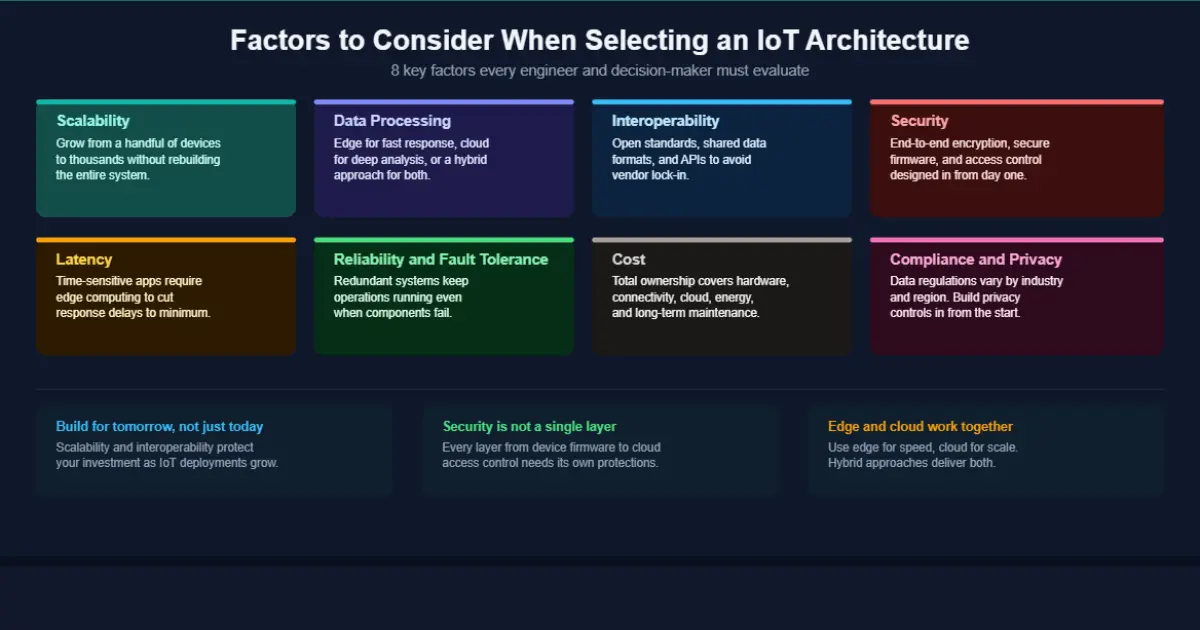
Scalability
The architecture must accommodate growth from an initial deployment to a system with hundreds of thousands of devices. Connectivity protocol standardization and hardware abstraction layers that support diverse device types are important scalability enablers. Cloud platforms that support horizontal scaling allow IoT systems to add capacity without architectural redesign.
Data Processing
The architecture must address where and how data is processed. Edge computing suits time-sensitive operations. Cloud computing suits deep analytical workloads. Most production deployments use a hybrid approach, with edge devices handling local real-time analytics and cloud infrastructure handling historical analysis and model training. Data ingestion pipelines must handle high-velocity streams without loss.
Interoperability
IoT environments contain devices and systems from many different vendors. The architecture must support open communication standards such as MQTT and CoAP, common data formats such as JSON and XML, and APIs that allow integration with external systems. Semantic interoperability standards allow devices that use different data models to exchange information meaningfully. Avoiding proprietary lock-in from any single vendor protects the long-term flexibility of the system.
Security
Security must be designed into the architecture from the start, not added as an afterthought. A security posture assessment at each layer identifies specific vulnerabilities and required controls. At the device level, this includes secure firmware, protected identity credentials, and tamper detection. At the network level, this includes encryption and access control. At the cloud level, this includes role-based permissions, audit trails, and regular vulnerability assessments. Firmware update strategies must ensure that devices receive security patches throughout their operational life.
Latency
Time-sensitive applications such as industrial automation, emergency response systems, and real-time control loops require minimal latency. Edge computing reduces the round-trip time between data capture and response. Context-aware processing units at the edge enable sub-second reaction times that cloud-only architectures cannot reliably achieve.
Reliability and Fault Tolerance
The architecture must continue operating when individual components fail. Redundant systems, graceful degradation when network connectivity is lost, and fault isolation so that a failure in one device or subsystem does not cascade across the entire deployment are all required for production-grade reliability.
Cost
Total cost of ownership includes hardware procurement, network connectivity fees, cloud computing and storage costs, energy consumption, and long-term maintenance. Energy-efficient devices reduce ongoing power costs. Adaptive resource allocation in cloud platforms controls compute spending. Designing for scalability from the beginning avoids costly architectural rework later.
Compliance and Privacy
Data protection regulations vary by industry and geography. Healthcare IoT deployments must comply with patient data privacy laws. Financial and critical infrastructure deployments face additional regulatory requirements. The architecture must support data anonymization, access controls, audit logging, and data residency requirements appropriate to the regulatory environment in which it operates.
Recent Tech Waves: Innovations in IoT Architecture
Breakthroughs in Edge Computing
Edge computing has fundamentally changed how IoT systems process data. By moving computation to the point of data generation, edge computing eliminates the latency associated with sending every data point to a central cloud server. This makes real-time analytics integration practical for use cases where a response delay of even a few seconds is unacceptable.
Edge devices today run advanced machine learning models locally. In smart manufacturing environments, edge AI systems analyze vibration, acoustic, and thermal sensor data to detect equipment anomalies before they cause failures. Predictive maintenance modeling at the edge reduces unplanned downtime and extends equipment life. In smart city infrastructure, edge-capable traffic management systems process sensor and camera feeds locally to adjust signal timing dynamically, reducing congestion without requiring continuous cloud connectivity.
Edge computing also changes the network design requirements of IoT systems. As processing is distributed across multiple edge nodes, secure transmission between those nodes becomes more complex. Each edge device becomes a potential attack surface that must be hardened with its own security controls.
Advancements in Security Features
IoT security has advanced significantly in response to the growing scale and sensitivity of IoT deployments. AES-256 encryption is now widely implemented across IoT devices and networks, providing strong data confidentiality protection that is computationally difficult to compromise. This level of encryption is particularly important for IoT systems handling sensitive data in healthcare, industrial operations, and critical infrastructure.
Blockchain technology has begun to influence how security is managed in distributed IoT environments. Blockchain-secured transactions provide a decentralized, tamper-resistant record of device interactions and data exchanges. In smart supply chain applications, blockchain enables transparent tracking of goods and verification of sensor data integrity across the full chain of custody.
Multi-factor authentication, hardware security modules, and zero-trust network access models are increasingly standard in enterprise IoT deployments. These controls reduce the risk of unauthorized access even when perimeter defenses are compromised.
The Role of Artificial Intelligence in IoT
Artificial intelligence (AI) gives IoT systems the ability to extract meaning from large, complex data streams that would overwhelm traditional rule-based systems. Three primary roles that AI plays in IoT architecture are advanced data processing, predictive analytics, and automated decision-making.
Advanced data processing through machine learning allows IoT systems to identify patterns and anomalies in sensor data far more accurately than static threshold rules. Machine learning models trained on historical data can distinguish between normal variation and genuine fault conditions, reducing false alerts while catching real problems earlier.
Predictive analytics uses historical and real-time IoT data to forecast future events. In manufacturing, AI models predict equipment failures days before they occur, allowing maintenance to be scheduled during planned downtime rather than in response to a breakdown. In healthcare, AI-equipped wearable monitoring systems detect early indicators of patient deterioration, enabling clinical intervention before a crisis develops.
Automated decision-making removes the need for human review of routine IoT decisions. In a smart home, AI adjusts the thermostat based on the homeowner’s occupancy patterns, local weather data, and utility pricing to optimize both comfort and energy cost. In agriculture, AI systems decide irrigation timing based on soil moisture sensor data combined with weather forecast inputs, reducing water consumption while maintaining crop yield. Cognitive computing interfaces allow these systems to improve their decision-making continuously as more data is collected.
Use Case
Smart Home Applications
In smart home applications, IoT architecture centers on interoperability and user experience. The Perception layer includes a wide variety of consumer devices, including smart thermostats, lighting systems, door locks, security cameras, and appliance sensors, all of which must communicate reliably with each other and with a central hub or gateway. The Network layer uses Wi-Fi and Bluetooth as primary connectivity technologies, supplemented by mesh networking protocols like Zigbee and Z-Wave for devices where low power consumption matters more than high data throughput. The Processing layer uses both local hub-based logic and cloud services to manage device interactions and learn the homeowner’s preferences over time. The Application layer delivers intuitive mobile apps and voice assistant integrations that let users control their full smart home ecosystem from a single interface. The Business layer enables energy companies and smart home platform providers to offer personalized services and subscription models based on usage data.
Industrial IoT (IIoT)
Industrial IoT (IIoT) architecture emphasizes robustness, scalability, and real-time processing capability in support of Industry 4.0 operational goals. The Perception layer consists of hardened sensors and actuators built to operate continuously in harsh industrial environments, monitoring complex machinery, production processes, and supply chain assets. The Network layer uses industrial-grade communication protocols that guarantee reliable data delivery even in environments with significant electromagnetic interference. Edge computing plays a central role at this layer, processing sensor data locally to minimize latency for control applications. The Processing layer applies advanced analytics and machine learning to predict maintenance needs, detect quality defects, and optimize production throughput. The Application layer delivers real-time dashboards and control interfaces that give plant operators and engineers immediate visibility into equipment status and process performance.
Healthcare
Healthcare IoT architecture prioritizes security, privacy, and reliability above all other considerations. The Perception layer comprises medical-grade sensors and wearable devices that collect vital health data including heart rate, blood oxygen saturation, glucose levels, and activity patterns. The Network layer must meet stringent healthcare regulatory requirements, ensuring that all patient data is transmitted with end-to-end encryption and handled in compliance with applicable privacy laws. The Processing layer analyzes health data streams in real time to generate alerts for clinical teams when patient readings indicate deteriorating conditions. The Application layer provides secure portals for both patients and healthcare professionals, supporting remote monitoring, teleconsultation, and personalized care plan management. The result is a system that improves patient outcomes while maintaining strict data protection standards.
Energy Management
Energy management IoT architecture focuses on operational efficiency and demand response across electricity grids and facilities. The Perception layer includes smart meters, grid sensors, and substation monitors that collect granular data on energy consumption, generation, and grid performance at intervals measured in seconds. The Network layer transmits this data securely between utility companies, grid operators, and end consumers, supporting two-way communication that enables dynamic pricing signals and demand response programs. The Processing layer applies analytics to identify consumption patterns, detect grid anomalies, and optimize load distribution across the network. A utility company can use this data to develop personalized energy plans for customers, predict demand peaks, and integrate renewable generation sources more efficiently. The Application layer provides consumer-facing interfaces that display real-time energy usage data and automated tools that help facility managers reduce energy costs.
Conclusion
IoT architecture layers explained covers how an Internet of Things system is structured from the physical devices that sense the world to the business systems that act on what those devices report. The 5 layers of IoT architecture including the Perception layer, Transport layer, Processing layer, Application layer, and Business layer each serve a distinct role in moving data from raw sensor readings to actionable insights. The 6-layer model adds a dedicated Security and Management layer that spans the entire stack. The 4-stage deployment model maps the same journey through Devices, Internet Gateways, Edge Computing, and Cloud or Data Centers.
Recent innovations in edge computing, security features, and artificial intelligence have significantly expanded what IoT architecture can accomplish. Edge computing brings real-time analytics integration directly to the point of data generation. Advanced encryption and blockchain-secured transactions strengthen security across distributed device networks. AI-powered applications enable predictive maintenance modeling, automated decision-making, and continuous system improvement without constant human intervention.
Understanding IoT architecture layers is the foundation for building IoT systems that scale, stay secure, and deliver consistent business value across use cases from smart homes and industrial automation to healthcare monitoring and energy management.
FAQs
What is internet of Things (IoT)?
Internet of Things (IoT) is a network of physical devices and objects that collect and share data over the internet through embedded sensors, software, and connectivity hardware. IoT devices include smart meters, wearables, industrial sensors, connected vehicles, and medical monitoring equipment. The IoT system value comes from the continuous loop of sensing data, processing it, and acting on the results.
What is internet of things (IoT) architecture?
Internet of Things (IoT) architecture refers to the framework that defines how IoT devices, networks, platforms, and applications interact within an IoT environment. IoT architecture refers to the rules governing how data flows from physical devices through communication networks, processing layers, and application services to reach the people and systems that need to act on it. Good IoT architecture ensures scalability, security, and interoperability across the full system.
What are the five layers of IoT architecture?
The five layers of IoT architecture are the Perception layer, Transport layer, Processing layer, Application layer, and Business layer. The Perception layer collects data from the physical environment through sensors and actuators. The Transport layer moves that data across networks including Wi-Fi, Bluetooth, and cellular networks. The Processing layer analyzes the data using machine learning, data mining, and real-time analytics. The Application layer presents processed data through dashboards and apps that enable users to make informed decisions. The Business layer uses IoT data to create business value through new services, operational improvements, and revenue models.




- Be Respectful
- Stay Relevant
- Stay Positive
- True Feedback
- Encourage Discussion
- Avoid Spamming
- No Fake News
- Don't Copy-Paste
- No Personal Attacks
- Be Respectful
- Stay Relevant
- Stay Positive
- True Feedback
- Encourage Discussion
- Avoid Spamming
- No Fake News
- Don't Copy-Paste
- No Personal Attacks
