What is Zero Trust Architecture?
Published: 6 Feb 2026
Zero Trust architecture (ZTA) is a security model that authenticates every user and device before granting access to resources, regardless of their location inside or outside the corporate network. Unlike traditional security models that assume trustworthiness within an organization’s network, ZTA operates on the principle of “never trust, always verify.”
The main benefits of Zero Trust architecture include improved remote and hybrid work support, minimized risk, easier regulatory compliance, simplified cloud migration, better employee experiences, and a strengthened security posture. It achieves this by implementing key principles such as least privilege access, continuous monitoring, and microsegmentation.
ZTA is used across various scenarios, including securing remote access, protecting critical data, and ensuring compliance with industry regulations. Key components of ZTA include identity and access management (IAM), multi-factor authentication (MFA), and endpoint detection and response (EDR). Major vendors like Microsoft and CrowdStrike offer Zero Trust architecture solutions to help organizations implement and manage this security model.
Table of Contents
What is a Zero Trust model?
A Zero Trust model is a security framework based on the principle of “never trust, always verify.” It assumes that no user or device, whether inside or outside the corporate network, should be automatically trusted. Instead, every access request is rigorously authenticated and authorized before granting access to resources. This approach mitigates the risk of breaches by limiting the impact of compromised accounts or devices. Zero Trust security focuses on protecting resources, rather than the network perimeter, and uses techniques like multi-factor authentication (MFA), microsegmentation, and continuous monitoring to achieve this.
Introduction to Zero Trust architecture
Traditional security models operate on the assumption that anything inside the organization’s network is safe. This “castle-and-moat” approach leaves organizations vulnerable if a breach occurs, as attackers can move laterally within the network once inside. Zero Trust architecture (ZTA) addresses this vulnerability by authenticating every user and device attempting to access resources, regardless of their location. Zero Trust security architecture treats every access request as potentially hostile and requires verification before granting access. This approach reduces the attack surface and limits the impact of successful breaches, strengthening the overall security posture of the organization.
Key takeaways
- Zero Trust architecture authenticates every user and device before granting access to resources.
- It operates on the principle of “never trust, always verify,” regardless of location.
- ZTA strengthens security by reducing the attack surface and limiting the impact of breaches.
- Key components include identity and access management (IAM), multi-factor authentication (MFA), and endpoint detection and response (EDR).
- ZTA supports remote work, minimizes risk, eases compliance, and improves employee experiences.
- Microsoft and CrowdStrike are among the vendors offering Zero Trust architecture solutions.
Core principles of ZTA
The core principles of Zero Trust architecture are built around the idea of minimizing implicit trust and continuously validating every access request. These principles include:
- Never trust, always verify: Every user, device, and application must be authenticated and authorized before being granted access to resources.
- Assume breach: Operate under the assumption that the network has already been compromised.
- Least privilege access: Grant users only the minimum level of access required to perform their job functions.
- Microsegmentation: Divide the network into small, isolated segments to limit the lateral movement of attackers.
- Continuous monitoring: Continuously monitor and analyze network traffic and user behavior for signs of suspicious activity.
- Multi-factor authentication (MFA): Require multiple forms of verification to authenticate users and devices.
Benefits of Zero Trust Architecture
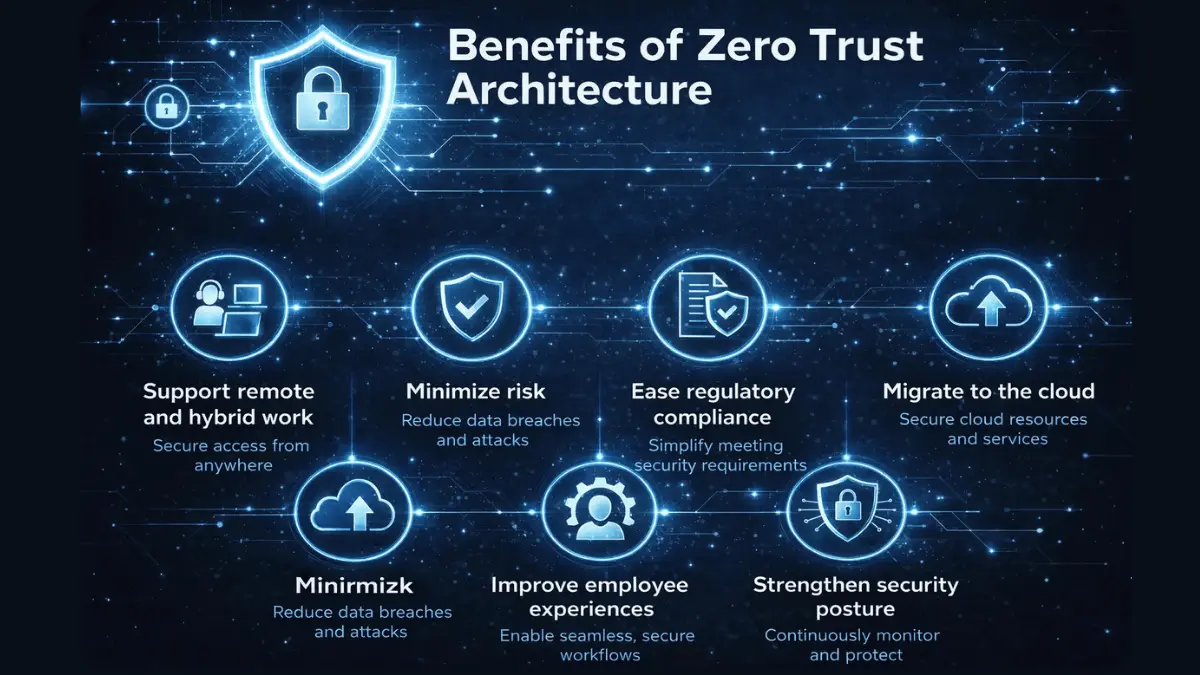
Zero Trust Architecture offers numerous benefits to organizations seeking to enhance their security posture and adapt to modern work environments.
Support remote and hybrid work
Zero Trust architecture facilitates secure remote and hybrid work environments by ensuring that all users and devices are authenticated and authorized, regardless of their location. This is especially important as more organizations embrace remote work, which expands the attack surface and increases the risk of breaches. By implementing Zero Trust principles, organizations can provide secure access to resources without compromising security.
Minimize risk
By authenticating every user and device before granting access to resources, Zero Trust architecture minimizes the risk of breaches and data loss. This approach limits the lateral movement of attackers within the network, reducing the impact of successful breaches. Zero Trust security helps organizations protect their sensitive data and critical assets.
Ease regulatory compliance
Zero Trust architecture helps organizations meet regulatory compliance requirements by providing a framework for securing sensitive data and systems. Many regulations, such as HIPAA and GDPR, require organizations to implement strong security controls to protect personal information. Zero Trust principles align with these requirements and can help organizations demonstrate compliance.
Migrate to the cloud
Zero Trust architecture simplifies cloud migration by providing a consistent security model that can be applied across on-premises and cloud environments. This allows organizations to securely migrate their applications and data to the cloud without compromising security. Zero Trust security ensures that access to cloud resources is properly authenticated and authorized.
Improve employee experiences
While security is paramount, Zero Trust architecture can also improve employee experiences by providing seamless and secure access to the resources they need. By implementing user-friendly authentication methods, such as multi-factor authentication (MFA), organizations can minimize friction and improve productivity.
Strengthen security posture
Overall, Zero Trust architecture strengthens an organization’s security posture by reducing the attack surface, limiting the impact of breaches, and improving visibility into network activity. This approach helps organizations proactively detect and respond to threats, minimizing the risk of successful attacks.
Streamline Your Zero Trust Journey
Implementing Zero Trust can seem daunting, but a phased approach helps streamline the process. Start by identifying critical assets and prioritizing the implementation of Zero Trust principles for those resources. Then, gradually expand Zero Trust to other areas of the organization.
Key components of ZTA
Key components of Zero Trust architecture include:
- Identity and Access Management (IAM): Manages user identities and controls access to resources.
- Multi-Factor Authentication (MFA): Requires multiple forms of verification to authenticate users.
- Microsegmentation: Divides the network into small, isolated segments.
- Endpoint Detection and Response (EDR): Detects and responds to threats on endpoints.
- Security Information and Event Management (SIEM): Collects and analyzes security data from various sources.
- Data Loss Prevention (DLP): Prevents sensitive data from leaving the organization.
- Network Segmentation: Isolates network segments to limit the impact of breaches.
- Application Security: Secures applications against vulnerabilities.
- Identity-Based Security: Uses identity as the primary security perimeter.
- Device Security: Ensures that devices are secure and compliant.
- data security: Protects data from unauthorized access and loss.
- Workload Security: Secures workloads running in the cloud or on-premises.
History and evolution of ZTA
The concept of Zero Trust was first introduced by John Kindervag at Forrester Research in 2010. Kindervag argued that traditional security models, which focused on perimeter security, were no longer effective in the face of modern threats. He advocated for a new approach that assumed that the network was already compromised and that every access request should be verified.
Over the years, Zero Trust has evolved from a theoretical concept to a practical framework that is being adopted by organizations around the world. The National Institute of Standards and Technology (NIST) has published guidelines for implementing Zero Trust architecture, and major vendors like Microsoft, Okta, and Palo Alto Networks offer Zero Trust solutions. Google’s BeyondCorp project is also a notable example of a Zero Trust implementation.
How Zero Trust architecture works
Zero Trust architecture works by implementing a set of security controls that authenticate and authorize every access request before granting access to resources. This process typically involves the following steps:
- User authentication: The user is authenticated using multi-factor authentication (MFA) or other strong authentication methods.
- Device authentication: The device is authenticated to ensure that it is secure and compliant.
- Authorization: The user’s access rights are verified to ensure that they have the necessary permissions to access the requested resource.
- Policy enforcement: Security policies are enforced to ensure that the user is accessing the resource in a secure manner.
- Continuous monitoring: Network traffic and user behavior are continuously monitored for signs of suspicious activity.
How to build a Zero Trust Architecture
Building a Zero Trust Architecture involves a multi-step process that encompasses assessment, planning, and implementation. Key steps include:
- Assess Your Current Security Posture: Evaluate your existing security infrastructure to identify gaps and vulnerabilities.
- Define Your Protect Surface: Determine your most critical assets and data that require protection.
- Develop a Zero Trust Strategy: Create a roadmap for implementing Zero Trust principles across your organization.
- Implement Security Controls: Deploy security controls such as multi-factor authentication (MFA), microsegmentation, and endpoint detection and response (EDR).
- Monitor and Optimize: Continuously monitor your security posture and optimize your Zero Trust architecture.
How to implement ZTA
Implementing Zero Trust architecture requires a phased approach that focuses on identifying critical assets, implementing security controls, and continuously monitoring and optimizing the environment. Key steps include:
- Identify critical assets: Determine which assets are most critical to the organization and require the highest level of protection.
- Implement security controls: Deploy security controls such as multi-factor authentication (MFA), microsegmentation, and endpoint detection and response (EDR).
- Enforce least privilege access: Grant users only the minimum level of access required to perform their job functions.
- Monitor and analyze network traffic: Continuously monitor and analyze network traffic for signs of suspicious activity.
- Automate security responses: Automate security responses to quickly detect and respond to threats.
- Continuously improve: Continuously improve the Zero Trust architecture based on feedback and lessons learned.
Zero Trust architecture use cases
Zero Trust architecture can be applied to a wide range of use cases, including:
- Securing remote access: Providing secure access to resources for remote workers.
- Protecting critical data: Protecting sensitive data from unauthorized access and loss.
- Ensuring compliance: Meeting regulatory compliance requirements.
- Securing cloud environments: Protecting cloud-based applications and data.
- Securing IoT devices: Securing internet of things (iot) devices.
- Protecting against insider threats: Mitigating the risk of insider threats.
Zero Trust architecture solutions
Numerous vendors offer Zero Trust architecture solutions, including:
- Microsoft: Microsoft Zero Trust solutions provide a comprehensive set of security controls for implementing Zero Trust architecture.
- CrowdStrike: CrowdStrike offers Zero Trust solutions that focus on endpoint security and threat detection.
- Okta: Okta provides identity and access management (IAM) solutions that are essential for Zero Trust architecture.
- Palo Alto Networks: Palo Alto Networks offers a range of Zero Trust solutions, including network security and endpoint security.
- Cisco: Cisco provides Zero Trust solutions that focus on network segmentation and access control.
- Cloudflare: Cloudflare offers Zero Trust solutions that focus on securing web applications and APIs.
- Zscaler: Zscaler provides Zero Trust solutions that focus on secure access to cloud applications.
Learn how Microsoft Security eases Zero Trust adaptation
Microsoft Security offers a comprehensive suite of tools and services that simplify the adoption of Zero Trust architecture (ZTA).
Microsoft Zero Trust model
The Microsoft Zero Trust model is based on the principles of “verify explicitly, use least privilege access, and assume breach.” It provides a framework for implementing Zero Trust architecture across the organization. Microsoft Entra ID, Microsoft Defender, and Microsoft Sentinel are key components of the Microsoft Zero Trust model.
Zero Trust and AI for end-to-end security
Microsoft leverages artificial intelligence (AI) to enhance Zero Trust security. AI-powered threat detection and response capabilities help organizations proactively identify and respond to threats. AI can also be used to automate security tasks and improve the efficiency of security operations.
Zero Trust assessment
Microsoft offers a Zero Trust assessment tool that helps organizations evaluate their current security posture and identify areas for improvement. This assessment provides a roadmap for implementing Zero Trust architecture.
Zero Trust adoption tracking
Microsoft provides tools for tracking Zero Trust adoption progress. These tools help organizations monitor the implementation of Zero Trust principles and measure the effectiveness of their security controls.
Is a Zero Trust model right for your organization?
A Zero Trust model is suitable for any organization that wants to enhance its security posture and protect its sensitive data. It is especially beneficial for organizations that:
- Have a large remote workforce.
- Are migrating to the cloud.
- Need to comply with regulatory requirements.
- Want to reduce the risk of breaches and data loss.
Jumpstarting Your Zero Trust Journey with CrowdStrike
CrowdStrike offers expertise and solutions to accelerate your Zero Trust journey. They provide guidance on assessing your environment, developing a Zero Trust strategy, and implementing security controls. CrowdStrike’s endpoint protection platform is a key component of a Zero Trust architecture.
Conclusion
Zero Trust architecture (ZTA) is a modern security model that authenticates every user and device before granting access to resources, regardless of their location. By operating on the principle of “never trust, always verify,” ZTA strengthens security, supports remote work, minimizes risk, eases compliance, and improves employee experiences. With the help of key components like identity and access management (IAM) and solutions from vendors such as Microsoft and CrowdStrike, organizations can implement Zero Trust security and protect their valuable assets in today’s dynamic threat landscape.
Frequently asked questions
What does Zero Trust architecture mean?
Zero Trust architecture (ZTA) means that no user or device is automatically trusted, whether inside or outside the corporate network. Every access request is authenticated and authorized before granting access to resources, implementing Zero Trust security.
What are the core pillars of Zero Trust architecture?
The core pillars of Zero Trust architecture include:
- Identity: Verify and validate user identities.
- Devices: Ensure device security and compliance.
- Network: Segment the network to limit lateral movement.
- Applications: Secure applications against vulnerabilities.
- Data: Protect data from unauthorized access and loss.
Is Zero Trust widely accepted?
Yes, Zero Trust is widely accepted as a best practice for cybersecurity. Organizations around the world are adopting Zero Trust architecture to enhance their security posture and protect their sensitive data.
What is an example of Zero Trust?
An example of Zero Trust is requiring multi-factor authentication (MFA) for all users accessing corporate resources, regardless of whether they are on the corporate network or working remotely. This ensures that only authorized users can access sensitive data and applications.






- Be Respectful
- Stay Relevant
- Stay Positive
- True Feedback
- Encourage Discussion
- Avoid Spamming
- No Fake News
- Don't Copy-Paste
- No Personal Attacks
- Be Respectful
- Stay Relevant
- Stay Positive
- True Feedback
- Encourage Discussion
- Avoid Spamming
- No Fake News
- Don't Copy-Paste
- No Personal Attacks
